





Mapping Where Gulper Eels Live in Deep Ocean Zones
As a quality specialist in the seafood export industry, I’m often asked about the origins and habitats of different species. One of the most fascinating is the Gulper Eel (Eurypharynx pelecanoides), also known as the pelican eel. The simple answer to where do gulper eels live is the deep, dark, open ocean, far from any coast. But for B2B buyers, importers, and food safety professionals, precision is everything. The specific oceanic zone an animal inhabits dictates its biology, its diet, and the environmental pressures it faces—factors that influence the entire supply chain, even for aquacultured species.
My work at Eelpro involves overseeing our ISO 22000:2018 and HACCP systems, ensuring full traceability from our customs-registered eel farming bases to final shipment. This requires a deep understanding of aquatic biology. While we specialize in farmed freshwater eels (Anguilla japonica and Anguilla anguilla), studying unique wild species like the gulper eel provides valuable insights into creating stable, high-quality aquaculture environments. This article breaks down the precise depths and conditions that define the gulper eel's home.
A Depth-Zone Map: Reconciling Gulper Eel Sightings with Ocean Layers
To accurately map the gulper eel's habitat, we must first understand how scientists classify the ocean's vertical layers. The open ocean, or pelagic zone, is divided by depth and the amount of sunlight that penetrates the water. The gulper eel occupies the lower two of these zones. Vague terms like "deep sea" are not sufficient for technical or sourcing discussions. The specifics matter.
Here is a breakdown that reconciles the official oceanic zones with the known depth range for the gulper eel family, which is typically recorded between 500 and 3,000 meters (about 1,600 to 9,800 feet).
| Ocean Zone | Depth Range | Sunlight & Conditions | Gulper Eel Presence & Activity |
|---|---|---|---|
| Mesopelagic Zone (Twilight Zone) | 200 – 1,000 meters | Faint sunlight, not enough for photosynthesis. Bioluminescence becomes common. Temperature drops sharply. | Upper Boundary: Gulper eels are rarely found above 500 meters. The upper part of their habitat begins in the lower half of this zone. |
| Bathypelagic Zone (Midnight Zone) | 1,000 – 4,000 meters | Complete darkness, except for bioluminescent organisms. Intense pressure (up to 5,850 psi). Stable, near-freezing temperatures. | Primary Habitat: This is the core territory where gulper eels live. The majority of sightings and specimen captures occur between 1,000 and 2,100 meters. Their physiology is perfectly adapted for this high-pressure, low-energy environment. |
| Abyssopelagic Zone (The Abyss) | 4,000 – 6,000 meters | No light, extreme pressure, and very sparse food sources. | Lower Boundary: While their official range extends to 3,000 meters, it is highly unlikely they thrive below this depth. The abyss represents the absolute limit of their known habitat. |
Practical Implication: The gulper eel is a true bathypelagic creature. Its entire biology—from its unhinging jaw designed to swallow scarce, large prey to its minimal musculature—is a direct result of living in a pitch-black, food-poor environment. Understanding this connection between environment and biology is fundamental to aquaculture, where we control environmental inputs to achieve specific quality outcomes in our unagi kabayaki products.
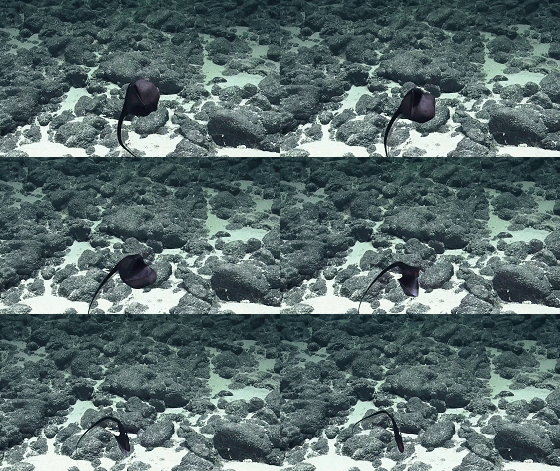
Key Adaptations for Life in the Midnight Zone
Living thousands of meters below the surface requires extreme biological adaptations. The gulper eel’s unique features are not random; they are direct solutions to the challenges of the bathypelagic zone. For anyone involved in sourcing or processing aquatic products, recognizing these adaptations reinforces why controlled, standardized farming is necessary to produce consistent food products.
- The Massive Jaw: The most defining feature is its enormous mouth, which is much larger than its body. In an environment where meals are rare, the ability to engulf any prey that comes along—regardless of size—is a major survival advantage. The jaw can unhinge to swallow creatures larger than itself.
- Bioluminescent Lure: The tip of the gulper eel's long, whip-like tail has a photophore, an organ that produces light. It is thought to function as a lure, attracting curious crustaceans and small fish in the total darkness.
- Reduced Anatomy: To conserve energy, the gulper eel has a minimalist body plan. It lacks scales, ribs, a swim bladder, and has very small fins. Its skeleton is poorly calcified, and its muscles are slight. This is a body built for waiting and ambushing, not active hunting.
- Pressure Resistance: Like other deep-sea organisms, its body is composed mostly of water, with no internal air cavities (like a swim bladder) that would collapse under the immense pressure. This allows it to thrive at depths that would instantly crush surface-dwelling animals.
These features highlight a creature perfectly tuned to its environment. At Eelpro, we apply a similar principle of control. Our 160+ employees, including 25 quality-control specialists, manage every aspect of our eel's life cycle. From water quality in our farms to the precise four-layer coating process in our roasting lines, we eliminate variables to ensure a safe, delicious, and consistent product for our export partners in Japan, the United States, and the European Union.
Common Sourcing Mistakes Stemming from Habitat Misunderstanding
While the gulper eel is not a commercial food species, the principles of its ecology offer lessons for B2B buyers of any seafood. Misunderstanding an animal's native habitat can lead to critical errors in product evaluation and supplier selection. Here are common mistakes to avoid:
Buyer's Checklist: Avoiding Habitat-Related Sourcing Errors
- Mistake #1: Ignoring Traceability. Assuming a product's quality is determined only at the factory. The gulper eel's biology is defined by its deep-sea origin. Similarly, the quality of a farmed eel is defined by its entire life cycle. Solution: Demand full-chain traceability. At Eelpro, we provide this through our network of ~20 customs-registered farms, with process verification and targeted sampling managed by our in-house eel lab.
- Mistake #2: Accepting Vague Environmental Claims. Suppliers may use terms like "clean water" or "natural feed." These are meaningless without data. Solution: Ask for specifics. What are the water quality parameters? What is the feed composition? Our farms adhere to strict standards required for export to Japan and the EU, covering everything from veterinary drug residues to microbiological indicators.
- Mistake #3: Overlooking the Impact of Stress. An unstable environment creates stress, which affects texture and flavor. A gulper eel could not survive in the epipelagic (sunlight) zone. Likewise, farmed eel quality suffers from improper temperature, density, or handling. Solution: Vet your supplier's logistics. Our 1,000-ton cold storage facility ensures product stability from our two modern production lines through to shipment, maintaining quality across a 4,000-ton annual capacity.
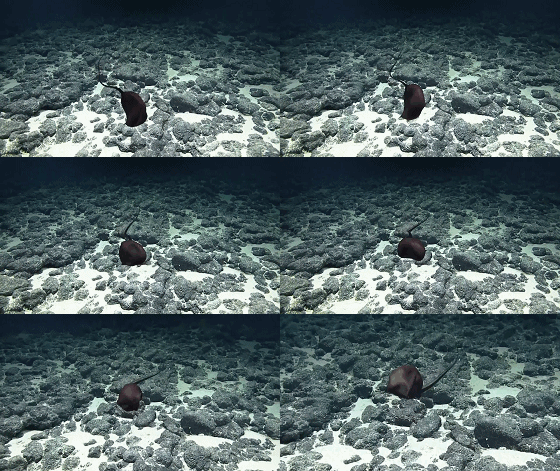
From Wild Ecology to Certified Production Excellence
Understanding where gulper eels live gives us an appreciation for the delicate balance of a natural ecosystem. At Eelpro, we translate that appreciation into a rigorously controlled production system. We don't leave quality to chance. Our entire operation is built on verifiable standards and scientific principles.
Our certifications—ISO 22000:2018, HACCP, and HALAL—are not just plaques on a wall. They are active management systems that guide our daily operations. Every batch of unagi kabayaki eel is subject to inspection at critical control points, including screening by metal detectors. Our patented low-fat roasting and deodorizing technology is the result of dedicated R&D to meet the exacting standards of our clients, from Japanese restaurant chains to German food importers.
The lessons from the deep sea are clear: environment dictates quality. Whether in the bathypelagic zone or in our certified aquaculture ponds, the conditions of life shape the final product. By managing those conditions with precision, we help our clients avoid trade risks and deliver a superior product to their end customers.
For more information on our traceable eel products or custom cutting and packaging specifications, please submit an inquiry to our export team.
 WhatsApp
 sales@chinaeels.com
 +8619937922411