


What Does the Gulper Eel Eat, and Why Its Giant Mouth Still Confuses Most People
Seen a photo of a gulper eel and assumed it swallows fish bigger than a dinner plate? Most people do. The mouth looks like it could unhinge and eat anything that swims past. But what does the gulper eel eat in actual recorded stomach contents is far smaller and far less dramatic than the viral captions suggest. This article separates the documented facts from the recycled myths, and explains exactly where the "giant swallowing" story breaks down.
What Does the Gulper Eel Eat in the Wild?
The gulper eel (Eurypharynx pelecanoides) lives between roughly 500 and 3,000 meters down, in near-total darkness. Researchers who have examined stomach contents from trawled and stranded specimens report a diet made up mostly of:
- Small crustaceans — copepods, shrimp-like amphipods, and isopods make up the bulk of recorded meals
- Small fish — occasional juvenile deep-sea fish species, rarely anything approaching the eel's own body length
- Cephalopods — small squid, taken opportunistically rather than hunted actively
- Organic detritus and plankton — some specimens show marine snow particles in gut samples, suggesting passive filtering during slow swimming
That's it. No sharks, no fish twice its size, no dramatic chase scenes. The eel is a weak, slow swimmer with a lightly built skeleton — it's built for opportunity, not pursuit.
Mouth Size vs Stomach Capacity — Where the Boundary Actually Sits
This is the part most articles skip, and it's the reason the "giant swallower" myth keeps spreading. A loose, hinge-jawed mouth that can expand doesn't mean the stomach behind it expands the same way. Physical capture capacity and documented diet are two different things, and confusing them is where most misinformation starts.
| Capability | What the mouth can physically do | What is actually documented in diet studies |
|---|---|---|
| Prey size | Can engulf prey larger than the eel's own head diameter, due to loosely hinged jaw bones | Most stomach samples show prey far smaller than the mouth's maximum gape |
| Prey type | Could theoretically trap any soft-bodied animal that drifts into range | Overwhelmingly small crustaceans and juvenile fish |
| Feeding behavior | Mouth can inflate like a pouch to create suction | Used mainly to gather scattered small prey, not to chase larger animals |
| Frequency of "oversized" meals | Possible under rare, opportunistic conditions | Documented as occasional, not routine — not the default feeding pattern |
The honest answer: the mouth's physical capacity is a safety margin, not a hunting strategy. A gulper eel built this way simply doesn't need to miss a meal in an environment where food is scarce and unpredictable. That's an evolutionary insurance policy, not evidence of it regularly eating large animals.
Common Myths About Gulper Eel Feeding — and Where They Fall Apart
- Myth: It regularly swallows prey larger than itself. Reality — stomach-content studies show this is rare, not routine. One oversized meal gets photographed and shared for years; it doesn't represent typical feeding.
- Myth: It actively hunts like a predator fish. Reality — its weak musculature and soft skeleton point to a slow, opportunistic feeding style, closer to drifting and waiting than chasing.
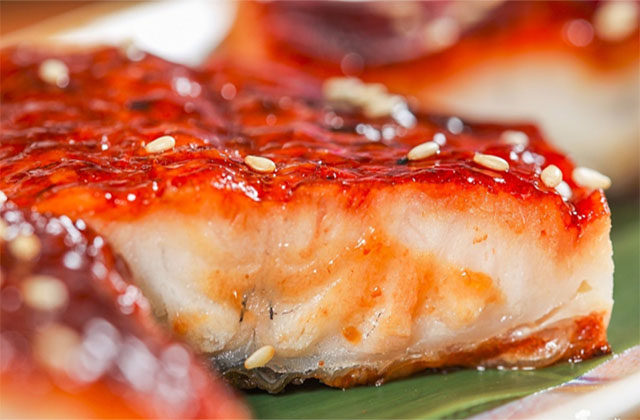
- Myth: It's closely related to edible eel species like unagi. Reality — the gulper eel belongs to a separate deep-sea order and shares no culinary or commercial relevance with the freshwater eel (Anguilla) used in dishes like unagi kabayaki.
- Myth: Its bioluminescent tail tip is used to light up prey for hunting. Reality — most researchers believe the glowing tip functions more as a lure or decoy than an active hunting light.
Why This Distinction Matters for Seafood Buyers
If you source eel products commercially, the gulper eel vs. freshwater eel confusion is worth clearing up once, because it affects sourcing conversations. The species used in kabayaki, eel sauce, and frozen seafood lines — Anguilla, the freshwater eel — is a completely different animal from the deep-sea gulper eel. One is a research curiosity with no food-market role; the other is farmed, processed, and exported under food safety frameworks.
A quick buyer's checklist when evaluating an eel supplier:
- Confirm the species named on the spec sheet is Anguilla (freshwater eel), not a generic "eel" label
- Ask whether the supplier can trace the product back to a certified eel farming base
- Check for food safety certification — ISO 22000:2018, HACCP, or HALAL, depending on your market
- Request lab test documentation for veterinary drug residues and microbiological indicators, especially for shipments to Japan, the US, or the EU
- Clarify cutting specification needs upfront — whole kabayaki, cut pieces, or sushi slices all affect pricing and lead time
Eelpro's own supply chain runs on roughly 20 customs-registered farming bases covering about 2,150 mu, with traceability from farm registration through process verification and sampling. Products move through an in-house laboratory and metal detection checkpoints before shipment, which is a different model entirely from a wild-caught, undocumented deep-sea species like the gulper eel.
Frequently Asked Questions
Does the gulper eel eat other eels?
There's no strong documented evidence of this being a regular behavior. Diet studies point to crustaceans and small fish as the primary food source, not other eels.
Can a gulper eel really unhinge its jaw like a snake?
Its jaw bones are loosely connected and can expand significantly, similar in principle to how some snakes feed, but the comparison is about jaw mechanics, not diet overlap.
Is the gulper eel dangerous to divers or fishermen?
No. It lives at depths divers don't reach, and its weak body structure makes it an unlikely threat even in a hypothetical encounter.
Is gulper eel meat used in any food products?
No. It has no commercial food role. The eel used in dishes like kabayaki, eel sauce, or frozen seafood lines comes from freshwater eel farming, not deep-sea species.
A Quick Note on Terminology Mistakes
One recurring mistake in casual articles: treating "eel" as a single category. In reality, freshwater eel (farmed, edible, used in kabayaki and eel sauce) and deep-sea gulper eel (wild, non-commercial, rarely observed) sit in entirely different taxonomic groups. Confusing the two leads to inaccurate claims — both about diet and about food safety. For background on how farmed freshwater eel is processed and verified before export, see our page on unagi kabayaki manufacturing standards.
For buyers working with freshwater eel sourcing — whether for kabayaki, cut pieces, or custom packaging — our team can walk through spec sheets and send samples on request. Reach out for a quote or ask for our current spec documentation.