

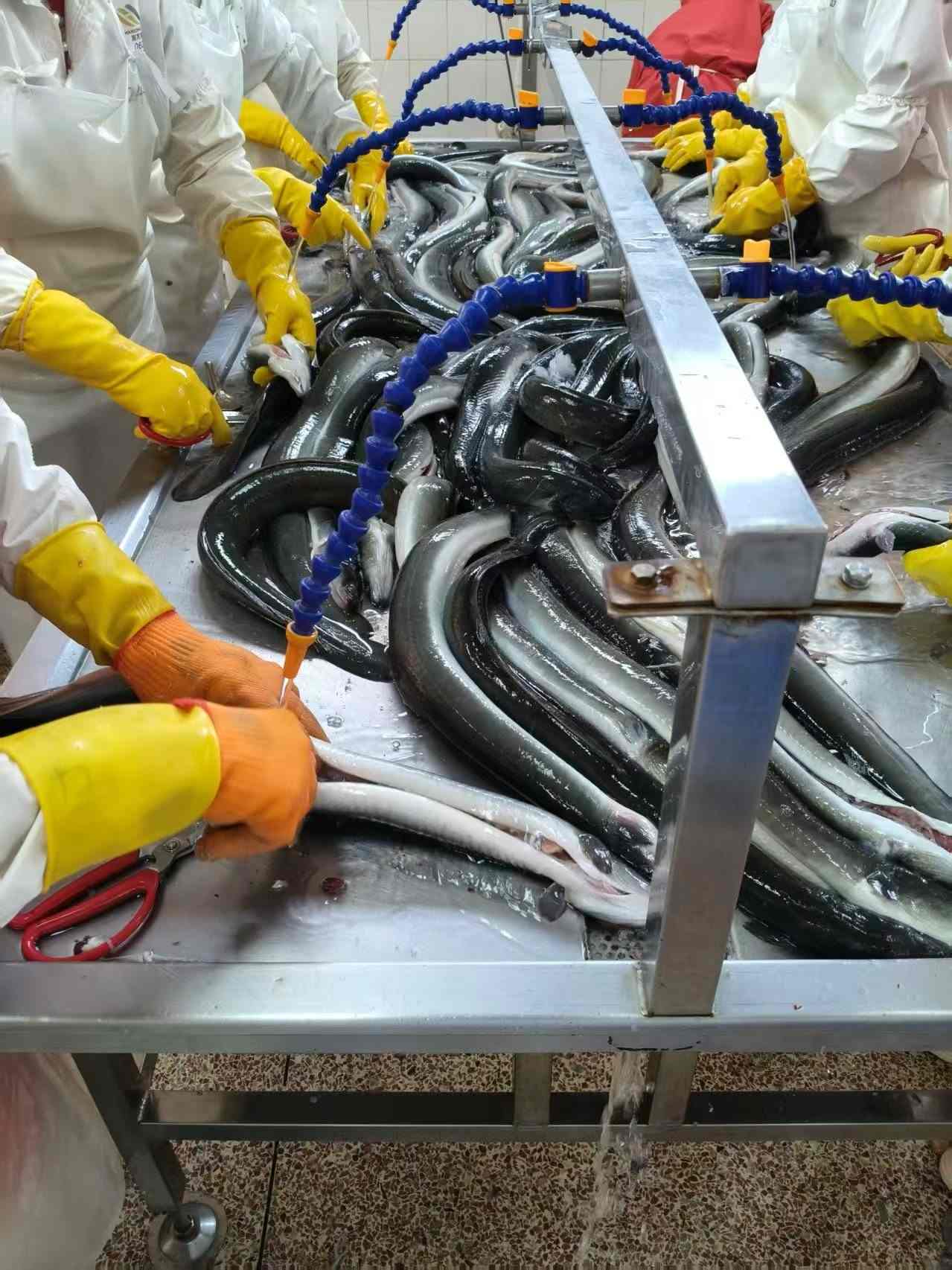
Do Eels Have Spines and How Do Their Fin Spines Differ From Vertebrae?
A diner finds a thin hard piece in grilled unagi and asks a fair question: do eels have spines, or was that piece of bone something else? The short answer is yes, true eels have an internal backbone, but they generally do not have the stiff, pointed fin spines found on many other fish.
That distinction matters more than it first appears. A buyer assessing boneless eel, an educator explaining fish anatomy, and a home cook preparing kabayaki can all avoid confusion by separating two very different structures: internal bones that support the body and external fin supports that may be soft or stiff.
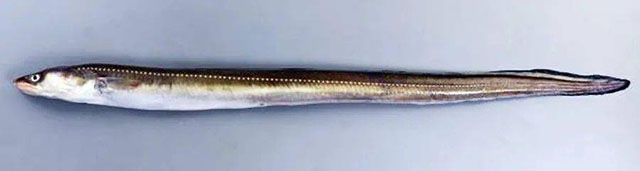
The short answer for buyers and cooks
Do eels have spines? They have a chain of internal vertebrae, often called the backbone or spinal column. These bones run through the body and support movement. True eels generally lack the hard, sharp fin spines that can make handling species such as some perch-like fish more hazardous.
This is why the question can create confusion. In everyday language, “spine” can mean any hard, narrow object in a fish. In anatomy, however, vertebrae and fin spines are not interchangeable.
| Structure | Where it is found | What it does | What buyers and cooks should expect |
|---|---|---|---|
| Vertebrae | Inside the eel’s body along the backbone | Support the body and provide attachment points for muscles | May remain as small bones unless the product has been deboned |
| Fin rays | Within the dorsal, anal, and tail-fin areas | Support flexible fin tissue during swimming | Usually flexible rather than needle-like in true eels |
| Fin spines | At the front of certain fins in many other fish groups | Provide stiff support and sometimes defense | Generally not a defining feature of true eels |
For product evaluation, the practical conclusion is simple: a hard piece encountered in eel is more likely to be associated with internal skeletal structure than with a defensive fin spine. That conclusion fits true eel products. It does not automatically apply to every long-bodied fish sold under a casual “eel” name, because not all eel-like fish belong to the true eel group.
Anatomical distinction between internal vertebrae and the fin spines that true eels generally lack
The most useful way to answer do eels have spines is to look at location, structure, and function. Internal vertebrae sit beneath muscle. Fin spines, where present in other fish, sit in fins and can be felt as stiff points near a fin base.
| Parameter | Internal vertebrae in eels | Fin spines in spiny-finned fish | What goes wrong if confused |
|---|---|---|---|
| Position | Inside the body, running from head toward tail | Embedded in fins, often near the front edge | A buyer may request the wrong trimming or inspection standard |
| Texture | Bone within cooked flesh; may be small and firm | Stiff, pointed, often easily felt near a fin | A cook may mistake a bone fragment for a dangerous sharp fin support |
| Main role | Body support and swimming motion | Fin support, stability, and sometimes defense | An anatomy lesson may incorrectly describe eel fins as weapon-like |
| Processing implication | Relevant to deboning, filleting, and cut specification | Relevant to fin trimming in species that possess them | A specification can fail to match the actual raw material |
True eels have an elongated body built for wave-like swimming. Their dorsal, anal, and tail fins often form a continuous-looking edge around much of the rear body. Those fins are supported by soft rays rather than the stiff fin spines familiar to buyers of some other seafood categories.
Cold fact: “No fin spines” does not mean “no bones.” This is the mistake behind many consumer questions about whether do eels have spines means an eel is naturally boneless. It is not naturally boneless. A boneless or deboned eel product has received additional processing to reduce or remove bones for its intended use.
For a sushi counter, rice-bowl program, or prepared-food line, choose a deboned format when the menu promise is convenient eating with minimal bone handling. For whole-fish education, traditional preparation, or anatomy demonstration, an intact format may be more appropriate. The deboned option is not always the right choice when a buyer specifically needs whole-body presentation or plans to carry out further cutting.
Why the distinction affects eel product specifications
When procurement teams ask do eels have spines, they are often really asking a specification question: “What hard structures could remain in the finished product?” That is the better question to put into an RFQ.
For frozen eel products, ask suppliers whether the item is whole, filleted, deboned, cut into portions, or sliced for a specific menu. Do not use “spine-free” alone as the product requirement. The phrase is too broad. State whether you require removal of the backbone, reduction of fine bones, or a particular cut format.
A practical RFQ checklist
- Name the product format: whole eel, fillet, kabayaki, cut pieces, strips, chunks, sushi slices, or another defined format.
- State the bone expectation: specify deboned or boneless/deboned rather than relying on “no spines.”
- Identify the end use: sushi, rice bowls, restaurant grilling, retail freezer packs, school education, or ingredient processing.
- Confirm packaging needs: skin packaging and gift-box formats may require different order planning.
- Request traceability information: this is especially relevant for export and foodservice procurement.
- Clarify market requirements: Japan, the United States, the European Union, Australia, Indonesia, and other destination markets may have different import documentation expectations.
This approach fits buyers who need consistency across outlets or retail stock-keeping units. It is less necessary for a one-time home meal, where a clear label such as “deboned kabayaki” is usually enough. Still, checking the label remains sensible because bone-removal language can differ between brands and markets.
Eelpro offers standardized cutting options including shredding, dicing, strip-cutting, chunk-cutting, three-section cuts, and sushi slices. These choices matter because a cut designed for an unagi rice bowl is not automatically suitable for a sushi topping or a noodle dish. Buyers considering prepared formats can review our unagi kabayaki product page for product direction.
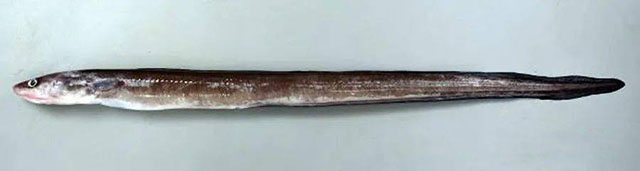
How to identify what you are seeing on an eel
If you are holding a raw or cooked eel product and wondering do eels have spines, use a simple observation sequence. Do not poke around aggressively with a knife. That can break small bones into pieces and make the result harder to assess.
- Check the location. A hard structure along the center of the body is more likely related to the backbone than to a fin.
- Look at the fin edge. True eel fins should not present the row of rigid, sharp front fin spines seen in some fish.
- Assess the product label. “Deboned,” “boneless,” and “fillet” are processing descriptions. They do not all guarantee the same bone-removal result unless the supplier defines the specification.
- Consider the preparation method. A roasted and sauced kabayaki fillet is handled differently from a whole raw eel intended for further processing.
- Ask the supplier for the cut standard. This is the best route for commercial buyers, particularly when serving children, high-volume diners, or customers expecting easy eating.
The answer to do eels have spines should therefore never be used as a food-safety shortcut. The anatomical answer tells you that true eels have vertebrae and generally lack stiff fin spines. It does not replace normal visual checks, product controls, or supplier documentation.
Common mistakes when discussing eel bones and fins
- Mistake: Calling every eel bone a fin spine. The correction is to identify where the structure came from. Internal bones and fin supports serve different roles.
- Mistake: Assuming all eel products are boneless. Choose a clearly defined deboned product when low bone presence is part of the menu requirement.
- Mistake: Treating all eel-like fish as true eels. Confirm the species and product description before teaching anatomy or setting a procurement standard.
- Mistake: Ordering only by portion size. Include bone status, cut style, glaze preference, packaging, and destination-market needs in the purchase brief.
- Mistake: Ignoring sauce compatibility. A rich kabayaki glaze can change how a menu item is perceived, so evaluate the sauce together with the eel application.
For example, a restaurant group serving grilled eel rice bowls may choose deboned kabayaki portions to reduce back-of-house handling. That decision fits a fast service model and an easy-to-eat menu promise. It may not fit a chef who wants whole eel for a specialized preparation. The product format should follow the dish, not a vague assumption about anatomy.
For sauce planning, compare the eel format with the desired flavor profile. Our eel sauce product page outlines a relevant accompaniment, while this kabayaki sauce article helps explain why glaze selection affects the finished plate.
What this means for traceable eel sourcing
For importers, the question do eels have spines belongs within a larger product-control discussion. Anatomy determines what can be present in a cut. Processing controls determine how the product is prepared, checked, packaged, and traced.
Eelpro operates two modern production lines for frozen roasted eel and deep-processed aquatic products, with annual finished-goods capacity of 4,000 tons. Our facility includes a 1,000-ton cold storage facility, an in-house laboratory, and metal detectors at control points. We are certified to ISO 22000:2018 and HACCP systems, hold HALAL certification and export food producer registration, and hold SC Food Production License No. SC11135062401122.
Our raw-material control includes about 20 customs-registered eel farming bases covering more than 2,150 mu, with traceability from farming registration through process verification, targeted sampling, and tracking. This sourcing model is relevant when a buyer needs documentation and controlled production rather than simply an anatomical explanation.
We supply kabayaki eel to Japanese restaurant chains and export unagi kabayaki and eel sauce to United States food importers. Eel products have also been supplied to importers and foodservice channels in Germany, Poland, Australia, Indonesia, and Southeast Asia. These examples show established market coverage; they are not a guarantee that every specification, import process, or order schedule will be identical.
Regular order delivery is approximately 30 days from order confirmation to shipment, subject to specification and quantity. Buyers needing deboned formats, custom cuts, or special packaging should confirm the production plan before committing a menu launch date. For farming and quality-control context, see our eel farming information and quality laboratory page.
Do eels have spines? Yes, they have internal vertebrae; true eels generally lack stiff fin spines. If you are selecting frozen unagi kabayaki or a custom eel cut, request a product specification and sample guidance from Eelpro.