





How to Estimate Canned Eel Landed Cost Before You Submit an RFQ
A quote that looks cheap on paper can quietly erase your margin by the time the container clears port. Buyers comparing canned eel suppliers often lock in a price per case, then get surprised by freight surcharges, duty reclassification, or a breakage claim nobody budgeted for. By the time the invoice lands, renegotiating is almost impossible. Before you send another RFQ, build the landed cost math yourself — not after the deposit is wired.
Landed cost is what a case of canned eel actually costs once it sits in your warehouse — not the FOB number on the supplier's proforma invoice. It adds freight, duties, clearance fees, and the allowance you set aside for damaged tins. Most importers treat canned eel landed cost as a single number. It isn't. Skip any one line and your real margin shrinks the moment the shipment arrives.
The Canned Eel Landed Cost Formula — What's Confirmed, Estimated, and Unknown
Some figures are locked the moment you sign the purchase order. Others stay an estimate until the shipment actually moves. A few remain unknown until the first container clears customs. Separating these three categories keeps you from quoting your own customers a number you can't actually guarantee.
Landed Cost = Unit Price + Packing/Case Cost + Freight + Duties & Tariffs + Customs Clearance + Insurance + Breakage Allowance
| Cost Component | Status | Why |
|---|---|---|
| FOB/EXW unit price | Confirmed | Fixed once the purchase order and spec sheet are signed |
| Case configuration (units per carton, carton weight/volume) | Confirmed | Set by the packing list; drives freight density calculations |
| Ocean or air freight | Estimated | Changes with carrier rate, fuel surcharge, and sailing season |
| Import duty, based on Harmonized System classification | Estimated | Depends on how customs in your destination country classifies canned eel |
| Customs clearance / broker fee | Estimated | Port-specific; usually a flat fee plus a percentage of CIF value |
| Breakage / damage allowance | Unknown until first shipment | Set a reserve percentage; actual rate depends on packing quality and transit handling |
| Inspection hold or demurrage | Unknown | Only applies if the shipment is flagged for extra inspection |
Treat canned eel cost estimates as a range, not a quote. Treat "unknown" rows as a reserve line in your spreadsheet — never as zero.
Case Configuration Changes Your Per-Unit Cost More Than the Headline Price
Two suppliers quote the same per-tin price for canned eel. One ships 24 tins per carton at 12 kg gross weight. The other ships 48 tins per carton at 19 kg. The second option moves almost twice the product per cubic meter of container space — which cuts per-unit freight cost even though the unit price never moved. When you compare canned eel quotes side by side, case configuration matters as much as price.
| Packing Format | Typical Use Case | Freight Efficiency | When It Fits |
|---|---|---|---|
| Bulk carton, 48+ units | Wholesale, catering chains | Higher — lower cost per cubic meter | Large-volume buyers with warehouse space |
| Skin-packaging, retail-ready | Retail and foodservice display | Lower — more packaging volume per unit | Buyers needing shelf-ready product, smaller MOQ |
| Gift box format | Specialty retail, gifting season | Lowest — highest packaging-to-product ratio | Premium retail channels, seasonal promotions |
Eelpro, for example, sets differentiated MOQ by packaging format — skin-packaging and gift box configurations carry different minimums than bulk carton orders aimed at catering chains. Ask any supplier the same question before comparing two quotes: what MOQ applies to this exact packing format, not just the product line in general.
Canned Eel vs Frozen Roasted Eel — Which Cuts Total Landed Cost
Canned eel skips cold-chain freight entirely — no reefer container, no cold storage at port. That lowers the logistics line per unit. But retort processing changes texture, and many foodservice buyers find frozen kabayaki holds closer to fresh-roasted flavor after reheating. If your channel is restaurant-grade sushi or donburi service, frozen unagi kabayaki often wins on plate quality even though it adds a cold-chain cost line.
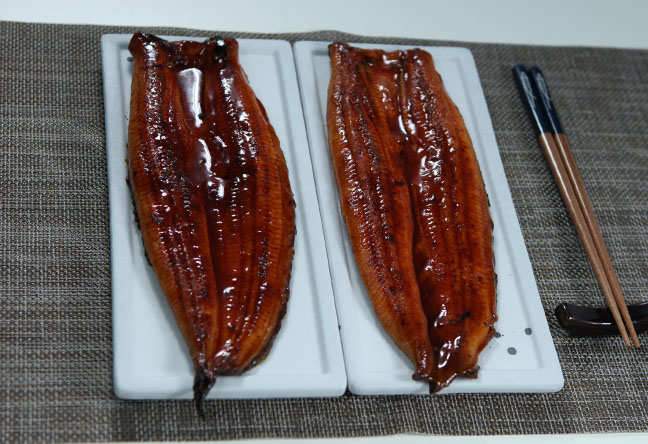
Frozen roasted eel does require reefer freight and cold storage capacity at destination — plan for that in your own warehouse, or confirm your supplier's frozen seafood line and cold storage support before signing. Suppliers running their own cold storage — Eelpro's facility holds 1,000 tons — can buffer production runs and protect delivery timing, which matters more for frozen format than for canned goods. If your channel sells canned eel primarily through retail gifting, the equation shifts again, since shelf stability outweighs texture for a gift-set buyer. Buyers bundling a glaze packet with kabayaki orders can also review eel sauce production details separately, since sauce packaging has its own case configuration.
Common Mistakes Buyers Make When Comparing Canned Eel Offers
- Quoting FOB price only, without adding freight and duty before comparing two canned eel suppliers side by side.
- Misclassifying the HS code, which produces a different duty rate at the border than what was budgeted.
- Skipping a breakage allowance line, then absorbing 100% of transit damage out of margin.
- Not confirming whether customs clearance fees are included in the freight forwarder's quote or billed separately.
- Treating a single sample shipment's breakage rate as guaranteed for every future order.
- Ignoring packing density differences between competing quotes, which changes the true per-unit freight cost.
- Not reconfirming canned eel HS classification when switching to a new country of origin mid-contract.
A Step-by-Step Worksheet to Build Your Own Landed Cost Before You Quote a Customer
- Get the FOB or EXW unit price and case configuration for your canned eel order from the supplier's quote.
- Request a freight quote from your forwarder for the actual container type — dry container for canned product, reefer for frozen.
- Confirm the HS code for your canned eel shipment with your customs broker, not with the supplier.
- Multiply CIF value by the duty rate tied to that HS code.
- Add a flat clearance/broker fee — ask your broker for their current port rate.
- Add insurance, typically a small percentage of CIF value.
- Add a breakage reserve, a percentage you set based on packing quality and route history.
- Divide total landed cost by total units to get a true per-unit cost before quoting your own customer.
Worked example (illustrative): a 20-foot container holds 2,000 cases of canned eel. Unit price $1.20/can, freight $3,800 total, duty 6% on CIF value, clearance fee $250, insurance $120, breakage reserve 2%. Run the math line by line — don't eyeball it — and compare the result against a competing quote using the same formula, applied consistently to both.
Quality Checks to Run Before You Commit to a Canned Eel Supplier
- Ask for the food safety certificate scope — does it cover the actual product you're importing, not just the company's overall registration?
- Confirm whether the canned eel facility tests for veterinary drug residues matching your destination market's threshold, since Japan, US, and EU standards differ.
- Request traceability documentation back to the farming base, not just the processing plant.
- Check whether the facility runs an in-house lab and metal detection at critical control points.
- Ask for a trial shipment before committing to a full container, and apply your landed cost formula to that trial order specifically.
Eelpro's own processing runs under ISO 22000:2018 and HACCP, with HALAL certification and full traceability from certified eel farming bases through shipment. Products are checked in an in-house laboratory and pass metal detectors at critical control points before packing. Whichever supplier you choose for canned eel or frozen roasted eel, ask for the same documentation level before you sign.
If you're ready to run actual numbers instead of estimates, send us your target case configuration and destination port. We'll return a spec sheet and FOB pricing you can plug directly into the formula above.
 WhatsApp
 sales@chinaeels.com
 +8619937922411