





Eel in Japanese Comes in Five Written Forms, and Getting the Right One Matters More Than You Think
You're reading a Japanese menu, or a supplier's spec sheet, and the word for eel shows up looking completely different each time — sometimes flowing curves, sometimes blocky characters, sometimes just plain English letters. Which one is correct? Short answer: all of them are. The word for eel in Japanese exists in five distinct written forms, and each one has a specific job, from casual signage to customs paperwork.
If you're buying unagi kabayaki for a restaurant chain, writing product copy for a retail package, or just trying to order the right dish on vacation, knowing which script to use — and why — saves you real headaches later.
The Written Forms of Eel in Japanese
Unagi (鰻/うなぎ/ウナギ) refers specifically to freshwater eel, most commonly Anguilla japonica. Here's how the same word breaks down across scripts:
| Script | Written Form | Romaji | Pronunciation | Typical Use Case |
|---|---|---|---|---|
| Hiragana | うなぎ | unagi | oo-NAH-ghee | Casual menus, children's books, everyday writing |
| Katakana | ウナギ | unagi | oo-NAH-ghee | Ingredient lists, scientific/product labeling, emphasis |
| Kanji | 鰻 | unagi | oo-NAH-ghee | Formal restaurant signage, traditional branding |
| Romaji | unagi | — | — | Export labels, English spec sheets, international buyers |
| Related term | 蒲焼 | kabayaki | kah-bah-YAH-kee | Cooking method: butterflied, grilled, glazed in sauce |
Every one of these five forms says eel in Japanese; the difference is where each one belongs. Hiragana is what most Japanese speakers learn to read and write first — it's the default for anything informal. Katakana tends to appear on packaging and ingredient panels because it reads as slightly more clinical, almost like how English uses italics for scientific names. The kanji 鰻 is visually striking but complex enough that many people skip it in casual writing and default to hiragana instead.
Fun fact: the kanji 鰻 combines the fish radical (魚) with a phonetic component borrowed for its sound, not its meaning. That's a common pattern in Japanese kanji construction — and it's exactly why so many everyday menus just write うなぎ instead of bothering with the character.
Why the Script Choice Actually Matters When You're Sourcing
This isn't just an academic distinction. Get the wrong script — or the wrong term entirely — for eel in Japanese on an export label, and you can run into real problems.
- Species confusion: Unagi (freshwater eel) and anago (saltwater conger eel, 穴子) are completely different species with different price points and culinary uses. A label that just says "eel" in English, without romaji "unagi" attached, can cause a buyer to assume they're getting one when they're actually getting the other.
- Customs and documentation: Import paperwork usually needs the English/romaji term alongside the scientific name. Kanji-only labeling, while authentic-looking, can slow down inspection if customs officers can't cross-reference it against the invoice.
- Pronunciation errors on calls: Mispronouncing "unagi" during a supplier call — stretching it into something that sounds like "una-ji" — has, in practice, led to mixed-up orders between unagi and anago. It's a three-syllable word, stress on the first syllable: oo-NAH-ghee.
None of this applies if you're only reading a menu for personal dining — in that case, any of the five forms will get you the same dish. It matters most when you're negotiating specs, writing packaging copy, or filling out shipping documents where precision has consequences.
Common Mistakes Buyers and Menu Writers Make
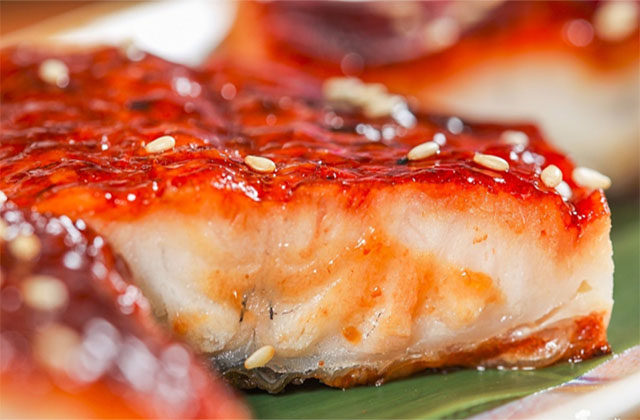
- Treating kabayaki as a species name. It's not — 蒲焼 (kabayaki) describes the cooking method: eel butterflied, grilled, and coated in a soy-based glaze. You can have unagi kabayaki or even other fish prepared kabayaki-style.
- Confusing unagi with anago on a spec sheet. If a supplier's document only says "eel" in English without the romaji or Latin species name, ask for clarification before confirming the order.
- Assuming "eel sauce" and unagi tare are identical everywhere. The sugar-to-soy ratio and reduction time vary by producer, which changes color, thickness, and shelf life. Our own kabayaki sauce process uses four layers of soy-sauce coating with temperature-controlled steps, which is a very different result from a quick one-pass glaze.
- Skipping the pronunciation check on verbal orders. A rushed phone call can turn "unagi" into something unintelligible — write it down, spell it out, confirm it back.
- Forgetting una-don (うな丼) is a dish, not a spec. It means "eel rice bowl." Useful for a menu, useless on a purchase order.
Reading a Spec Sheet or Menu: A Quick Decision Checklist
Before confirming an order or finalizing packaging copy, run through this list:
- Confirm the species listed matches Anguilla japonica (or the specific freshwater eel species you intend), not conger eel.
- Check whether "unagi" appears paired with kanji 鰻 for authenticity marketing, or in romaji-only form for an English-speaking market.
- Verify certification numbers on the shipping documents — for example, an ISO 22000:2018, HACCP, or HALAL certificate number, and a valid export food producer registration.
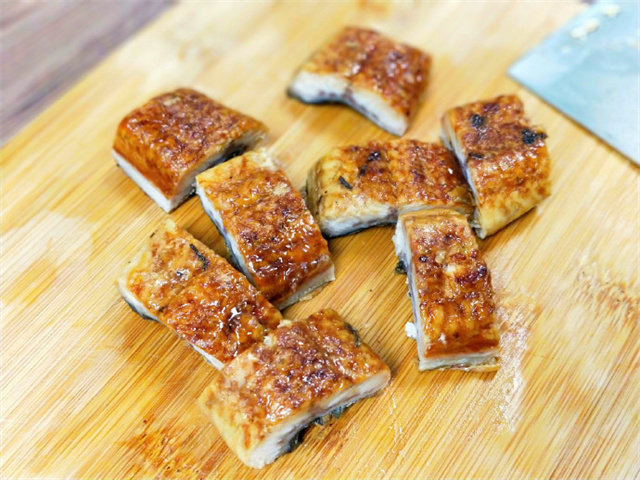
- Ask for the cutting spec in plain English terms: whole, fillet, kabayaki, diced, or sliced — not just kana shorthand.
- Request sample labels showing all relevant scripts if you're selling into a bilingual retail market, such as an Asian grocery chain in the US or Australia.
How This Shows Up in the Products You Actually Order
At Eelpro, our frozen unagi kabayaki and cut-eel products carry export labeling in romaji alongside English descriptors, so buyers in Japan, the US, Germany, Poland, and across the EU can match the product against customs paperwork without guesswork. We're ISO 22000:2018 and HACCP certified, HALAL certified, and hold an Export Food Producer Registration Certificate plus SC Food Production License No. SC11135062401122 for quick-frozen prepared foods.
Our roasting line applies a four-layer soy-sauce coating process with temperature-controlled steps, producing the graded color standards used across the industry — from "white-roasted" (shirayaki-style, before sauce) through the 1st-to-4th soy-sauce coating stages. Raw material comes from roughly 20 customs-registered eel farming bases covering over 2,150 mu, giving full traceability from farm registration through shipment. Everything is checked in our in-house laboratory and passed through metal detectors at critical control points, backed by 25 quality-control staff among 160+ employees.
With 2 production lines and 4,000 tons of annual capacity, plus a 1,000-ton cold storage facility, we handle everything from restaurant-chain kabayaki skewers to cut pieces for retail packs — and the same attention to labeling accuracy applies whether the customer is a Japanese restaurant group or a European importer stocking frozen seafood shelves.

Whether you're writing a menu, briefing a translator, or reviewing a supplier's spec sheet, the underlying rule stays the same: match the script to the audience. Kana and kanji speak to Japanese readers; romaji speaks to export buyers. Ask your supplier to show you eel in Japanese on the label in every script relevant to your market before you confirm an order — it's a five-minute check that prevents a much longer delay later.
Want to see how our labeling and cutting specs look for eel sauce or kabayaki products? Request a sample spec sheet, and we'll walk you through the exact terms, certifications, and cut options available for your market.

 WhatsApp
 sales@chinaeels.com
 +8619937922411