


How Does the Skeleton of an Eel Differ Between Morays and True Eels?
A long fish opens its mouth, showing sharp teeth and a second set of jaws. Is it an eel? Yes. Is it a “true eel” in the same sense as freshwater unagi? Not necessarily. That is where many anatomy labels, aquarium discussions, and food-related comparisons go wrong.
The skeleton of an eel is not a single fixed anatomy pattern. Morays and freshwater true eels share an elongated body plan, but they belong to different family groups within the Anguilliformes. Their skull form, visible teeth, jaw mechanics, and external fin structure should not be treated as interchangeable.
For an aquarium reader, this distinction helps prevent incorrect species identification. For a natural-history reader, it separates a family-level adaptation from a trait shared by every eel. For culinary buyers, it clarifies why a marine moray seen in a reef documentary is not an anatomical stand-in for farmed freshwater eel used in unagi dishes.

Start with taxonomy before comparing teeth or jaw movement
The practical conclusion is simple: identify the animal’s family group first, then compare its skeletal features. A dramatic mouth image alone is not enough to classify an eel accurately.
Morays belong to the family Muraenidae. They are marine eels, often associated with reef crevices, rocky coastlines, and other sheltered saltwater habitats. Freshwater eels commonly discussed as “true eels” in food and aquaculture contexts belong to the family Anguillidae, including the genus Anguilla. Japanese-style unagi products are made from freshwater eel, not moray.
The reason this boundary matters is that shared body shape can hide major differences. Both groups have long bodies and reduced limbs, but their feeding habits and head structures developed under different ecological pressures. A moray’s head is built for gripping prey in confined spaces. A freshwater eel may also eat animal prey, but its skull and teeth should not automatically be described with the same extreme traits.
What observations support the distinction
- Morays are marine members of the eel order: their family identity is a stronger guide than body length or color pattern.
- Freshwater true eels have a separate family identity: Anguilla species are commonly associated with freshwater and coastal life stages, and they are the relevant reference group for unagi.
- Moray mouths are visually specialized: exposed sharp teeth and broad gape behavior are common reasons moray anatomy attracts attention.
- Not every eel has the same jaw display: a statement about a moray should remain labeled as a moray trait unless it is documented across other eel families.
This is especially useful when reading short social-media captions or product descriptions. If the description says “eels have a second jaw,” the safer interpretation is that the writer may be referring to a moray’s specialized pharyngeal-jaw system rather than making a reliable statement about every eel.
For culinary sourcing, use the commercial species and product specification rather than a reef-animal photo. A buyer evaluating frozen unagi should ask about species, cut format, bones, roasting method, sauce, pack style, and food-safety documentation. Skull appearance is informative biology, but it is not a replacement for a procurement specification.
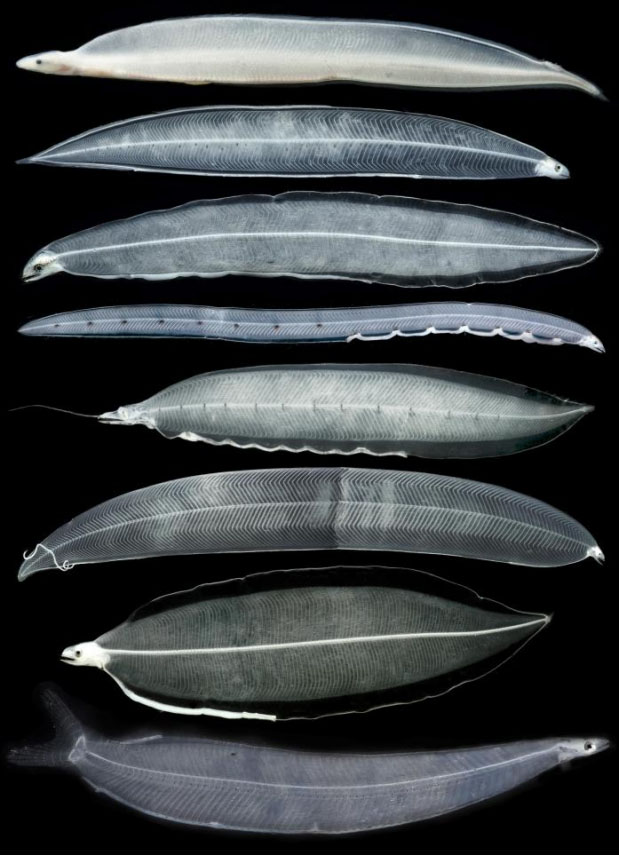
A species-boundary comparison of skull shape, teeth and pharyngeal jaws that prevents moray anatomy from being generalized to all eels
The best conclusion is that morays have a distinctive feeding apparatus, while “true eel” anatomy varies by species and should be assessed on its own terms. The table below separates direct anatomical observations from overextended assumptions.
| Feature | Morays in the family Muraenidae | Freshwater true eels in the family Anguillidae | Buyer or reader takeaway |
|---|---|---|---|
| Skull shape | Usually appears deep-headed and strongly built around a wide oral opening suited to prey capture. | Often appears more streamlined and less visually broad at the head, although shape differs among species. | Do not identify an eel from body shape alone. Examine the head and confirm the family or species. |
| Visible teeth | Often conspicuous, pointed, and directed to grip prey. | Teeth may be present and functional but are not automatically as obvious or as specialized in appearance as those of a moray. | “Sharp moray teeth” is a reasonable moray description, not a universal description of all eels. |
| Pharyngeal jaws | Morays are known for highly mobile pharyngeal jaws that can help move prey from the mouth toward the throat. | True eels also have pharyngeal structures as teleost fishes, but their form and function should not be assumed to match the striking moray mechanism. | Do not use a moray video as proof that all eels feed in the same way. |
| Feeding scene | Commonly observed taking prey from crevices, where gripping and transport are important. | Feeding behavior differs by species, habitat, prey, and life stage. | Behavior is supporting evidence, not a substitute for correct identification. |
| External fin clue | Morays lack pectoral fins. | Freshwater Anguilla eels have pectoral fins. | This is often a more useful field clue than trying to judge teeth from a distant image. |
A useful cold fact: the famous “second jaw” is not a separate skull hidden inside the head. It is a specialized pharyngeal-jaw apparatus located in the throat region. In morays, its mobility is unusually noticeable and supports prey transport. That makes it memorable. It does not make it a defining feature of every animal called an eel.
The limit is equally important. Not every moray species will look identical, and a skull photograph without a scale bar, location record, or species label may still be difficult to interpret. Teeth can be damaged, hidden by soft tissue, or distorted by camera angle. Treat a single image as a clue, not final evidence.
Use the right anatomical clue for aquarium, museum, and food questions
Different questions require different evidence. The most common mistake is to use a feature that answers one question to answer another.
| Your question | Best evidence to check | What not to rely on alone |
|---|---|---|
| Is this animal likely a moray? | Family identification, marine habitat information, pectoral-fin absence, head profile, and verified species record. | Long body, spotted skin, or an open mouth. |
| Does it have the famous mobile throat-jaw behavior? | Species-level biology from a museum, aquarium, or scientific reference. | A general statement that “all eels have two jaws.” |
| Is this an eel suitable for unagi-style foodservice? | Commercial species, food-grade processing specification, traceability records, and import compliance documents. | Whether a wild eel species has dramatic teeth. |
| Will a prepared eel product reduce kitchen bone work? | Declared cut, deboning status, cooking instructions, and pack format. | Anatomy diagrams of whole wild fish. |
For example, a home cook may see a moray hunting clip and assume eel dishes must contain large visible teeth or difficult jaw bones. That is the wrong comparison. Prepared unagi kabayaki is a processed freshwater eel product. Its kitchen suitability depends on processing and cut control, not on the appearance of a living moray.
At Eelpro, our processing focus is freshwater eel for foodservice and retail formats, including frozen roasted eel and deep-processed aquatic products. Buyers can review our unagi kabayaki product information when they need a commercial reference rather than a broad “eel anatomy” label.
We also provide boneless or deboned eel options and standardized cutting formats, including shredding, dicing, strip-cutting, chunk-cutting, three-section cuts, and sushi slices. These choices fit kitchens that need predictable portions. They do not apply to aquarium identification, where species records and morphology remain the proper tools.
Avoid these common moray-versus-eel comparison mistakes
The conclusion here is practical: separate observed traits from assumptions. This protects both scientific accuracy and purchasing decisions.
- Mistake: Calling every elongated fish with teeth a moray.
Why it fails: Teeth occur in many fishes, and eel families differ widely.
Use instead: Confirm habitat, family, external fins, and a credible species label. - Mistake: Saying all eels use the same throat-jaw mechanism.
Why it fails: Morays are notable for the visible mobility and feeding role of their pharyngeal jaws.
Use instead: Say “morays have specialized mobile pharyngeal jaws” unless species-specific evidence supports a wider claim. - Mistake: Treating a moray skull as a diagram of freshwater unagi.
Why it fails: Morays and Anguilla freshwater eels are not the same family group.
Use instead: Match the anatomy reference to the product species or research subject. - Mistake: Using anatomy to judge processed-food quality.
Why it fails: A food buyer needs processing controls, residue compliance, cold storage, and specification confirmation.
Use instead: Request documents and samples for the exact product format. - Mistake: Assuming “eel” automatically means a single culinary category.
Why it fails: Common names can cover different species, habitats, and product uses.
Use instead: State freshwater or marine origin and name the commercial product clearly.
Translate anatomy knowledge into a better eel purchasing check
For a buyer, the key conclusion is that anatomy research should improve the questions asked during sourcing, not distract from food-safety and product-fit checks. A restaurant chain selecting kabayaki needs an edible-product specification. A distributor needs shipment stability and compliance evidence. An aquarium supplier needs documented species identification. These are different decisions.
- Define the use case. Is the request for aquarium identification, a school display, menu development, retail, or foodservice? This determines whether morphology or processing data comes first.
- State the species boundary. If the subject is a moray, label it as Muraenidae. If the product is unagi, request the freshwater eel specification. Do not use “eel” as the only identifier.
- Ask for the relevant physical format. Foodservice buyers should specify whole fillet, cut pieces, strips, sushi slices, or another required cut.
- Check the processing controls. For prepared eel, verify safety systems, traceability, laboratory controls, and metal detection rather than relying on general anatomy claims.
- Review sauce and heating needs separately. Roasting and tare affect flavor, while species and cut format affect the product base. The two decisions should be documented separately.
Eelpro operates two modern production lines with an annual finished-goods capacity of 4,000 tons and a 1,000-ton cold storage facility. Those are supply-chain facts, not evidence about wild moray anatomy. They matter when a buyer has already confirmed the correct freshwater eel product and needs stable storage and cold-chain handling.
Our food-production operations are certified to ISO 22000:2018 and HACCP requirements and also hold HALAL certification, export food producer registration, and an SC Food Production License. We apply export quality standards to domestic sales as well. For buyers serving markets with formal import checks, this is more decision-useful than an unsupported claim that one eel’s jaw design predicts another eel’s product quality.
Traceability should be part of the final check. Eelpro works with around 20 customs-registered farming bases covering more than 2,150 mu, with traceability controls extending from farm registration through process verification and shipment tracking. Our in-house laboratory and metal detectors support product-control decisions, while morphology remains relevant mainly to correct species understanding.
What remains uncertain and what evidence should change your view
A careful reader should keep two limits in mind. First, eel anatomy can vary within a family. Diet, age, sex, habitat, and species all influence the details seen in the head, dentition, and body form. Second, a video or isolated skull image may not provide enough context for identification.
Change your assessment when stronger evidence appears. A verified museum label, a species-level scientific description, a clear image of pectoral fins, or a reliable aquarium record can support a better biological conclusion. For food procurement, change your assessment when the supplier’s product sheet shows a different species, cut, deboning status, packaging format, or compliance record than the one requested.
If your question moves from anatomy to menu use, compare prepared formats rather than reef predators. Our eel sauce product page helps buyers consider tare alongside roasted eel, while the eel lab of Eelpro Co., Ltd provides useful context for quality-control discussions. For serving ideas after selecting the correct product, see our eel rice bowl toppings guide.
Need help matching a freshwater eel cut, roasting style, and sauce format to your market? Request a product specification or sample from Eelpro.