

Sourcing Chinese Eel Requires Understanding the Right Mandarin Terms
As a quality specialist who has guided dozens of overseas clients, I see a common point of confusion that can cause significant sourcing problems: the translation of "eel" into Mandarin. If you're an importer, distributor, or chef sourcing from China, you've likely seen the terms 鳗鱼 (mányú), 鳝 (shàn), and 鳗 (mán). Using them interchangeably is a mistake that can lead to miscommunication, incorrect product specifications, and receiving a species entirely different from what you intended. The success of your import operation hinges on this small but critical detail.
Understanding the precise Chinese eel terminology is the first step in ensuring you source the correct product, specifically the freshwater eels of the Anguilla genus used for dishes like unagi kabayaki. This guide clarifies the distinctions and provides a framework for communicating your exact needs to suppliers like Eelpro Co., LTD.
Decoding Eel in Chinese: Mányú vs. Shàn vs. Mán
For international food buyers, the most important distinction is between 鳗鱼 (mányú) and 鳝 (shàn). While both can be translated as "eel" in a general sense, they refer to different families of fish with vastly different culinary uses, textures, and market values. Using the wrong term in a purchase order or specification sheet is a frequent but avoidable error.
Here’s a direct comparison to help you clarify your sourcing requirements.
| Term (Pinyin) | Common English Name | Scientific Family/Genus | Key Characteristics & B2B Application |
|---|---|---|---|
| 鳗鱼 (mányú) | Freshwater Eel | Anguillidae (Genus: Anguilla) | This is the commercially valuable eel used for Japanese unagi kabayaki. It has a rich, fatty texture and is suitable for grilling and roasting. This is the term you should use when sourcing products for Japanese cuisine. Our entire production of unagi kabayaki product is made from this type of eel. |
| 鳝 (shàn) or 黄鳝 (huángshàn) | Swamp Eel / Rice Paddy Eel | Synbranchidae (Genus: Monopterus) | This is a different, snake-like fish common in Chinese and Southeast Asian cuisine. It has a firmer, less fatty texture and is typically stir-fried, braised, or used in soups. It is not a substitute for mányú in unagi dishes. Sourcing this by mistake would be a major procurement error for a Japanese restaurant chain. |
| 鳗 (mán) | Eel (General term) | General character | This single character is less specific and usually appears in compound words to denote other types of eel-like fish. For example, 海鳗 (hǎimán) refers to conger or sea eel. On its own, it's too ambiguous for a technical specification sheet. Always use the full term 鳗鱼 (mányú) for clarity. |
The 鳗鱼 meaning is specifically tied to the Anguilla eels that are the foundation of the global unagi market. In contrast, the 鳝 meaning is tied to a completely different culinary tradition. When you work with Eelpro, you are exclusively sourcing 鳗鱼 (mányú), raised in our network of ~20 customs-registered farming bases and processed in our certified facility.
What International Buyers Must Verify When Sourcing Chinese Eel
Beyond correct terminology, successful sourcing requires a detailed verification process. As an ISO 22000 and HACCP certified auditor, I've seen buyers face import detentions or product recalls due to gaps in their supplier's documentation or processing standards. A reliable supplier should be able to provide clear answers and evidence for every item on your checklist.
Use this checklist as a framework for your next supplier discussion to mitigate risks and ensure product quality.
Buyer's Sourcing Checklist for Frozen Roasted Eel
-
Certification Compliance: Does the supplier hold internationally recognized certifications?
Our Standard: We operate under an ISO 22000:2018 Food Safety Management System, HACCP, and HALAL certifications. We also hold an Export Food Producer Registration Certificate, which is non-negotiable for shipping products overseas from China. This ensures our processes meet global standards for food safety. -
Traceability from Farm to Shipment: Can the supplier trace the raw materials back to the specific farm?
Our Standard: We maintain full-chain control. Our supply comes from 19 self-operated and cooperative certified farming bases covering over 2,150 mu. Every batch is traceable from farming registration and targeted sampling through to final processing and shipment, ensuring accountability. You can learn more about our unagi eel farm network and its role in quality control. -
Processing and Technology: What specific processing technologies are used to ensure consistency and quality?
Our Standard: Our process includes patented low-fat roasting and deodorizing equipment. Our signature kabayaki involves a precise 4-layer soy sauce coating with temperature-controlled steps, creating a consistent color and flavor profile that our long-term clients in Japan demand. -
Production Capacity and Lead Time: Can the facility handle your volume, and what is the typical order-to-shipment timeline?
Our Standard: Our two modern production lines have a combined annual capacity of 4,000 tons. A 1,000-ton cold storage facility ensures product integrity. Standard order delivery is approximately 30 days from confirmation, but this is negotiable based on the specifications and quantity required. -
Export Market Compliance: Has the product been tested to meet the standards of your specific import market (e.g., Japan, US, EU)?
Our Standard: Our products are regularly verified to meet the strict food inspection standards for Japan, the United States, and the European Union, particularly concerning veterinary drug residues and microbiological indicators. This proactive compliance helps our buyers avoid trade risks and customs delays.
How Eelpro's Quality Systems Deliver Export-Grade Unagi
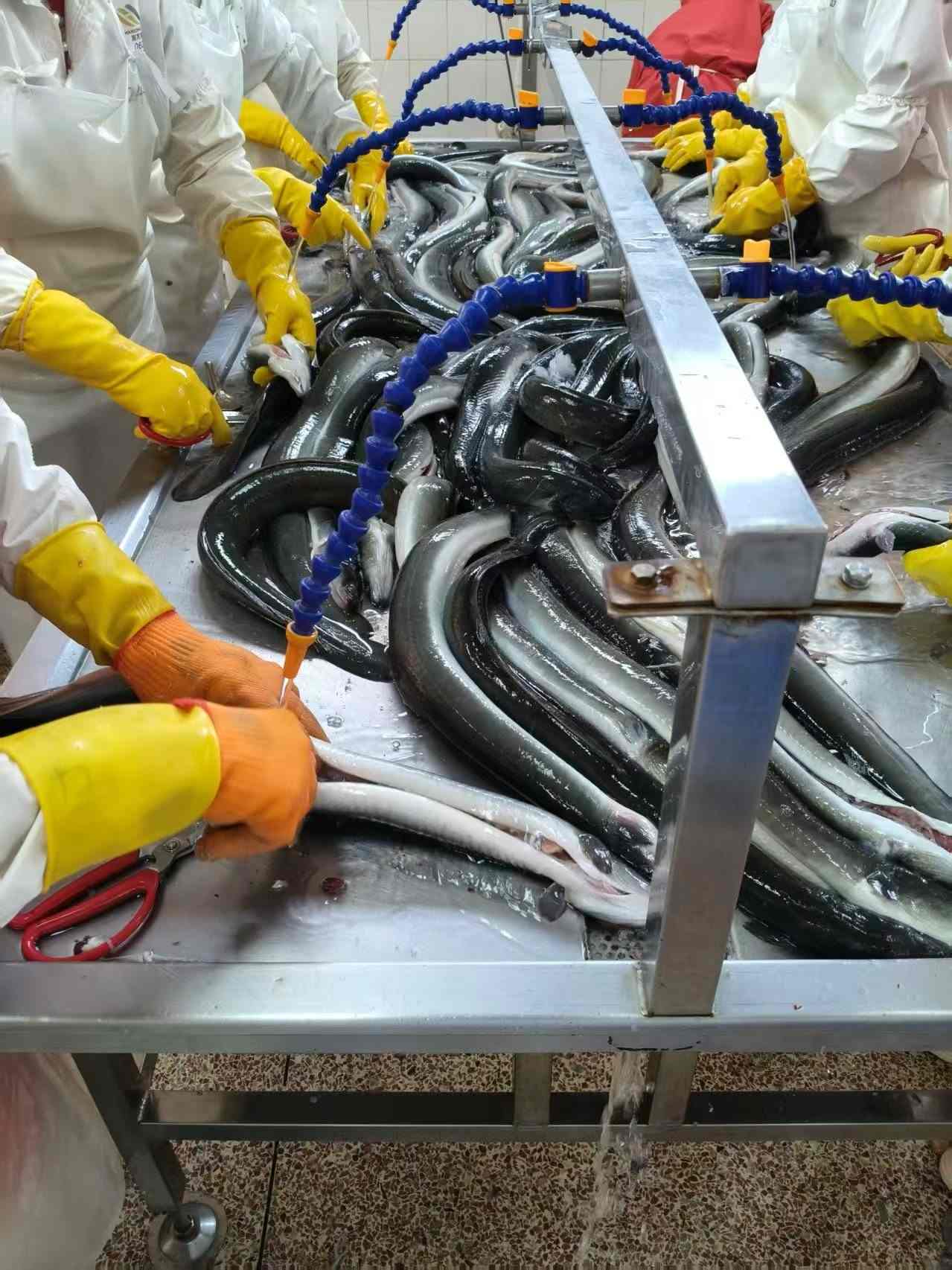
Translating your needs correctly is just the start. The real value comes from a supplier whose internal systems are built for export compliance and consistency. At Eelpro, our entire operation, established in October 2019, was designed with global markets in mind. Our 8,497 m² production workshop is staffed by over 160 employees, including a dedicated team of 25 technical and quality-control personnel.
Our quality assurance is not just a department; it's a system integrated into every step.
- Raw Material Control: We source over 5,000 tons of high-quality raw eel annually from our network of certified farming bases. This ensures a stable supply of materials that already meet our strict initial quality criteria before they even enter our facility.
- In-House Laboratory and CCPs: We don't rely solely on third-party testing. Our own professional eel lab performs regular checks. Critical Control Points (CCPs), such as metal detectors, are integrated into the production line to eliminate physical hazards, a core principle of our HACCP system.
- Standardized, Value-Added Processing: For our foodservice clients in the US, Germany, and Australia, consistency is key. We offer boneless and deboned eel with custom cutting specifications—including shredding, dicing, sushi slices, and 3-section cuts. This ready-to-heat format reduces back-of-house labor costs and ensures a uniform product for restaurant chains.
- Cold Chain Integrity: From production to shipment, the cold chain is never broken. Our 1,000-ton on-site cold storage facility ensures that finished goods are held at the optimal temperature until they are loaded for transport, preserving the texture and safety of the final product.
This comprehensive system is why we are recognized as a Provincial-Level Leading Enterprise in Agricultural Industrialization and a Provincial-Level Innovative SME. It’s how we confidently supply demanding markets from Japanese restaurant chains to Polish foodservice distributors and Indonesian importers.
By understanding the correct Chinese eel translation and partnering with a supplier built on verifiable quality systems, you can secure a stable, safe, and profitable supply chain for your business.
If you have specific requirements for your market or need assistance defining your product specifications, please contact our team. We can provide a detailed quote based on your needs.