

Trace Japanese Eel From Glass Eel to Kabayaki
How does a transparent juvenile fish become the glossy grilled fillet served over rice? For chefs, seafood distributors, and purchasing teams, the answer matters because the biological animal and the processed product are not the same buying decision. Japanese eel is the starting point; frozen unagi kabayaki is the finished format that determines kitchen labor, portion control, flavor consistency, and import documentation.
The species commonly associated with unagi is Anguilla japonica. Yet a carton labelled “eel” does not automatically tell a buyer the species, farming source, cut style, bone treatment, sauce profile, or processing controls. This guide follows the chain from ocean-spawned larvae through grow-out and roasting, then shows what to verify before specifying kabayaki for foodservice or retail.
Follow the life stages and handling transitions to the grilled product
The useful way to understand this supply chain is to separate biology from handling. The animal changes through distinct life stages. At the same time, every transfer—from capture and farming registration to processing and frozen storage—changes what a buyer can verify.
| Life stage or transition | What happens | What the parameter affects | What a buyer should ask for |
|---|---|---|---|
| Ocean-spawned larvae | The species begins as leaf-shaped larvae in the ocean before moving toward coastal waters. | This explains why eel supply begins with a migratory species rather than a fish bred from fully closed commercial hatchery cycles. | Species identification and a clear explanation of raw-material sourcing. |
| Glass eel | The juvenile stage is transparent or nearly transparent and enters estuarine or freshwater environments. | This is the transition from wild early life to the juvenile stock used for farming. It affects the traceability story, not the final sauce flavor by itself. | Farm registration records and supplier traceability procedures. |
| Elver and juvenile acclimation | Young eels adapt to freshwater farming conditions before larger-scale grow-out. | Handling quality during acclimation influences whether a farming program can maintain orderly records from incoming stock onward. | Whether the processor can connect farm records to production batches. |
| Grow-out at farming bases | Eels are raised until suitable for processing. | Farm management, residue controls, and batch discipline affect export eligibility and later inspection confidence. | Registered farming-base information, targeted sampling practices, and residue compliance documentation for the destination market. |
| Harvest and transport to plant | Raw eels move from farm to processing. | Identity preservation matters here. If batch information is lost, a finished fillet cannot be meaningfully traced back to a farming source. | Lot coding and farm-to-plant traceability records. |
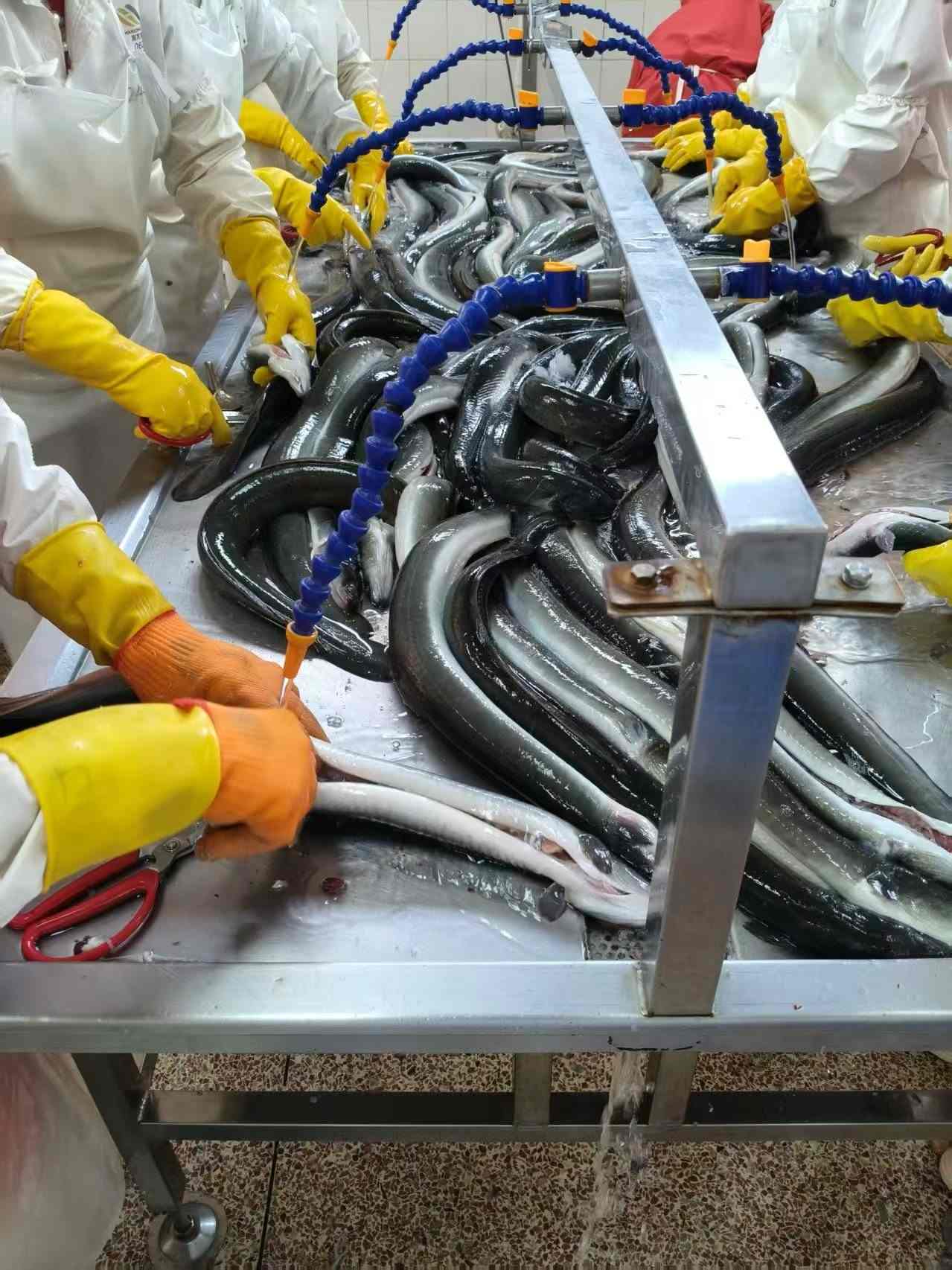
| Preparation and cutting | Eels are processed into formats such as whole fillets, cut pieces, strips, chunks, sushi slices, or skewers. | Cut geometry determines portioning, plate appearance, and the amount of back-of-house work required. | Requested cut drawing, bone treatment, piece format, and packaging style. |
| White roasting and sauce coating | The eel is roasted, then finished through controlled soy-sauce coating steps for kabayaki. | Roasting develops texture; sauce layers build color and flavor. These are related but not interchangeable controls. | Whether the order is white-roasted or kabayaki, and the agreed sauce and color standard. |
| Freezing, storage, and shipment | Finished packs are frozen, stored, and prepared for cold-chain transport. | Storage capacity and handling discipline protect the condition established during processing. | Cold-chain plan, storage capability, carton configuration, and shipment schedule. |
The key practical point is simple: glass eel is a biological stage, while kabayaki is a processed food format. A buyer should not use one term as evidence for the other. Knowing the species does not confirm sauce style, boneless status, or export inspection readiness. Likewise, a glossy kabayaki fillet does not by itself establish farm traceability.
At Eelpro, full-chain controls extend from farming registration and process verification to targeted sampling and traceability tracking. Our supply network includes approximately 20 customs-registered eel farming bases covering more than 2,150 mu. That is meaningful for buyers who need traceability evidence, but it does not remove the need to match each order to its intended market and product specification.
Understand what turns an eel into kabayaki rather than simply grilled fish
Kabayaki is not just an eel fillet with sauce added at the end. The processing sequence shapes the result. Roasting changes the flesh texture and surface. Soy-based sauce coating adds the familiar dark sheen, sweet-savory profile, and visual finish. If either element is poorly matched to the intended menu, the product can look right but perform poorly after reheating.
Our export-grade process uses four precise layers of soy-sauce coating with temperature-controlled roasting steps. Eelpro also maintains white-roasted color standards and first-through-fourth coating-color standards. This matters because color gives buyers a visible reference point when approving samples and receiving later lots.
| Processing choice | What it changes in practice | Best-fit scenario | Limit or trade-off |
|---|---|---|---|
| White-roasted eel | Provides a less finished flavor base for a customer’s own seasoning or sauce program. | Restaurant groups developing a house glaze or regional menu variation. | Requires more kitchen or central-kitchen finishing work. It is not the fastest ready-to-serve choice. |
| Finished kabayaki | Combines roasted eel with established sauce coating for a recognizable unagi presentation. | Rice bowls, sushi menus, prepared meals, and operators seeking simpler reheating. | The existing sauce profile must fit the menu. Do not assume every kabayaki matches the same sweetness or color expectation. |
| Whole or large fillet format | Supports plated presentations and visible fillet portions. | Restaurants where the eel itself is a menu centerpiece. | May require more portioning control in the kitchen than pre-cut formats. |
| Cut pieces, strips, or sushi slices | Reduces handling and supports repeatable portions. | Sushi production, meal kits, rice bowls, and foodservice assembly lines. | Less flexibility for operators who want to cut each portion to order. |
| Deboned or boneless specification | Reduces labor and improves convenience for many foodservice uses. | High-throughput kitchens and retail-ready applications. | Buyers must define their bone-treatment requirement rather than assuming it from the product name. |
For example, a distributor supplying ready-to-heat rice bowls should normally prioritize standardized cut pieces and clearly specified sauce coverage. A chef building a signature grilled eel dish may prefer white-roasted skewers or a less-finished format. Neither selection is inherently better. The deciding factor is where final flavor, cutting, and plating control should sit: with the processor or with the kitchen.
For product-format reference, review our unagi kabayaki product page. Buyers developing their own glaze program can also compare options through the eel sauce product page.
See how biology, farming controls, and processing specifications interact
One common misunderstanding is that a higher-quality finished fillet can be judged from species alone. Species matters, but it is only one layer. The commercial result depends on several connected controls.
- Species and product identity: Anguilla japonica identifies the animal. The purchase specification identifies the saleable item: kabayaki, white-roasted eel, cut pieces, or another agreed format. Use both descriptions in the RFQ. Species alone does not tell the receiving team how to prepare the product.
- Farm traceability and export risk: Registered-base records, sampling, and batch tracking support verification of raw material history. This is most relevant for importers and distributors handling destination-market compliance. It does not replace the importer’s own obligation to confirm local labeling, import, and documentation requirements.
- Roasting and sauce coating: Roasting establishes the cooked eel base; layered coating creates the finished kabayaki appearance and flavor. More visible sauce is not automatically better. Excessive or mismatched sauce can conflict with a chef’s desired profile, while too little may not deliver the expected finished look.
- Cutting and kitchen cost: Standardized cutting shifts labor from the kitchen to the processor. This suits operators with repetitive assembly work. It is less suitable when chefs require irregular, made-to-order presentation cuts.
- Frozen storage and receiving condition: A well-made product still depends on controlled frozen handling after production. Cold-chain capability matters for distributors holding inventory before final delivery.
Eelpro operates two modern lines for frozen roasted eel and deep-processed aquatic products, with annual finished-goods capacity of 4,000 tons. A 1,000-ton cold storage facility supports product storage and cold-chain logistics. These figures matter for buyers planning recurring volume or staggered shipments; they are not a substitute for confirming the available production window for a particular specification.
Avoid the buying mistakes that confuse raw eel with finished unagi
These mistakes often create preventable sample disputes, menu inconsistency, or receiving problems.
- Mistake: Ordering “unagi” without naming the finished format.
Correction: State whether you need white-roasted skewers, finished kabayaki, whole fillets, chunks, strips, or sushi slices. “Unagi” is too broad for a production order. - Mistake: Treating bone treatment as implied.
Correction: Request the exact boneless or deboned requirement in writing. This is especially relevant for prepared meals, sushi, and family-oriented retail products. - Mistake: Approving a sample only by appearance.
Correction: Assess color, sauce profile, cut dimensions, reheating behavior, packaging, and label information against the actual menu use. A sample for a rice bowl should be checked as a rice bowl, not only tasted on its own. - Mistake: Assuming all export markets need the same documentation.
Correction: Identify the destination before finalizing the order. Requirements can differ by market and importer process. - Mistake: Asking for a fixed universal minimum order quantity.
Correction: Provide the product type and packaging format first. MOQ is negotiable based on items such as white-roasted skewers, kabayaki, cut pieces, skin packaging, and gift boxes.
A useful cold fact: the rich brown surface of kabayaki is a processing result, not the natural color of the living fish. That distinction helps a buyer avoid judging farm origin from the appearance of a sauced, roasted fillet.
Use a practical RFQ checklist for kabayaki and related eel formats
A clear RFQ reduces revisions because it connects the biological source, processing request, and commercial use in one document. Use this sequence before asking for a quote or sample.
- Name the intended dish or sales channel. Specify whether the product is for restaurant rice bowls, sushi, catering, retail, meal kits, or distribution.
- Specify the product state. Choose finished kabayaki or white-roasted eel. If you need a house glaze, explain that the product must remain suitable for later seasoning.
- Define the cut. Request whole fillets, strips, diced eel, chunks, three-section cuts, or sushi slices as required by the menu.
- Confirm bone treatment and packing. State the required boneless or deboned condition, then identify the preferred packaging format, including skin packaging or gift boxes where relevant.
- Identify the destination market. This allows the supplier and importer to align product documents and inspection expectations. Eelpro products are processed to meet Japan, United States, and European Union food inspection standards for veterinary drug residues and microbiological indicators.
- Set the required delivery window. Eelpro’s regular order delivery time is approximately 30 days from order confirmation to shipment, with timing negotiable by specification and quantity. Do not treat this as a blanket promise for every custom request.
- Request traceability and quality evidence. Ask how the lot links to farming sources, process verification, laboratory controls, and critical-point metal detection.
For buyers who require documented food-safety controls, Eelpro holds ISO 22000:2018, HACCP, HALAL certification, export food producer registration, and SC Food Production License No. SC11135062401122. Our facility also has an in-house laboratory and metal detectors at critical control points, supported by more than 160 employees including 25 technical and quality-control personnel.
Match the finished format to the channel rather than buying by name alone
A Japanese restaurant chain and a retail importer may both buy kabayaki, yet their specifications can be very different. Restaurant operators often need reheating consistency, standardized portions, and less back-of-house preparation. Retail buyers may place greater emphasis on pack presentation, labeling, and consumer-friendly cuts. Distributors need a format that can serve several accounts without creating excessive inventory fragmentation.
Real market experience can help frame that selection. Eelpro has long-term kabayaki supply experience with Japanese restaurant chains, exports unagi kabayaki and eel sauce to food importers in the United States, and supplies eel products to German and Polish importers. We also serve Asian foodservice and retail channels in Australia, Indonesia, and Southeast Asia. These cases show that the same species can reach different markets in different processed forms; they do not mean one format or pack is appropriate everywhere.
If your team is comparing finished fillets with sauce components for menu development, our kabayaki sauce article explains why sauce selection should be considered alongside roasting and serving style. For broader sourcing context, visit our frozen eel supplier page.
Request a sample or specification review to match your target dish, cut format, packaging, and destination market.