

Unagi Is Eel, But Not Every Eel Can Legally Call Itself Unagi
A buyer emails us: "Is unagi just the Japanese word for eel, or a specific type?" It's a fair question — and one that trips up a lot of menu developers before their first container ever ships. Short answer: unagi is eel, specifically freshwater eel prepared a certain way. But the word alone doesn't tell you which species is in the box, and that gap has cost buyers real money.
This matters more than it sounds. Get the species wrong on a spec sheet, and you might receive a product with different fat content, different bone structure, or a flavor profile your customers won't recognize.
What "Unagi" Actually Means on a Menu vs in a Fish Tank
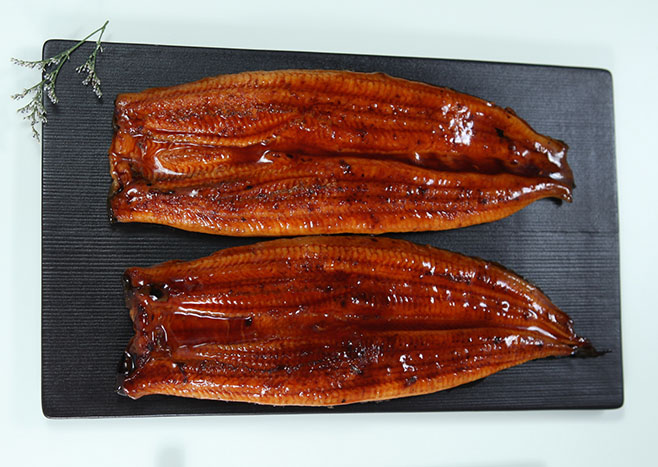
"Unagi" is a Japanese culinary term. It refers broadly to freshwater eel, usually prepared as unagi kabayaki eel — split, deboned, grilled, and glazed with a soy-based sauce. It's a food category, not a taxonomy label.
Anguilla japonica is the biological species most commonly used to make traditional kabayaki in Japan. It's a specific freshwater eel native to East Asia. This is where the boundary gets blurry for buyers: unagi is eel prepared in a certain style, and Anguilla japonica is one particular eel species — but the two terms are not interchangeable in every case.
| Term | What It Describes | Why It Matters to Buyers |
|---|---|---|
| Unagi | Japanese food term for prepared freshwater eel dishes | Tells you the cooking style, not the species or origin |
| Anguilla japonica | A specific freshwater eel species (Japanese eel) | Determines flesh texture, fat percentage, and bone size |
| Anguilla anguilla / Anguilla rostrata | European and American eel species, sometimes processed kabayaki-style | Different growth rate and fat distribution than A. japonica |
| Freshwater eel (general term) | Any eel species living in freshwater habitats | Too broad for a purchase spec — always confirm species on the contract |
Some suppliers process other eel species using the same kabayaki technique and market it as "unagi style." That's not dishonest by itself, but a buyer expecting Anguilla japonica characteristics — firmer skin, a specific fat marbling pattern — may be disappointed if a different species arrives labeled the same way.
Why the Species Behind Your Unagi Matters More Than the Label
Here's what actually changes when the species or processing spec is wrong, and why it's worth confirming before you sign a purchase order.
- Fat content: Anguilla japonica raised on managed farms typically carries higher, more even fat marbling. Lower-fat substitutes grill drier and can crack during the soy-sauce coating stage. Eelpro's patented low-fat roasting process was developed specifically to manage this variable without sacrificing texture.
- Bone structure and deboning yield: Species with thicker central bones need more aggressive deboning, which lowers usable meat yield per kilogram. This directly affects your cost-per-portion on a donburi or sushi menu.
- Sauce absorption: The 4-layer soy-sauce coating process used in export-grade roasting depends on skin porosity. Different species absorb sauce at different rates — get this wrong and you get an uneven "1st-through-4th coating color," which is one of our internal quality checkpoints.
- Cutting compatibility: Sushi slices and 3-section cuts require a certain body length and firmness. A soft-textured eel from an unmanaged source may fall apart under precision cutting equipment.
Common Mistakes Buyers Make When Sourcing "Unagi"
- Ordering by the word "unagi" alone without specifying species on the purchase contract.
- Assuming all frozen kabayaki products meet the same veterinary drug residue standards required by Japan, the US, or the EU.
- Skipping a sample request before committing to a full container — texture and fat content are hard to judge from photos alone.
- Not asking whether cutting specs (shredding, dicing, chunk-cutting, sushi slices) are available before finalizing menu portions.
How Eelpro Turns Farmed Eel Into Export-Grade Kabayaki
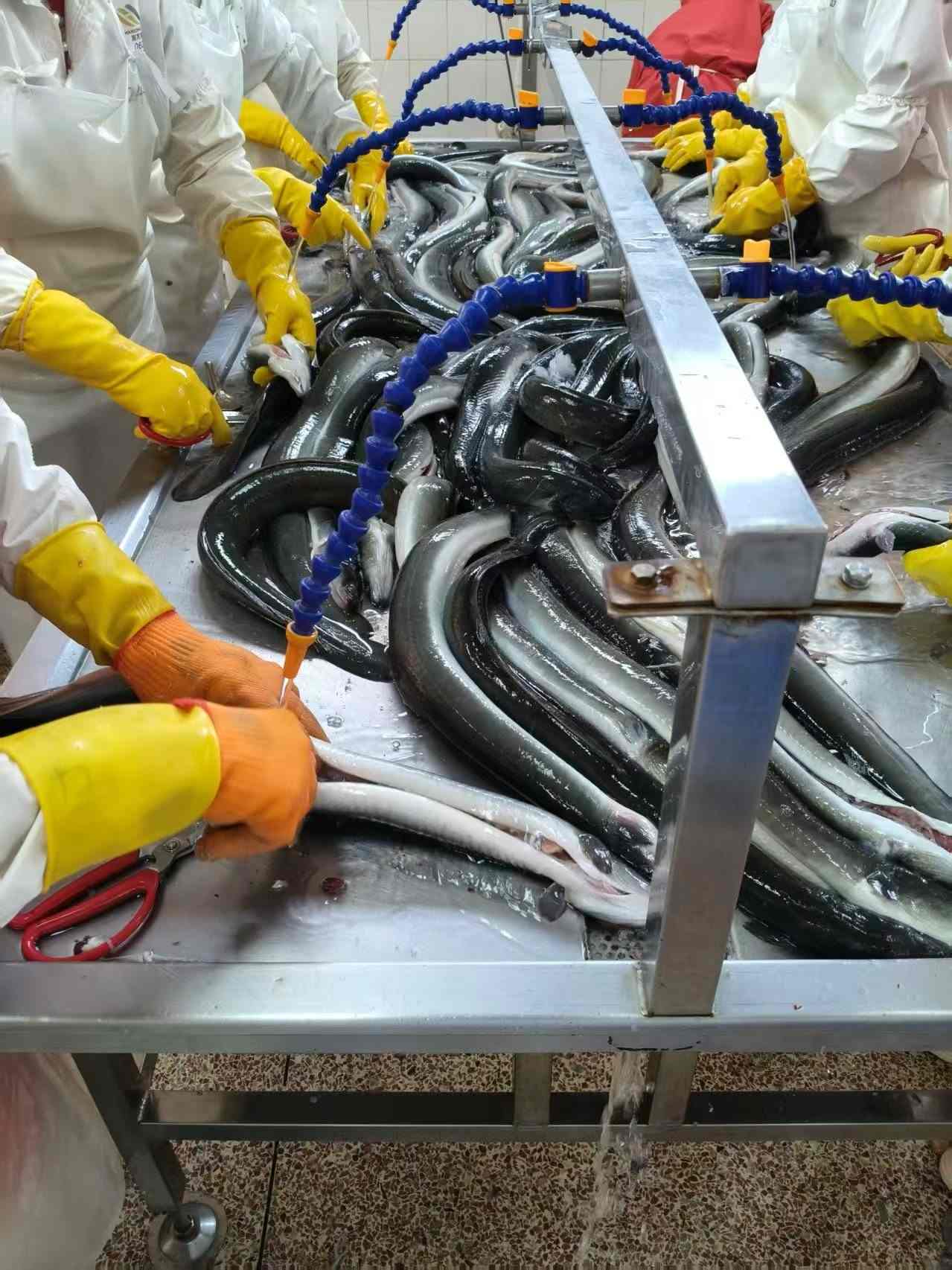
We work with 19 self-operated and cooperative certified farming bases, plus around 20 customs-registered farming sites covering over 2,150 mu, supplying more than 5,000 tons of raw material a year. Every batch is tracked from farm registration through process verification, targeted sampling, and final traceability review — you can see how this works on our eel farm page.
Once the eel arrives at our facility, it moves through two production lines with a combined annual capacity of 4,000 tons: one for frozen roasted eel, one for deep-processed aquatic products. The roasting process itself uses temperature-controlled steps across four soy-sauce layers, with internal "white-roasted color" standards checked at each stage. Every critical control point passes through metal detectors, and our in-house team — 25 of our 160+ staff work specifically in quality control — verifies results in our eel lab.
Worked example: a US foodservice importer sourcing pre-cut, boneless kabayaki for a chain menu needs consistent portion weight across every case. Because our cutting specs (chunk-cutting, strip-cutting, 3-section cut) are standardized before freezing, back-of-house teams skip manual trimming — which is exactly the kind of labor-cost problem foodservice buyers ask us about most.
Sourcing Checklist Before You Place an RFQ for Unagi Kabayaki
Before sending a request for quote, confirm these points with any supplier — including us:
- Species confirmation: Ask directly whether the product is Anguilla japonica or another species. Get it in writing on the spec sheet.
- Certification match: Confirm ISO 22000:2018, HACCP, and HALAL status if your market requires it. Our SC Food Production License (No. SC11135062401122) covers quick-frozen prepared and seasoned aquatic products.
- Compliance target market: Japan, US, and EU each have different veterinary drug residue and microbiological thresholds — confirm the supplier tests against your specific market, not a generic standard.
- Cutting spec availability: Skewers, sushi slices, dicing, or 3-section cuts — not every producer offers all formats.
- Packaging format: Skin-packaging for retail, gift boxes for premium channels, bulk cartons for foodservice — MOQ varies by format.
- Cold chain capability: Ask about cold storage capacity. Our 1,000-ton facility supports stable logistics from production through shipment.
- Lead time: Standard order delivery runs about 30 days from confirmation to shipment, though this is negotiable depending on spec and volume.
Where This Applies — and Where It Doesn't
This checklist fits buyers placing container-level or foodservice-chain orders where consistency across batches matters. It's less relevant for one-off retail purchases where a single product photo and price are the only deciding factors — though even then, checking species on the label is a five-second habit worth keeping.
Traceability and Why It Protects Your Menu Reputation
We've supplied kabayaki eel to Japanese restaurant chains on a long-term basis, exported unagi kabayaki and eel sauce to US food importers, and shipped eel products meeting EU food safety and veterinary drug residue standards to German and Polish distributors. Buyers in Australia, Indonesia, and across Southeast Asia use the same traceability system — from customs-registered farm to shipment — because a mislabeled species claim discovered mid-supply chain is a much bigger problem than a delayed shipment.
If you're building a menu around eel sauce pairings or testing recipes, our kabayaki sauce breakdown explains how the glaze itself affects shelf stability and flavor consistency across batches — a detail worth reviewing before finalizing your final product spec. And if your kitchen team needs prep guidance, our deboning and cleaning guide covers handling steps that matter for consistent plating.
For buyers comparing frozen product lines more broadly, our frozen seafood catalog and unagi kabayaki manufacturer overview lay out capacity, packaging options, and certification details in one place.
If you're at the early research stage and want a spec sheet, sample box, or a straight answer on species and cutting options before your next RFQ, reach out — we're happy to walk through what fits your menu or import requirements.