


What Type of Eel Is Used in Sushi and Why Species Selection Matters
Order "unagi" at two different sushi counters and you might get two different fish. One restaurant serves rich, buttery freshwater eel. Another serves a leaner, paler saltwater cousin labeled anago. So what type of eel is used in sushi, exactly? The honest answer: it depends on the menu term, the region, and increasingly, what the supply chain can actually source in volume.
For buyers — restaurant groups, importers, foodservice distributors — this isn't trivia. Get the species wrong on a purchase order, and you'll either overpay for a protected fish or serve something your menu didn't promise.
The Short Answer: Freshwater Unagi vs Saltwater Anago
Traditional Japanese "unagi" sushi uses freshwater eel, genus Anguilla — most authentically Japanese eel (Anguilla japonica). It's grilled with a soy-based glaze (kabayaki style), producing the dark, caramelized fillet most Western diners picture when they hear "eel sushi."
"Anago" is a different animal entirely — saltwater conger eel (Conger myriaster). It's lighter, flakier, and traditionally simmered rather than roasted in heavy sauce. Sushi menus that list both items aren't making a mistake; they're naming two distinct species with different flavor profiles and different sourcing chains.
Here's the practical catch: wild Japanese eel stock has been under conservation pressure for over a decade, so most kabayaki sold today — in Japan and abroad — comes from farmed freshwater eel, often Anguilla japonica or close relatives raised in aquaculture ponds across East Asia.
Comparison of Japanese, American, and European Eel Species
Buyers sourcing for sushi programs or foodservice menus should know the three commercially relevant Anguilla species and how each tends to show up in supply chains.
| Species | Common Name | Typical Role in Sushi Supply | Sourcing Note |
|---|---|---|---|
| Anguilla japonica | Japanese eel | Benchmark for authentic kabayaki flavor and texture | Farmed extensively in China and Taiwan; wild stock is heavily regulated |
| Anguilla rostrata | American eel | Used as a substitute or regional specialty in North American sushi | Smaller farmed volume; export availability varies by season and quota |
| Anguilla anguilla | European eel | Historically used in Europe; now rare in sushi supply chains | Listed under CITES trade restrictions due to population decline |
Why this matters in practice: if a buyer assumes "eel is eel," they risk two problems. First, compliance — European eel shipments can trigger customs holds or outright bans under CITES rules, which apply across the EU and many importing countries. Second, consistency — American eel and Japanese eel differ in fat content and texture, so swapping species mid-contract can change how the roasted product behaves on the grill and how customers perceive quality. A kitchen that built its menu around one texture profile will notice the difference immediately if the species changes without notice.
Common Mistakes Buyers Make When Sourcing Sushi Eel
- Assuming "unagi" on a spec sheet guarantees Anguilla japonica. Some suppliers use the term loosely for any farmed freshwater eel. Ask for the Latin name on the product spec.
- Not checking farming origin documentation. Traceability from a customs-registered farm matters for both food safety audits and species verification.
- Ignoring veterinary drug residue testing. Japan, the US, and the EU each apply strict residue limits; a shipment that passes in one market can still fail in another.
- Confusing kabayaki (grilled, saucy) with shirayaki (white-roasted, unsauced). These are preparation styles, not species, but mixing them up in a purchase order causes fulfillment delays.
- Overlooking cold-chain continuity. Freshwater eel fillets lose texture quality if cold storage is interrupted between processing and final delivery.
How Processing and Traceability Affect the Eel on Your Plate
Species identification is only the first checkpoint. What happens after harvest determines whether that Japanese eel genetics actually delivers the texture and safety profile buyers expect.
At Eelpro, eel raw material is drawn from roughly 20 customs-registered farming bases covering over 2,150 mu, feeding into full-chain traceability — from farm registration through process verification, targeted sampling, and final shipment tracking. That chain matters because a single contaminated batch, or a mislabeled species, can be traced back to its specific pond rather than an entire region.
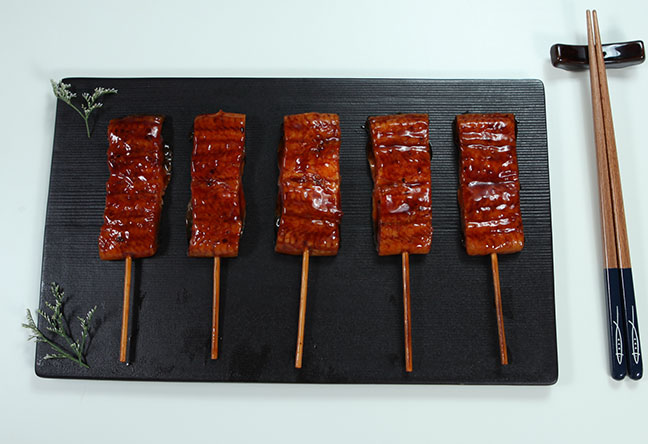
Processing itself affects outcome as much as species does. Our roasting line applies a four-layer soy-sauce coating process with temperature-controlled steps, producing the graded "white-roasted color" and sequential soy-sauce coating standards used to judge frozen unagi kabayaki quality. Patented low-fat roasting and deodorizing technology addresses a common complaint about farmed freshwater eel — excess fat and a muddy aftertaste — without changing the underlying species.
Every batch runs through an in-house laboratory and passes metal detectors at critical control points before it reaches cold storage. The 1,000-ton cold storage facility keeps product at stable temperature from processing through shipment, which matters because freshwater eel fillets are sensitive to temperature fluctuation — repeated thaw-refreeze cycles break down the collagen structure that gives kabayaki its signature bite.
Buyer's Decision Checklist Before Placing an Order
- Confirm the Latin species name on the spec sheet — do not accept "unagi" alone as sufficient documentation.
- Request farm traceability records, especially for shipments entering the EU, US, or Japan.
- Verify veterinary drug residue test results match the destination market's standard, not just the exporting country's.
- Specify cutting format needed — whole fillet, strip-cut, dice, or sushi slice — since this affects portion cost and kitchen labor.
- Ask about certification coverage: ISO 22000, HACCP, and HALAL status should be explicit in the supplier's documentation, not implied.
- Check cold-chain continuity from factory to port, not just factory conditions alone.
Eelpro's SC Food Production License (No. SC11135062401122) covers quick-frozen prepared foods, including seasoned aquatic products, and our facility operates under ISO 22000:2018 and HACCP systems alongside HALAL certification — details worth requesting in writing from any eel supplier before signing a contract.
What This Means for Different Buyer Types
A Japanese restaurant chain prioritizing authentic kabayaki flavor should specify Anguilla japonica genetics and request shirayaki-grade color standards. A US importer building a broader seafood catalog might accept either Japanese or American eel, provided veterinary residue testing meets FDA-aligned benchmarks. A German or Polish distributor supplying EU retail needs documentation proving the product is not Anguilla anguilla, given CITES restrictions — this is a compliance requirement, not a preference.
For foodservice operators in Australia, Indonesia, and Southeast Asia supplying Asian restaurant chains, the practical priority is usually consistency across orders — same fat content, same cutting spec, same roast color — more than species debate, since farmed Japanese eel genetics dominate that supply chain already.
Pairing the right eel sauce with the right species matters too. A heavier eel sauce glaze suits the richer fat profile of farmed freshwater eel, while lighter anago preparations traditionally use thinner, less reduced sauces. If you're troubleshooting glaze consistency on your own line, this kabayaki sauce breakdown covers the layering steps that affect final color and viscosity. Buyers assembling a full menu might also look at an eel sushi roll recipe to see how species and sauce choice interact in a finished dish.
Our production lines handle 4,000 tons of finished product annually across two lines — frozen roasted eel and deep-processed aquatic products — backed by 160+ staff, including 25 dedicated quality-control specialists. That scale exists specifically to keep species identification, residue testing, and cutting specs consistent batch after batch, which is the part buyers actually feel once product lands at their dock.
Nancy Chen, who oversees our HACCP and ISO 22000 systems, notes that most compliance issues she's guided overseas clients through trace back to incomplete species documentation at the point of order — not processing failures. Catching that gap before shipment, rather than after customs inspection, is the difference between a smooth delivery and a held container.
If you're sourcing sushi-grade eel for a restaurant chain, import program, or foodservice menu, request a spec sheet with species confirmation, residue test results, and cutting options before placing your first order — our team can put one together based on your target market.