





A Consistent Recipe Unagi Sauce Starts with Weight Not Time
As a quality specialist, I often see commercial kitchens struggle with one persistent issue: sauce consistency. A chef develops a perfect recipe unagi sauce one day, but the next batch made by a different cook is too thin, or a larger batch for a catering event becomes a thick, overly-salty syrup. The common culprit is relying on a timer. Simmering for "20 minutes" is not a reliable unit of measurement for reduction, as evaporation rates change with every pan, heat source, and even the day's humidity.
For foodservice professionals in Japan, the United States, and the EU, batch-to-batch consistency isn't a preference; it's a requirement for brand integrity and cost control. At Eelpro, our ISO 22000:2018 certified processes depend on precise, repeatable metrics. This guide explains the method we use for perfect sauce reduction at scale—a method your kitchen can adopt immediately: measuring by finished weight, not by time.
Why Simmering Time Fails Commercial Kitchens
Relying on a timer for sauce reduction is like trying to measure distance with a watch. It only works if your speed is always identical, which it never is in a kitchen environment. Several variables directly impact the rate of water evaporation, making time an unreliable control point.
- Surface Area: A wide, shallow rondeau pan has a much larger surface area than a deep stockpot holding the same volume. More surface area means faster evaporation. A 20-minute simmer in the rondeau could reduce the sauce by 50%, while the same time in a stockpot might only achieve a 25% reduction.
- Heat Source Fluctuation: Gas, induction, and electric stovetops all deliver heat differently. Even the same burner can have hot spots or fluctuate in output. A "medium-low" setting on one stove may be significantly more powerful than on another, leading to drastic differences in reduction speed.
- Batch Size: The physics of heating a small 2-liter batch versus a 20-liter batch are fundamentally different. Larger volumes have greater thermal inertia and a different surface-area-to-volume ratio, making simple time scaling (e.g., "simmer for twice as long") inaccurate.
- Ambient Conditions: Factors like kitchen humidity and even barometric pressure can subtly alter the boiling point of water and the rate of evaporation, introducing another layer of variability.
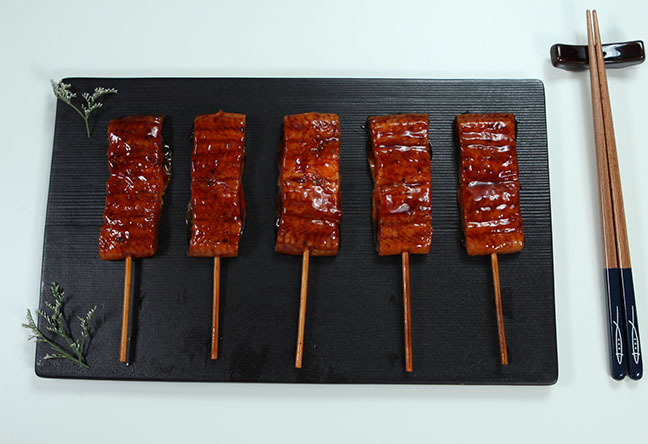
When a recipe unagi sauce is inconsistent, it directly impacts the final dish. A sauce that is too thin won't cling to unagi kabayaki, resulting in a bland product. A sauce that is too thick can burn easily during grilling, overpower the delicate flavor of the eel, and increase food cost per serving due to over-application.
Control by Weight vs. Time: A Technical Comparison for Repeatable Sauce Reduction
Shifting from time-based to weight-based process control is the single most effective change a kitchen can make to guarantee sauce consistency. It removes ambiguity and makes the recipe transferable across different staff, equipment, and locations. The goal is no longer to "simmer for 20 minutes" but to "reduce to 600 grams." This targets the final concentration of solids (sugar, soy, mirin), which is what determines viscosity and flavor intensity.
Here is a direct comparison of the two methods for a foodservice environment.
| Parameter | Control by Time | Control by Weight |
|---|---|---|
| Consistency | Highly variable. Results change with pan size, heat source, and batch volume. Prone to human error and interpretation of "simmer." | Extremely high. A specific target weight guarantees the same solids-to-liquid ratio every time, producing identical viscosity and flavor concentration. |
| Scalability | Poor. A recipe timed for a 1-liter batch does not scale linearly to a 10-liter batch. Requires re-testing and guesswork for each volume change. | Excellent. The reduction target is a percentage of the starting weight. To make a 10x batch, simply multiply the starting ingredients and the target final weight by 10. The process remains the same. |
| Equipment Dependency | High. The final product is tied to a specific pot on a specific stove. Changing equipment requires re-calibrating the recipe's timing. | Low. Requires only a reliable digital scale. The pan, stove, and heat level can vary; as long as the target weight is reached, the result is the same. |
| Process Control & Training | Subjective and difficult to document precisely. Training new staff is harder as results depend on their "feel" for the heat and timing. | Objective and easy to document. The instruction "Reduce from 1000g to 600g" is unambiguous. It simplifies training and ensures any team member can replicate the recipe perfectly. |
For our export clients in Germany and Poland, whose foodservice channels demand unwavering product quality, this level of control is non-negotiable. Our own production of commercial eel sauce relies on industrial load cells to monitor weight reduction in real-time, ensuring every batch meets the exact specifications required for distribution in demanding markets.
How to Implement Weight-Based Sauce Reduction: A Step-by-Step Guide
Adopting this method requires a digital scale capable of handling the weight of your pot and ingredients. The process is simple and quickly becomes second nature.
- Tare the Cooking Pot: Before adding any ingredients, place your empty cooking pot on the digital scale and press the "Tare" or "Zero" button. This removes the pot's weight from the measurement.
- Measure Your Starting Weight: Add all your unagi sauce ingredients (soy sauce, mirin, sake, sugar) to the pot while it is on the scale. Record this total starting weight. Let's say it is 2,500 grams.
- Define the Target Finished Weight: Decide on your desired reduction level. A common reduction for a glazing sauce is 30-40%. For a 40% reduction, your calculation is: 2,500g * (1 - 0.40) = 1,500g. This is your target weight. Write it down.
- Simmer and Monitor: Bring the sauce to a simmer. You no longer need a timer. Periodically, carefully lift the pot off the heat and place it back on the tared scale to check the current weight.
- Stop at the Target: Once the scale reads your target weight (e.g., 1,500g), the reduction is complete. Remove the pot from the heat. The sauce will have the exact same concentration and viscosity as every other batch made to this target weight.
Common Mistakes to Avoid
- Forgetting to Tare the Pot: The most common error. If you measure the starting ingredients without first taring the empty pot, your target weight calculation will be incorrect.
- Measuring While Vigorously Boiling: The upward force of steam and bubbles can slightly lift the pot, giving an inaccurate, lower-than-actual weight reading. Remove the pot from direct heat for a stable measurement.
- Inaccurate "Hot" vs. "Cold" Viscosity Judgment: A hot sauce is always thinner than the same sauce when cooled. Do not be tempted to over-reduce because it "looks thin." Trust the weight measurement. The correct thickness will appear as it cools to room temperature.
- Not Using a Heat-Resistant Pad for the Scale: Placing a very hot pot directly on a digital scale can damage its sensitive electronic components (load cells). Use a cork trivet or silicone mat on the scale platform.
Eelpro's Commitment to Quality and Consistency
For large-scale food importers and restaurant chains, consistency is the foundation of their business. At Eelpro, we've built our entire operation around this principle. Our 4,000-ton annual production capacity is managed by over 25 dedicated quality-control specialists who enforce strict process controls at every step.
Our patented low-fat roasting and deodorizing technology for eel processing is complemented by this same precision in our sauce production. Every batch of our unagi tare is manufactured in a facility with ISO 22000:2018, HACCP, and HALAL certifications. We don't just time our reductions; we monitor them by weight using integrated systems to ensure that the kabayaki sauce recipe we supply to a restaurant chain in Australia is identical to the one we ship to an importer in the United States. Our professional laboratory verifies product specifications, including viscosity and brix, ensuring our clients receive a product they can rely on, shipment after shipment.
This commitment starts from the source. With ~20 customs-registered eel farming bases, we maintain full-chain traceability from the farm to the finished, sauced product. By controlling the inputs and the process, we deliver a final product that meets the stringent food inspection standards of Japan, the US, and the EU.
For importers and distributors seeking a reliable supply of frozen unagi kabayaki or bulk unagi sauce, understanding your supplier's process controls is critical. A supplier that controls for weight, not time, is one that understands the fundamentals of scalable food production.
If your business requires a consistent, high-volume supply of unagi sauce or prepared eel products that meet international food safety standards, contact our team to request a product specification sheet or a sample.
 WhatsApp
 sales@chinaeels.com
 +8619937922411