

Are Gulper Eels Dangerous to Humans? Understanding the Jaw That Looks Scarier Than It Is
A photo surfaces online every few months: a black, balloon-mouthed fish with a jaw that looks like it could swallow a diver whole. The caption usually asks some version of the same question — are gulper eels dangerous to humans? The short answer is no, and the reason has nothing to do with temperament and everything to do with anatomy. This article breaks down exactly why, using the same kind of structural logic we apply when assessing any animal-derived food product for safety and handling.
What a Gulper Eel Actually Is (and Isn't)
The gulper eel, scientifically known as Eurypharynx pelecanoides, also goes by "pelican eel" because of its expandable throat pouch. It lives in the deep sea, typically between 500 and 3,000 meters down, in near-total darkness and cold water. It's a real eel, distantly related to the freshwater eels used in kabayaki production, but the similarity stops at the word "eel." Gulper eels are not farmed, not eaten commercially, and never encountered by swimmers, divers, or fishermen in any practical sense. Humans and gulper eels simply don't share the same environment. That single fact already answers most of the fear. But the jaw itself deserves a closer look, because it's the visual trigger for the whole "dangerous" narrative.
Jaw Anatomy, Prey Size, and Feeding Behavior — The Real Technical Breakdown
This is the part most articles skip, and it's the part that actually explains the behavior instead of just describing the look.
What the expandable jaw is built to do
The gulper eel's jaw is loosely hinged and lacks the strong closing muscles found in predatory fish like groupers or moray eels. It expands not through muscular force but through low water pressure created inside the mouth cavity — similar to how a pelican's pouch balloons open. This mechanism is built for one purpose: engulfing small, soft-bodied prey whole in an environment where food is scarce and unpredictable.
What happens if you assume "big mouth" means "big bite force"
This is the common mistake. People see the size of the open mouth and assume it correlates with bite strength. It doesn't. Bite force depends on muscle mass and jaw leverage, not cavity volume. A gulper eel's jaw muscles are thin and weakly developed compared to its mouth size — the opposite of what a dangerous predator's anatomy looks like.
| Anatomical Feature | What It Actually Affects | Consequence If Misunderstood |
|---|---|---|
| Loosely hinged jaw | Allows wide gape for swallowing prey whole | Mistaken for aggressive biting capability |
| Weak jaw musculature | Limits bite force to near-negligible levels | Assumed to mean a powerful crushing bite |
| Small, needle-like teeth | Prevents prey escape during swallowing, not tearing flesh | Confused with predatory teeth built for attack |
| Distensible stomach | Stores irregular, infrequent deep-sea meals | Assumed capacity to consume large animals |
| Small body diet (crustaceans, small fish) | Defines actual prey-size ceiling | Overestimated as capable of attacking large animals |
The prey-size ceiling matters most here. Gulper eels feed on small crustaceans, copepods, and small fish — animals a fraction of their own body length. Their entire feeding strategy is built around opportunistic engulfment of small, weak, slow-moving organisms in a food-scarce environment, not pursuit or attack of large, mobile animals. A human, at over 1,000 times the mass of typical prey, falls completely outside the biomechanical range this jaw was built to handle. Even if a gulper eel encountered a diver — which has essentially never been documented — its jaw physically cannot generate the force or gape control needed to cause harm.
Common Misconceptions About Deep-Sea Eels (And Where They Come From)
- Misconception: The huge mouth means an aggressive predator. Reality: The mouth is oversized relative to body only to compensate for scarce food, not to hunt large prey.
- Misconception: Gulper eels are commonly caught by fishermen or divers. Reality: They live in depths well beyond recreational or most commercial fishing zones.
- Misconception: "Eel" implies a relation to the freshwater eels used in food production. Reality: Gulper eels are biologically distinct from the freshwater eel species processed for kabayaki and other seafood products, and they share almost nothing in habitat, diet, or use.
- Misconception: Bioluminescent tail tip means the animal is a threat display. Reality: It's a lure to attract small prey in the dark, not a warning signal.
How This Compares to the Freshwater Eels People Actually Eat
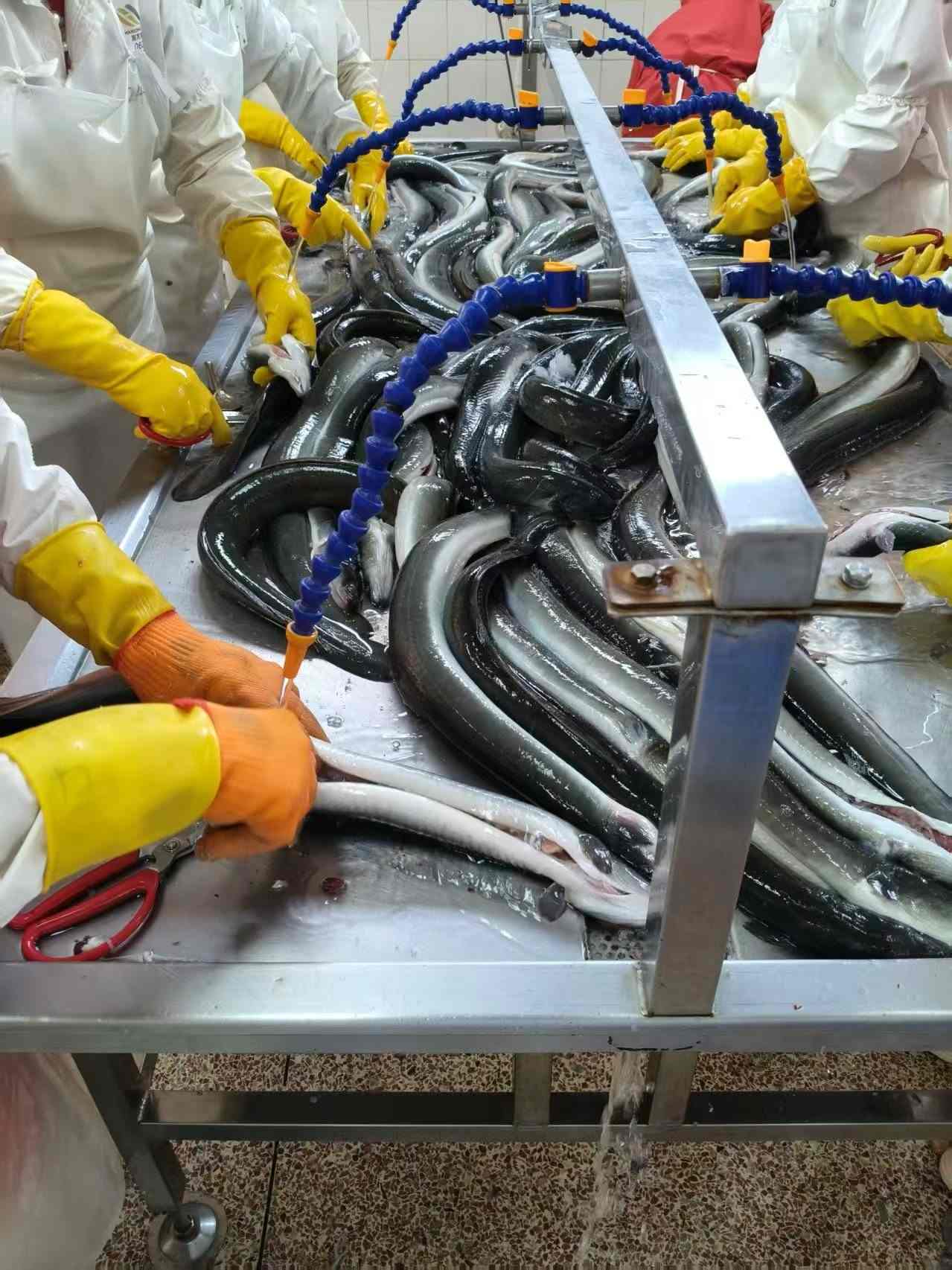
Since gulper eels get lumped into "eel" searches, it's worth separating fact from fish. The eels used in food production — including the unagi kabayaki eel used across Japanese, US, and European foodservice channels — are freshwater or catadromous species raised in controlled farming environments, not deep-sea predators. These eels are processed through certified facilities, not caught wild from ocean trenches.
| Feature | Gulper Eel | Freshwater Eel (Food Species) |
|---|---|---|
| Habitat | Deep sea, 500–3,000m | Freshwater rivers, farmed ponds |
| Human interaction | Virtually none | Farmed, processed, and exported for food |
| Jaw structure | Loosely hinged, weak bite force | Firm jaw, used for gripping smaller prey |
| Commercial relevance | None | Processed into kabayaki, sauces, frozen fillets |
This distinction matters for readers researching eel biology for content or education purposes — conflating the two species leads to inaccurate claims spreading online, which is part of why the "dangerous" myth about gulper eels persists in the first place.
A Buyer's Checklist If You're Sourcing Eel Content or Products for Educational Use
- Confirm the species before publishing — "eel" alone covers over 800 species with wildly different biology.
- Check habitat depth and range before making behavioral claims — deep-sea species rarely interact with humans at all.
- Verify jaw and feeding mechanism claims against peer-reviewed marine biology sources, not viral captions.
- For food-related eel content, rely on suppliers with traceable, certified production — our own operation, for instance, documents every batch from farm to shipment.
Why This Question Keeps Coming Up
Visual shock drives most of the "is it dangerous" search traffic. A wide-mouthed fish photographed under bright camera light in a museum jar looks nothing like the same animal at 1,000 meters, drifting slowly, mouth relaxed, waiting for a small crustacean to swim close enough to engulf. Context changes everything. Once you understand the jaw mechanism is built for gape, not grip, and the diet ceiling tops out at prey a few centimeters long, the fear resolves itself.
For readers who came here through an interest in eels more broadly — whether biology, cuisine, or both — the freshwater side of the eel world offers a very different story, one involving eel sauce production, roasting techniques, and export-grade processing standards rather than deep-sea mystery. If you're curious how those two ends of the eel world connect, our kabayaki sauce article covers the food side in more depth, while resources like how to cook eel: cleaning, skinning & deboning guide show how differently these food-grade species are actually handled compared to their deep-sea cousins.
If you're researching eel species for content, education, or product sourcing and want verified information on food-grade eel production standards, feel free to reach out for a spec sheet or sample details.