


Why Your Box Price for Frozen Unagi Kabayaki is Misleading
As a food importer or restaurant chain procurement manager, the price per kilogram on a supplier's quote is your starting point. But it's not your end cost. I've spent over a decade guiding international clients through import compliance, and the most common budgeting error I see is failing to account for usable yield. The quoted price for frozen unagi kabayaki doesn't represent the actual amount of eel that ends up on a customer's plate. Relying on it leads to inaccurate menu pricing and shrinking margins.
Hidden costs are buried in sauce weight, thaw loss, and cutting waste. A seemingly cheaper product can become significantly more expensive once you calculate the true cooked eel yield. Understanding how to calculate your real cost per portion is the most critical step before committing to a container load. This analysis protects your profitability and ensures you’re comparing supplier quotes on a level playing field.
Calculating Your True Landed Cost Per Portion
To accurately budget and set profitable kabayaki menu pricing, you must move beyond the supplier's FOB or CIF price. The key metric is the 'Landed Cost per Usable Gram'. This figure represents what you actually pay for the eel meat that is served to your customers. Here is a step-by-step framework to calculate it.
The core formula is simple:
(Total Landed Cost per Case / Net Usable Eel Weight per Case) = True Cost per Kilogram
The challenge lies in accurately determining the variables. We can break this down into a practical worksheet.
Cost & Yield Calculation Worksheet
Use this model to compare quotes from different suppliers. Be rigorous in separating confirmed costs from estimates.
| Component | Variable / Calculation | Example | Notes for Your Calculation |
|---|---|---|---|
| A. Invoice Price per Case | Price per kg × Case Weight (kg) | $20/kg × 10 kg = $200.00 | This is the confirmed price from your supplier's quote. |
| B. Logistics & Import Costs | Freight + Insurance + Tariffs + Port Fees | $25.00 | These are often estimates until the final invoice. Use data from past shipments for a more accurate figure. |
| C. Total Landed Cost (A+B) | $200.00 + $25.00 = $225.00 | This is your total cash outlay to get the case to your warehouse. | This is a confirmed cost once all invoices are paid. |
| D. Gross Weight per Case | As stated on the box. | 10.0 kg | This is the starting point for your yield calculation. |
| E. Thaw & Drip Loss (%) | (Weight After Thawing / Gross Weight) - 1 | ~2-5% | Request a sample and perform a test. High-quality freezing processes minimize this loss. Our facility uses a 1,000-ton cold storage system to maintain a stable cold chain, which helps reduce ice crystal formation and subsequent drip loss. |
| F. Sauce Weight (%) | (Sauce Weight / Gross Weight) | ~15-25% | This is a critical variable. A thicker, heavier sauce layer means less eel. Our 4-layer coating process is designed to achieve a specific, consistent sauce-to-meat ratio. Always verify this with a sample test. |
| G. Net Usable Eel Weight | D × (1 - E - F) | 10kg × (1 - 0.03 - 0.20) = 7.7 kg | This is the actual weight of the cooked eel meat you can use. |
| H. True Cost per Usable kg | C / G | $225.00 / 7.7 kg = $29.22/kg | This is your most important metric. Notice it's 46% higher than the initial $20/kg invoice price. |
By applying this formula, you can directly compare the true value of products. A supplier offering a $19/kg price might seem attractive, but if their sauce content is 5% higher and drip loss is 2% greater, their true cost could easily exceed that of a higher-quality, higher-priced initial product.
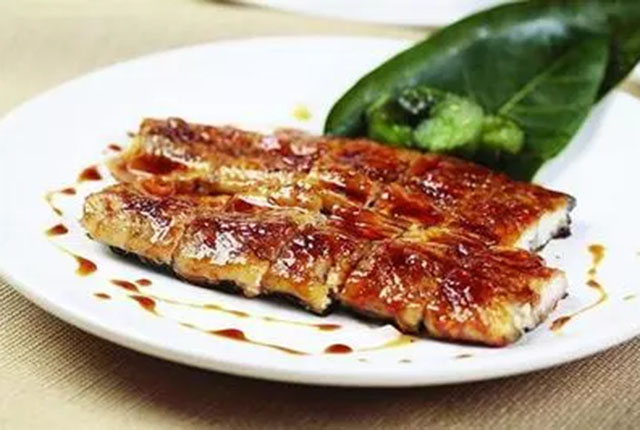
Key Factors That Impact Your Final Unagi Portion Cost
The true cost calculation reveals the financial impact of product quality. Several processing and sourcing factors directly influence your yield and, consequently, your final unagi portion cost. When evaluating a frozen eel supplier, these are the areas to investigate.
1. Sauce-to-Meat Ratio and Glazing Process
The sauce is essential for flavor, but it also adds weight that isn't eel meat. A supplier's glazing technique is a major differentiator.
- Inconsistent Coating: A manual or poorly controlled process can lead to wide variations in sauce percentage from batch to batch, making your food cost unpredictable.
- Controlled Application: We use an automated 4-layer soy sauce coating process with precise temperature controls for each step. This method ensures a consistent glaze that adheres well without adding excessive weight, giving you a predictable meat yield every time. Our process establishes clear standards for 'white-roasted color' and subsequent sauce coatings.
2. Raw Material Quality and Full-Chain Traceability
The quality of the live eel determines the texture and final cooked weight. Eels raised in stressful or suboptimal conditions can have a lower fat content and a tougher texture, which can affect customer satisfaction.
- Source Verification: Can the supplier trace their raw materials back to the source? Without this, you risk quality inconsistencies and potential food safety issues.
- Traceable Supply Chain: We manage a supply chain backed by approximately 20 customs-registered eel farming bases. This full-chain control, from our unagi eel farm partners to our processing facility, includes registration, process verification, and targeted sampling. This ensures a consistent supply of over 5,000 tons of high-quality raw eel annually, meeting the stringent standards of clients in Japan, the US, and the European Union.
3. Cutting, Deboning, and Packaging Specifications
How the eel is processed and packed before freezing directly impacts your back-of-house labor costs and waste. What you save in kitchen prep time adds directly to your bottom line.
- Whole Fillets: Require skilled labor to portion, increasing labor costs and the risk of inconsistent serving sizes.
- Pre-Portioned and Custom Cuts: We offer fully deboned fillets and a range of custom cutting specifications: shredding, dicing, 3-section cuts, and sushi slices. This ready-to-heat format eliminates almost all back-of-house processing. Your kitchen staff just needs to thaw and heat the product, drastically reducing labor costs and ensuring every portion served is identical. This standardization is a hidden but significant factor in lowering your overall frozen eel food cost.

A Buyer's Checklist for High-Yield, Compliant Eel Suppliers
Finding a reliable supplier of frozen unagi kabayaki goes beyond price. It's about securing a partner who can deliver consistent quality, verifiable safety, and a predictable yield. As an ISO 22000 and HACCP certified auditor, I use a similar checklist when evaluating our own supply chain. Use these points to vet potential suppliers before placing a large order.
Common Sourcing Mistakes to Avoid
- Mistake #1: Focusing Only on FOB Price. As demonstrated, the initial price is only part of the story. A low FOB price often hides high sauce content or poor processing that leads to a higher landed cost per usable gram.
- Mistake #2: Ignoring Certification Validity. Asking if a supplier is "certified" is not enough. Ask for the certificate number, the certifying body, and the scope of the certification. Our SC Food Production License (No. SC11135062401122) and ISO 22000:2018 certification are verifiable credentials that cover our specific production processes.
- Mistake #3: Overlooking Production Capacity. A small supplier may offer a good trial price but fail to deliver during peak season. Our two modern production lines have an annual capacity of 4,000 tons, ensuring we can handle large, regular orders for major restaurant chains and importers, like our long-term partners in Japan and Germany.
- Mistake #4: Skipping the Sample Test. Never commit to a container without first performing your own yield test on a sample. Physical verification is the only way to confirm a supplier's claims about sauce ratio and thaw loss.
Our commitment to quality is validated by our in-house professional laboratory and the use of metal detectors at critical control points. This internal oversight ensures that the products we ship not only meet our own high standards but also comply with the strict veterinary drug residue and microbiological limits required by Japan, the US, and the EU, helping our clients avoid costly import rejections. Our success in exporting to demanding markets like the United States and across Southeast Asia is built on this foundation of trust and verification.
By shifting your focus from the box price to the true cost per portion, you empower your business to make more profitable purchasing decisions. A reliable partner should be able to provide the data and samples you need to conduct this analysis with confidence.
To evaluate the yield and quality of our unagi kabayaki for yourself, contact our team to request a detailed specification sheet or a product sample.