

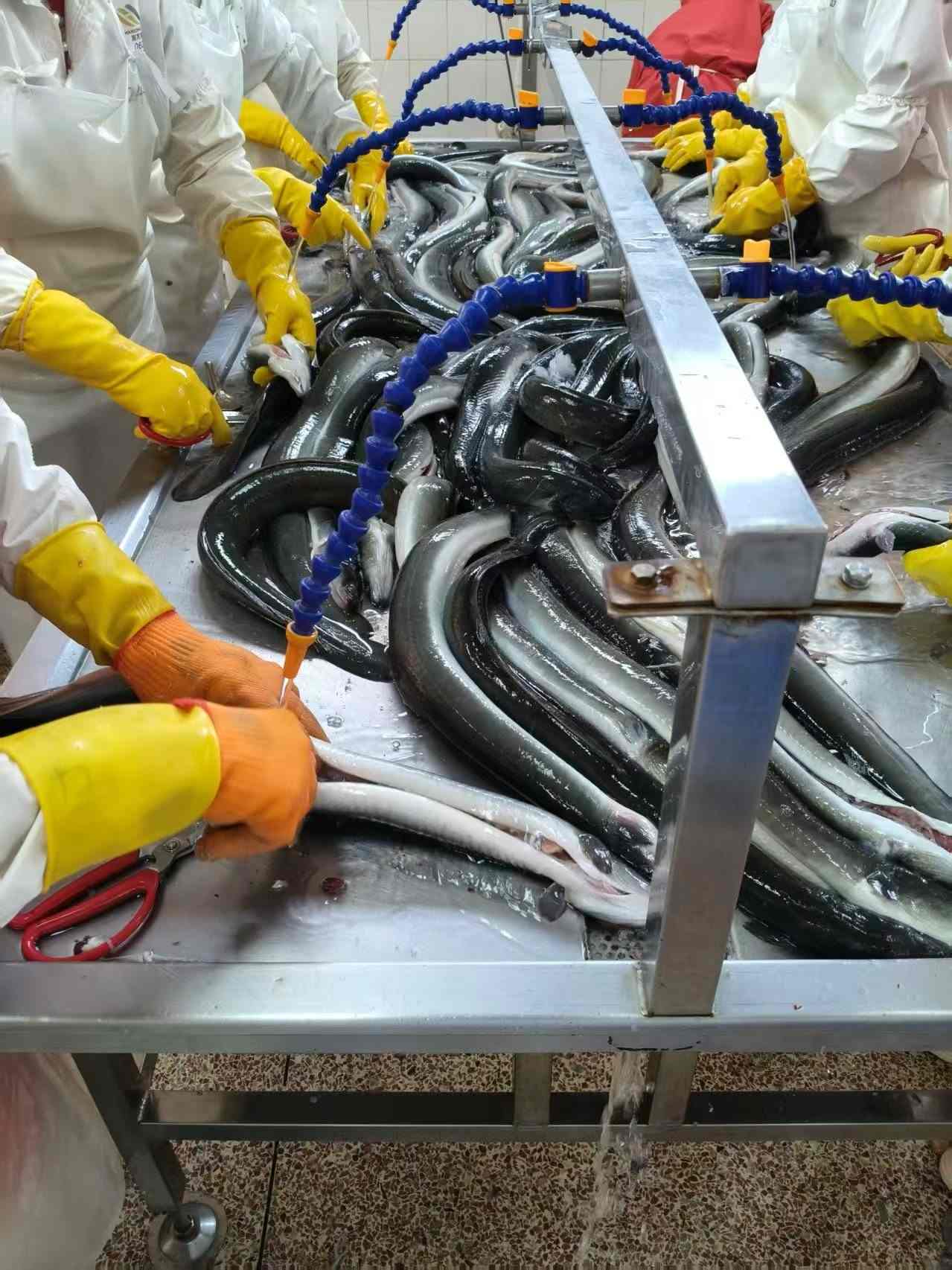
Do Eels Have Spines? How Dorsal Fins Separate True Eels From Spiny Eels
A buyer once asked us why a "spiny eel" fillet sample looked nothing like the unagi kabayaki in our catalog. Fair question. The short answer: true eels do not have spines — no sharp rays anywhere on their bodies. Spiny eels do, and that single feature is what separates two groups that share a name but almost nothing else.
If you're sourcing freshwater eels for foodservice or retail, this distinction matters more than it sounds. Mislabeling costs money, invites compliance headaches, and can wreck a menu launch. Let's break down the biology, then the sourcing implications.
What Does "Do Eels Have Spines" Actually Mean?
In fisheries and taxonomy, "spines" refers to stiff, unsegmented, often sharp rays supporting a fin — as opposed to "soft rays," which are flexible and segmented. True eels, family Anguillidae, have a single continuous fin running from the back, around the tail, to the belly — built entirely from soft rays. No spines, no separate fin segments.
Spiny eels (family Mastacembelidae and Notacanthidae, depending on species) are a different story. They carry a row of isolated, needle-like spines along the front portion of the dorsal fin, standing apart before the soft-rayed section begins. That row of spines is visible to the naked eye and is the fastest field check available.
True Eels vs Spiny Eels: The Dorsal-Fin Comparison
This is the core differentiator, and it deserves a direct side-by-side rather than a vague description.
| Feature | True Eel (Anguilla spp.) | Spiny Eel (Mastacembelidae) |
|---|---|---|
| Dorsal fin structure | Single, continuous, soft-rayed fin from back to tail to belly | Separate row of isolated spines in front, soft rays behind |
| Spines present? | No — zero spines anywhere on the body | Yes — typically 20-40 short, free-standing spines |
| Body shape | Smooth, cylindrical, slimy skin, no visible scales | Often laterally compressed, snout elongated and tubular |
| Culinary use | Farmed for unagi kabayaki, sushi, teriyaki, soup | Rarely farmed commercially; mostly wild-caught, ornamental, or regional dishes |
| Common market name confusion | Sometimes called "freshwater eel," "unagi" | Sometimes mislabeled "eel" in aquarium trade or local markets |
The takeaway for buyers: if a supplier's sample shows any spine-like structure on the dorsal fin, it is not a true eel in the Anguillidae sense, and it should not be marketed or purchased as unagi.
FAQ: Answering the Real Questions Buyers Ask
Do eels have spines on any part of the body, not just the dorsal fin?
No. In true eels, the entire fin system — dorsal, caudal, and anal — is one continuous soft-rayed structure. There are no spines on the pectoral fins either. This is consistent across the genus used in commercial unagi production.
Why do people confuse spiny eels with true eels at all?
Both have elongated, snake-like bodies and lack visible scales at a glance. Regional common names don't help — "spiny eel" and "eel" get used loosely in local markets and aquarium retail, especially in Southeast Asia where several Mastacembelus species are sold fresh or live. The name overlap is a labeling problem, not a biological one.
Does this distinction affect food safety or grading?
Indirectly, yes. Species misidentification affects everything downstream — nutritional labeling, allergen documentation, and veterinary drug residue testing protocols, which differ by species and farming method. Our own export process runs veterinary drug residue and microbiological checks calibrated to Anguilla species farmed under registered conditions, meeting Japan, US, and EU inspection standards. A spiny eel from an untracked wild source would not carry the same traceability.
Can I tell the difference after the eel is filleted or roasted?
This is the real limitation. Once the fish is skinned, cut, and glazed in kabayaki sauce, the dorsal-fin test is gone. At that stage, identification depends entirely on supplier documentation — farm registration, species certificates, and lab traceability records. This is exactly why full-chain traceability from farm to shipment matters more than a visual check once product reaches finished form.
Are spiny eels ever used commercially for food products?
Some Mastacembelus species appear in regional Southeast Asian and South Asian dishes, usually wild-caught and sold fresh, not processed into kabayaki-style products. They are not part of the Anguilla supply chain that supports frozen unagi kabayaki, eel sauce, or standardized cut specifications used in export foodservice.
A Common Mistake Buyers Make When Sourcing "Eel"
- Mistake 1: Trusting the word "eel" on a packing list without species verification (Latin name should appear on spec sheets).
- Mistake 2: Assuming frozen, skinless product is automatically true eel — species fraud is easier to hide after processing.
- Mistake 3: Skipping farm traceability checks because the sample tasted fine. Taste doesn't confirm species or residue compliance.
- Mistake 4: Not asking whether the supplier's farming bases are customs-registered — this affects both species assurance and export clearance.
How to Verify Species Before You Place an Order
Here's a workable checklist we walk overseas clients through before contract signing:
- Request the Latin species name (Anguilla japonica, Anguilla anguilla, etc.) on the spec sheet, not just "eel."
- Ask for farm registration details — customs-registered farming bases provide a paper trail from hatchery to processing plant.
- Check for lab testing records covering veterinary drug residues and microbiological indicators, matched to your destination market's standards (Japan, US, EU differ slightly).
- Confirm the processor holds recognized certification — ISO 22000, HACCP, or equivalent — rather than relying on verbal assurance.
- If sourcing whole or semi-processed fish, request a dorsal-fin photo before cutting, as an added visual confirmation layer.
This is a low-cost, low-effort step. Adding it to your RFQ process costs nothing and closes a real risk.
Where This Fits Into Sourcing Frozen Unagi Kabayaki
Our production runs on registered Anguilla stock from around 20 customs-registered farming bases covering over 2,150 mu, with traceability tracking from farm registration through process verification. That's the backbone that lets us confirm — with paperwork, not just a fin check — that what ships as unagi kabayaki eel is true eel, not a spiny-eel substitute or a mixed-species batch.
Roasting and grading follow our four-layer soy-sauce coating process, with color and texture checked against internal white-roasted and soy-sauce coating standards at each stage. None of that matters, though, if the raw material isn't a true eel to begin with — which is why species verification sits at the very front of our quality chain, ahead of roasting, ahead of cutting specs like shredding or sushi slices.
For buyers building a menu around eel sauce or kabayaki dishes, understanding this species split also helps with ingredient labeling and supplier audits — especially for markets like the EU and US where seafood mislabeling enforcement has tightened.
When the Dorsal-Fin Rule Does NOT Apply
Be clear on the limits here. The dorsal-fin check works on whole, unprocessed fish with intact fins. It does not work on:
- Filleted, skinned, or minced product
- Roasted, seasoned, or sauced kabayaki-style items
- Frozen cut pieces (dicing, strip-cutting, chunk-cutting) where fin structure is already removed
For these formats, documentation and lab traceability replace visual identification entirely. If a supplier can't produce species certification or farm records for processed product, the dorsal-fin rule can't help you retroactively — that's a real limitation worth flagging to your compliance team.
Curious how the roasting process affects flavor after species is confirmed? Our article on kabayaki sauce covers that in more depth, and our eel noodle soup recipe is a good example of how true eel behaves once cooked versus tougher spiny-eel substitutes.
If you're sourcing frozen unagi kabayaki, eel sauce, or cut freshwater eel for export and want species and traceability documentation before committing to an order, request our spec sheet and lab certificates — we're glad to walk through the farm-to-shipment paperwork with your team.