

How Long Is a Gulper Eel Compared With a Human?
Many people are surprised to learn that the gulper eel, a deep-sea creature, can grow to a length that rivals the height of an adult human. However, its total length is deceptive. The real story isn't just about its measurement from end to end, but about its extraordinarily thin, ribbon-like body and enormous mouth, which make a direct gulper eel size comparison to human scale both fascinating and misleading. Understanding these distinctions is key, especially when contrasting this biological curiosity with the commercially important freshwater eels used in global cuisine.
As a food safety and quality specialist, I often see confusion between different eel species. While the gulper eel captures the imagination, it's the freshwater eel that demands rigorous quality control for B2B importers and foodservice chains. Let's first visualize the gulper eel's true scale and then explore what that means for businesses sourcing high-quality eel products for consumption.

Visualizing Gulper Eel Size: A Direct Comparison to Human Height
The most striking feature of the gulper eel (Eurypharynx pelecanoides) is its length relative to its mass. It is exceptionally long and slender, which can be difficult to conceptualize without a direct comparison. If you were to encounter one in its deep-sea habitat, its proportions would look unlike almost any other creature.
Here’s a breakdown comparing its reported dimensions to that of an average adult human:
| Feature | Gulper Eel | Average Adult Human |
|---|---|---|
| Reported Adult Length | 0.75 to 1 meter (approx. 2.5 to 3.3 feet) | 1.77 meters / 5 feet 9 inches (male) or 1.63 meters / 5 feet 4 inches (female) |
| Body Shape & Proportions | Extremely thin, ribbon-like, or whip-like. Very little muscle mass along its body. | Robust, with significant muscle and skeletal mass distributed throughout the body. |
| Most Prominent Feature | Disproportionately massive, hinged jaw and pouch-like mouth that can be larger than its body. | Upright posture, with limbs proportioned for mobility. Head is a small fraction of total body size. |
| Typical Habitat | Bathypelagic (deep-sea) zone, from 500 to 3,000 meters (1,600 to 9,800 feet) deep. | Terrestrial (land-based). |
The key takeaway from this comparison is the concept of "effective size." While a gulper eel can be half as long as a human is tall, its body is so gracile that it has a tiny fraction of a human’s mass. Its length is almost entirely in its tail. The "business end" of the eel is its enormous mouth, designed to swallow prey much larger than itself in the food-scarce deep ocean. This is a creature built for a single, opportunistic function, not for the powerful swimming or muscular structure seen in eels from other environments.
From Deep-Sea Curiosity to Your Supply Chain: The Eels of Commerce
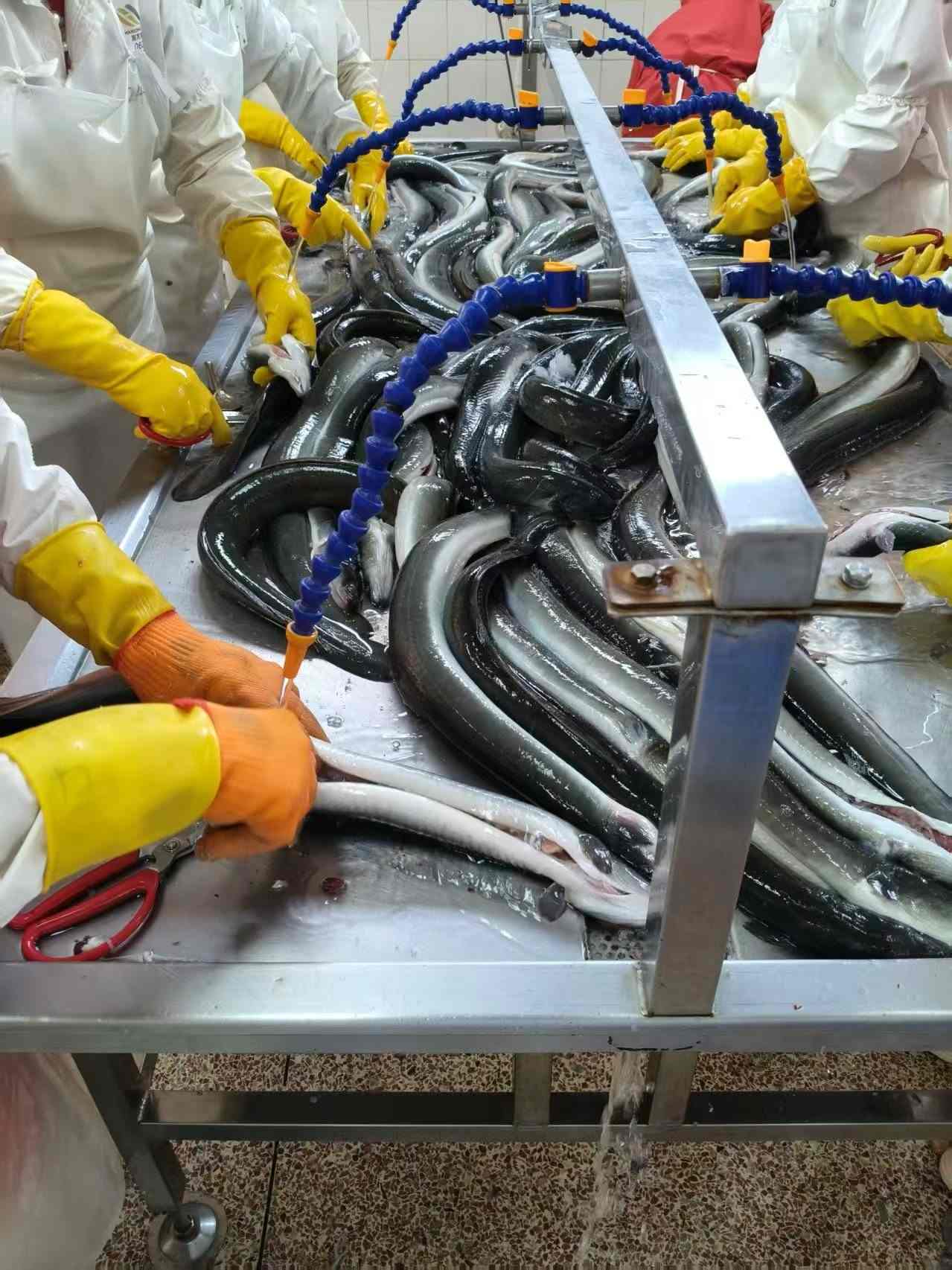
The gulper eel is a biological marvel, but it holds no commercial value for the food industry. The eels that form the basis of popular dishes like unagi kabayaki are freshwater species, primarily from the Anguilla genus. These eels are prized for their rich, firm flesh, high fat content, and flavor profile that is ideal for grilling and saucing.
For B2B buyers—importers, distributors, and large restaurant chains—the distinction is critical. The quality, safety, and consistency of your eel supply depend on sourcing from producers who manage the entire lifecycle of commercial freshwater eels. Unlike the wild, untamable gulper eel, our freshwater eels are raised in controlled environments to ensure they meet stringent export standards.
At Eelpro, we specialize in these high-value freshwater eels. Our operations are built around full-chain traceability, starting from our 20 customs-registered eel farming bases. This control allows us to consistently supply over 5,000 tons of high-quality raw eel annually, ensuring our clients in Japan, the US, and the EU receive a product that is safe, delicious, and free from trade risks associated with veterinary drug residues or microbiological contaminants.
Sourcing Checklist for B2B Eel Importers and Distributors
When evaluating a potential supplier for frozen eel products, focusing on the right quality and safety indicators can protect your business from supply chain disruptions and product recalls. A supplier's ability to provide documentation and transparency is just as important as the product itself. Before placing a large order, use this checklist to verify their capabilities.
- Traceability and Farming Standards: Does the supplier operate or partner with customs-registered farming bases? Full-chain traceability from farm to shipment is essential for food safety. Ask for documentation on their farming registration, process verification, and sampling protocols.
- International Certifications: Are their facilities certified under globally recognized food safety management systems? Look for ISO 22000:2018 and HACCP. For specific markets, HALAL certification may also be required. These are not just logos; they represent a documented, audited commitment to safety.
- Processing and Production Technology: What does their production process involve? Our facility utilizes a patented low-fat roasting process and a precise 4-layer soy-sauce coating technique. This ensures a consistent color, texture, and flavor profile in every batch. Standardized processing reduces culinary labor for your end-users.
- In-House Quality Control Infrastructure: Does the supplier have its own laboratory for testing? An in-house eel lab of Eelpro Co., Ltd allows for rapid, targeted sampling for veterinary drug residues and microbiological indicators. Metal detectors at critical control points are another non-negotiable for preventing physical contamination.
- Production Capacity and Logistics: Can the supplier handle your volume requirements? With an annual capacity of 4,000 tons and a 1,000-ton cold storage facility, we ensure stable supply and maintain product integrity throughout the cold chain. Ask about their standard delivery times and flexibility for large orders.
Eelpro's Commitment to Verifiable Quality and Export Compliance
Understanding the difference between a gulper eel and a commercial freshwater eel highlights the importance of specialization. At Eelpro, our entire operation is dedicated to the science and craft of producing premium frozen roasted eel. Our team of over 160 employees, including 25 dedicated technical and quality-control specialists, oversees every step of the process.
Our commitment to quality is validated by our certifications and registrations, including:
- ISO 22000:2018 Food Safety Management System
- HACCP System Certification
- HALAL Certification
- Export Food Producer Registration Certificate
- SC Food Production License No. SC11135062401122
This framework allows us to confidently export to demanding markets like Japan, Germany, Poland, and the United States, helping our clients avoid import rejections and build a reputation for quality. Whether you need perfectly cut kabayaki eel for a restaurant chain or skin-packaged products for retail, our processes are designed for consistency and safety. This attention to detail extends across our entire frozen seafood portfolio.
By focusing on the right species and the right production standards, we turn a traditional delicacy into a reliable, scalable, and safe food product for global markets.
If your business requires a consistent supply of certified, high-quality frozen eel products with verifiable traceability, contact us to discuss your specifications and receive a detailed quotation.