

How to Read Unagi Freshwater Eel Labels Before You Buy
A glossy sauce pack and a familiar “unagi” name can hide the details that matter most. Before comparing price, cut style, or flavor, buyers need to confirm exactly what they are purchasing. The first question is simple: does the label clearly identify the unagi freshwater eel product, its origin statement, and its farmed status?
For import buyers, distributors, restaurant groups, and menu planners, label review is an early risk-control step. It helps prevent a product approved by purchasing from later being rejected by compliance, customs, a retail customer, or a chef who expected a different eel specification.
Start with a three-part label screen before comparing products
Conclusion: Screen every eel label for species, origin, and production status before reviewing price or sauce coverage. These three points establish product identity. A low-priced item is not comparable if its declared species, source country, or farmed claim differs from the item in your specification.
This approach fits research-stage sourcing, distributor portfolio selection, and restaurant-chain menu planning. It does not replace import documentation review, destination-market labeling rules, or laboratory testing. It is the first filter, not the final approval.
A species declaration should be treated as a traceability checkpoint, not decorative text. Buyers importing into the United States can consult the species declaration guidance and seafood naming resources published by the U.S. Food and Drug Administration when confirming acceptable market names.
| Label checkpoint | What to look for | Why it affects the buying decision | When the label alone is not enough |
|---|---|---|---|
| Species name | A clear common name and, where required by your market or specification, the scientific name. | “Unagi” is a culinary and menu term. It may not provide enough detail for a formal product specification. | When the scientific name is missing, unclear, or does not match the purchase specification. |
| Country-of-origin statement | Wording that identifies the declared country of origin and does not confuse processing location with raw-material origin. | Origin can affect import documentation, customer requirements, and approved-supplier status. | When the label only names the packing or processing country. |
| Farmed-status claim | Terms such as “farmed,” “aquaculture,” or another claim supported by supplier records. | Farmed status may be required by retail programs, menu policy, or sourcing standards. | When a claim appears without farm, batch, or traceability support. |
| Product form | Whether the item is frozen roasted eel, white-roasted eel, kabayaki, slices, cut pieces, or skewers. | Species and origin may match, while labor needs and menu use still differ. | When the buyer needs exact cutting, bone-removal, or packaging details. |
For unagi freshwater eel, the practical rule is to keep these three data points together in your buying file: declared species, declared origin, and declared production status. Do not approve one based on another. A country statement does not prove species, and a farmed claim does not prove origin.
Interpret species names, country-of-origin statements, and farmed-status claims on packaging
Conclusion: Read the label as a set of separate claims. Each claim answers a different question, and each should be checked against the purchase order, product specification, and supplier documents. This method works for retail packs, foodservice cartons, inner bags, and frozen kabayaki portions. It does not apply when packaging is removed before receiving; in that case, carton markings and lot records become even more important.
A unagi freshwater eel label can look straightforward at first glance. The difficulty begins when “unagi,” a country name, and “farmed” are presented close together. Those words may describe different stages of the supply chain.
1. Read the species name as an identity claim
Start with the name used on the primary label or foodservice carton. “Unagi” tells a buyer how the product is positioned for Japanese-style cuisine, but it should not automatically be treated as a full species identification for every procurement program.
- Check the approved product specification: Confirm whether your customer requires a common name only or both common and scientific names.
- Match the label to the RFQ: If the request specifies a particular species declaration, the carton and final label should follow that request.
- Ask for clarification before approval: A vague product name may be acceptable for a menu draft but unsuitable for regulated retail labeling or import filing.
- Keep the evidence: Store a label image, specification sheet, lot reference, and supplier confirmation together.
Common failure reason: Buyers treat “unagi” as if it automatically answers every species question. It does not. The correct response is not to reject every product called unagi; it is to confirm whether the declared identity meets your market and customer requirements.
When reviewing a unagi freshwater eel offer for sushi, rice bowls, or grilled menu applications, request the product specification before building menu claims around the ingredient. This is especially relevant if your customer publishes species, sustainability, or origin information on menus.
2. Separate origin from processing location
A country statement can refer to several commercial facts depending on wording and market rules: where the eel was raised, where it was processed, where it was packed, or where the final food was declared to originate. Buyers should not assume these are identical.
For example, a carton may identify a processing location while the raw eel was supplied from registered farming bases elsewhere in the supply chain. The label needs to be reviewed alongside origin documents and supplier traceability records. This is the safe approach for unagi freshwater eel imports where an origin claim influences customer approval or customs paperwork.
- Acceptable use case: Use a country statement for a preliminary sourcing comparison when it is supported by the supplier’s product documents.
- Do not rely on it alone: Do not use a processing-country statement as proof of farming origin without supporting records.
- Ask one direct question: “Does this origin statement refer to farming, processing, packing, or final product origin?”
- Record the answer in writing: Verbal explanations are not enough for an approval file.
3. Treat “farmed” as a claim requiring traceability support
Farmed status is often relevant to buyers seeking predictable raw-material supply and controlled production records. Yet the word “farmed” should be linked to traceability, not treated as a broad quality promise. Farmed and wild products can each have different sourcing contexts; the label claim only tells you the declared production status.
For a unagi freshwater eel buyer, the best supporting evidence is a traceability path that connects farming-base registration, incoming raw-material verification, production lot information, and shipment records. Ask what information can be provided by lot, and make that requirement part of the procurement specification.
| Claim on pack or carton | Buyer interpretation | Next verification action | Frequent mistake |
|---|---|---|---|
| “Unagi” | A culinary product name, not automatically a full technical species declaration. | Request the product specification and confirm required naming. | Assuming the menu name completes compliance review. |
| Country name | A declared origin-related statement that may need context. | Confirm whether it refers to farming, processing, packing, or final origin. | Equating the processing site with the farming location. |
| “Farmed” or “aquaculture” | A production-status claim. | Request traceability records linked to the lot or supply chain. | Assuming farmed status proves species or country of origin. |
| “Product of” wording | A label declaration that may be governed by the destination market’s rules. | Have your importer or compliance team verify local wording requirements. | Copying packaging language from another export market. |
Use a repeatable label-review procedure for research-stage sourcing
Conclusion: A simple five-step review prevents buyers from spending time on products that cannot meet their technical or documentation needs. It is suitable before requesting samples, quotations, or artwork approval. It does not replace an importer’s legal review for the destination country.
- Collect all label faces. Request photos of the retail pack, inner bag, master carton, ingredient panel, and lot-code area. One front-panel photo is not enough.
- Highlight the three identity claims. Mark the species name, country-of-origin statement, and farmed-status claim. If any item is absent, list it as an open question.
- Compare against your buying specification. Check whether the wording meets your customer’s required declaration and whether the product form matches the intended use.
- Request supporting documents. Ask for the product specification, traceability explanation, and applicable export documents before confirming the supplier shortlist.
- Approve label wording separately from product quality. A good-tasting sample should not automatically approve its package claims. Maintain separate sign-off lines for commercial, quality, and labeling teams.
Cold fact: The most useful label is not always the most detailed-looking one. A pack with many marketing statements can still leave the buyer unable to determine whether the country named is the farming source or the processing site. Clear wording beats decorative copy.
This process is particularly useful for unagi freshwater eel products sold in multiple formats. A retail portion for a frozen aisle, a foodservice carton for restaurant kitchens, and a skin-packed gift presentation may need different label layouts while relying on the same verified product records.
Match the label review to the product format and menu use
Conclusion: Identity verification should come before deciding whether to buy whole fillets, cut pieces, sushi slices, or skewers. Once the label claims are acceptable, choose a format based on kitchen labor, menu presentation, and packaging needs. This does not mean every cut is suitable for every menu.
Frozen kabayaki is often selected when a buyer wants a ready-to-heat grilled eel format with sauce. White-roasted skewers may fit buyers who want greater control over final seasoning. Cut pieces, strips, chunks, diced eel, three-section cuts, and sushi slices may reduce preparation work, but they should be specified clearly before quotation.
At Eelpro, our frozen roasted eel line uses a four-layer soy-sauce coating process with temperature-controlled steps. The company has standards for white-roasted color and first through fourth soy-sauce coating color. Buyers evaluating finished kabayaki can also review our unagi kabayaki product information and compare sauce needs with our eel sauce range.
- For restaurant chains: Prioritize consistent portion format, label clarity, and documentation that supports receiving controls. Boneless or deboned formats can reduce back-of-house handling, but confirm the exact cut specification first.
- For import distributors: Prioritize origin wording, lot traceability, destination-market label review, and stable cold-chain arrangements.
- For retail buyers: Prioritize consumer-readable wording, ingredient presentation, country claims, and the distinction between product name and species declaration.
- For menu planners: Confirm the product identity before publishing menu descriptions. Then select a cut and sauce profile that suits the dish.
A menu team testing rice bowls may prefer portioned kabayaki, while a sushi counter may request standardized slices. For recipe and serving concepts after the sourcing decision, see our eel rice bowl toppings guide.
Ask suppliers for proof that supports the packaging claim
Conclusion: Choose suppliers that can connect package statements with documented controls from raw material through shipment. This is most relevant when importing, supplying chain customers, or selling under a private-label program. It may be less demanding for a small local trial purchase, but records still reduce avoidable disputes.
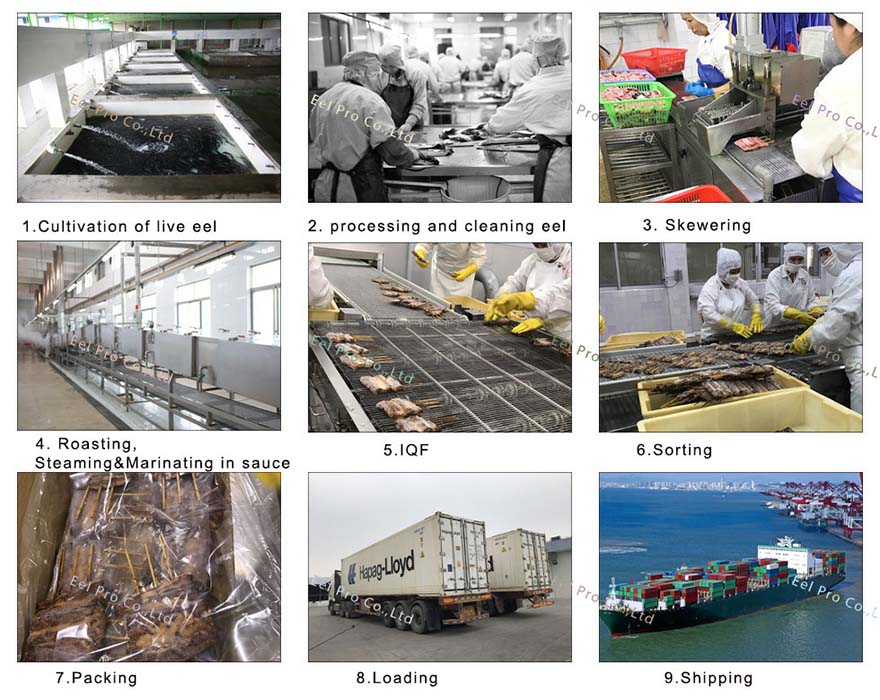
Eelpro supports traceability through approximately 20 customs-registered eel farming bases covering more than 2,150 mu. Full-chain controls extend from farming registration and process verification to targeted sampling and traceability tracking. Our facility also has an in-house laboratory and metal detectors at critical control points. Buyers can review more about our unagi eeel farm for eelpro co., ltd and eel lab of eelpro co., ltd controls.
For unagi freshwater eel export programs, Eelpro holds ISO 22000:2018, HACCP, and HALAL certification, along with export food producer registration and an SC Food Production License covering quick-frozen prepared foods. Products are produced for inspection requirements applicable to Japan, the United States, and the European Union, including veterinary drug residue and microbiological indicators.
The company operates two modern production lines with an annual finished-goods capacity of 4,000 tons and a 1,000-ton cold storage facility. Regular orders are generally delivered in approximately 30 days from order confirmation to shipment, subject to product specification and quantity. This is a planning reference, not a fixed shipment promise.
Before you compare offers for unagi freshwater eel, send us your target market, required label wording, product format, and expected order quantity for practical selection advice or a quotation.