Sourcing Canned Eel for Asian Grocery Shelves Comes With Hidden Import Risks
Most buyers regret their canned eel order after it clears customs, not before. A cheap price per case looks fine on paper — until the species on the label doesn't match what's inside, the shelf-life stamp is shorter than promised, or the export paperwork is missing a signature customs actually needs. By then the container is already at the port, and the distributor is the one holding the problem.
This guide walks through what to check before you send an RFQ for canned eel, why each check matters, and where frozen roasted eel (unagi kabayaki) fits as a shelf alternative that some grocery buyers now stock alongside canned formats.
Why Canned Eel Orders Go Wrong Before the Container Even Ships
Most sourcing failures trace back to the same handful of shortcuts. Buyers skip a step to save a week on lead time, and the cost shows up later — in a rejected shipment, a customer complaint, or a recall.
- No species verification. "Eel" on a label can mean several different species with different price points. Without lab confirmation, you can't prove what's in the can if a regulator asks.
- Trusting a factory audit report that's over a year old. Facilities change staff, suppliers, and processes. An old certificate tells you nothing about this month's production run.
- Ignoring the veterinary drug residue testing standard. Japan, the US, and the EU each apply different thresholds. A batch that clears one market can fail another.
- Assuming shelf life on the box matches shelf life at retail. Transit time, customs clearance, and warehouse dwell time all eat into that number before the product ever reaches a shelf.
- Skipping the traceability question. If a supplier can't tell you which farming base a batch came from, you have no way to isolate a problem if one surfaces later.
The Supplier-Vetting Checklist for Canned Eel: Species, Processing, Can Size, Labeling, Shelf Life, and Export Documentation
Before you commit to a canned eel supplier, run through these six checks. Each one protects against a specific, predictable failure — not a hypothetical one.
| Check Item | What to Verify | Risk If Skipped |
|---|---|---|
| Species identification | Ask for a lab certificate confirming the eel species (freshwater eel vs. substitutes). Request a copy per production lot, not per contract. | Mislabeling triggers customs holds, retailer delisting, or a public recall in strict markets like the EU. |
| Processing style | Confirm whether the product is kabayaki-style (roasted, soy-glazed), white-roasted (unseasoned), or plain cooked. Ask for the roasting and sauce-coating process description. | A mismatched processing style disappoints retail buyers expecting a specific flavor profile, and returns eat your margin. |
| Can size and fill weight | Check drained weight, not just gross can weight. Ask for a sample can to weigh yourself before the full order. | Underfilled cans generate consumer complaints and violate net-weight labeling rules in most import markets. |
| Labeling compliance | Confirm allergen declarations, country-of-origin marking, and nutrition panel format match the destination market's rules. | Non-compliant labels are one of the most common reasons for held or rejected shipments at port. |
| Shelf life | Get the actual shelf-life test data, not just a marketing claim. Subtract your realistic transit and warehouse time from that number. | A product that looks fine on paper may have only weeks of usable shelf life left once it reaches the store. |
| Export documentation | Confirm the supplier holds a valid export food producer registration, health certificate template, and — where relevant — HALAL certification for your target buyers. | Missing documentation is the single most common cause of customs delay, and delays mean demurrage fees and stockouts. |
If a supplier hesitates on any of these six items, treat that as your answer. A supplier confident in its own process will hand over documentation without pushback.
Canned Eel vs. Frozen Roasted Eel: Which Fits Your Shelf Better
Not every grocery buyer needs canned format. Frozen unagi kabayaki has become a common companion product on the same shelf, especially where a store has freezer space and wants a fresher-tasting option. Here's how the two compare on the factors that actually affect a buying decision.
| Factor | Canned Eel | Frozen Roasted Eel (Kabayaki) |
|---|---|---|
| Shelf life | Long, ambient storage | Long, but requires continuous cold chain |
| Texture and taste | Softer, can pick up a slight metallic note over long storage | Closer to fresh-roasted texture; retains the 4-layer soy-sauce glaze profile |
| Retail placement | Dry grocery aisle, no freezer needed | Freezer case, needs cold display |
| Prep at point of sale | Ready to eat, no reheating step | Ready-to-heat; reduces back-of-house labor for foodservice buyers |
| Typical buyer | Value-focused retail, long-tail distribution | Restaurant chains, premium retail, foodservice |
A grocery distributor stocking both formats often finds canned eel moves faster on price-sensitive shelves, while unagi kabayaki sells at a premium where customers expect a restaurant-style eating experience. Neither format replaces the other — they serve different price points on the same category.
A Step-by-Step Procedure to Qualify a New Eel Supplier Before Sending an RFQ
- Request the certification package first. Ask for ISO 22000, HACCP, HALAL (if relevant), and export food producer registration documents before discussing price.
- Order a sample can or sample pack, not a photo. Weigh it, taste it, and check the drained weight against the label claim.
- Ask for the veterinary drug residue and microbiological test report tied to the specific batch you're sampling, not a generic factory report.
- Confirm traceability back to the farming base. A supplier with registered farming bases and a lab that runs targeted sampling can usually produce this in a day or two.
- Confirm production lead time in writing. A regular order typically runs about 30 days from confirmation to shipment — get this in the contract, not a verbal estimate.
- Check cold storage capacity if you're ordering frozen product. A supplier without dedicated cold storage can't guarantee consistent temperature history for your shipment.
A Worked Example: Sourcing for a German Import Distributor
Consider a distributor supplying Asian grocery chains across Germany. They currently stock canned eel from two suppliers but want to add a frozen kabayaki line for foodservice customers who ask for restaurant-quality product. The checklist above applies the same way: confirm species and processing style, request veterinary residue test data that satisfies EU thresholds, and verify the supplier's cold storage can hold a full container at consistent temperature before departure. This is the same due-diligence pattern used across import relationships in Germany, Poland, and the wider EU market — species proof, residue testing, and documented cold-chain handling come first, price negotiation comes second.
What Backs a Reliable Frozen Eel Supply Chain
For buyers evaluating a frozen alternative to canned eel, the supply chain details matter more than the marketing copy. A supplier running two production lines with a combined 4,000-ton annual capacity, supported by roughly 20 customs-registered farming bases covering over 2,150 mu, can usually document full-chain traceability from farm registration through shipment. A 1,000-ton cold storage facility keeps temperature history consistent between processing and loading — a detail worth asking about directly, since inconsistent cold storage is one of the quieter causes of quality complaints after arrival.
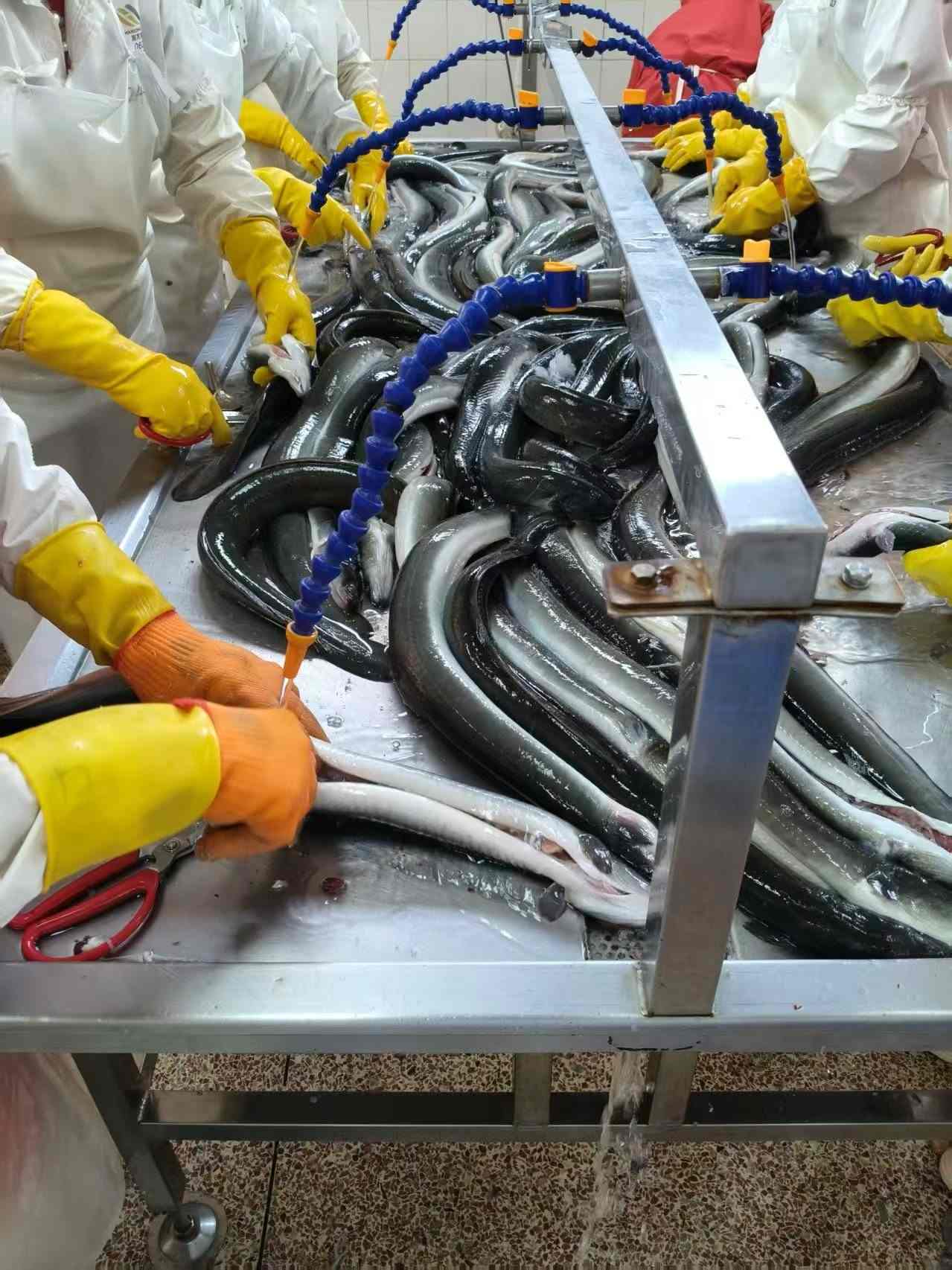
Quality control staffing matters too. A facility with 25 dedicated quality-control specialists among its workforce, an in-house laboratory, and metal detectors at critical control points is running the kind of checks that catch problems before they leave the plant — not after a customer complains. Patented low-fat roasting and deodorizing technology, combined with a 4-layer soy-sauce coating process, is what produces the "white-roasted" and progressive coating-color standards that foodservice buyers look for in kabayaki-style product.
Common Label and Documentation Mistakes Worth Flagging Early
- Vague species wording like "eel product" instead of the actual species name — ask for the scientific name in writing.
- Net weight printed but not drained weight — for canned product this is the number that actually matters to the end consumer.
- Health certificates that don't name the destination country — a generic certificate rarely satisfies a specific market's customs office.
- No batch-level residue testing — a factory-wide report from six months ago doesn't cover the batch sitting in your container.
Buyers preparing to bring frozen product into the same category often review the kabayaki sauce profile and pairing options before finalizing a specification, since sauce coating affects both shelf appeal and repeat purchase. It's also worth checking a frozen eel supplier's HACCP compliance under the FDA import framework if the US market is part of your distribution plan.
Request Samples Before You Commit
Whether you're finalizing a canned eel order or comparing it against a frozen kabayaki line, the same rule applies: verify species, processing, labeling, shelf life, and export documentation before the container ships — not after. If you're weighing frozen roasted eel or eel sauce as part of your shelf mix, request a spec sheet and a sample pack first, and compare it directly against your current canned line before placing the next RFQ.