

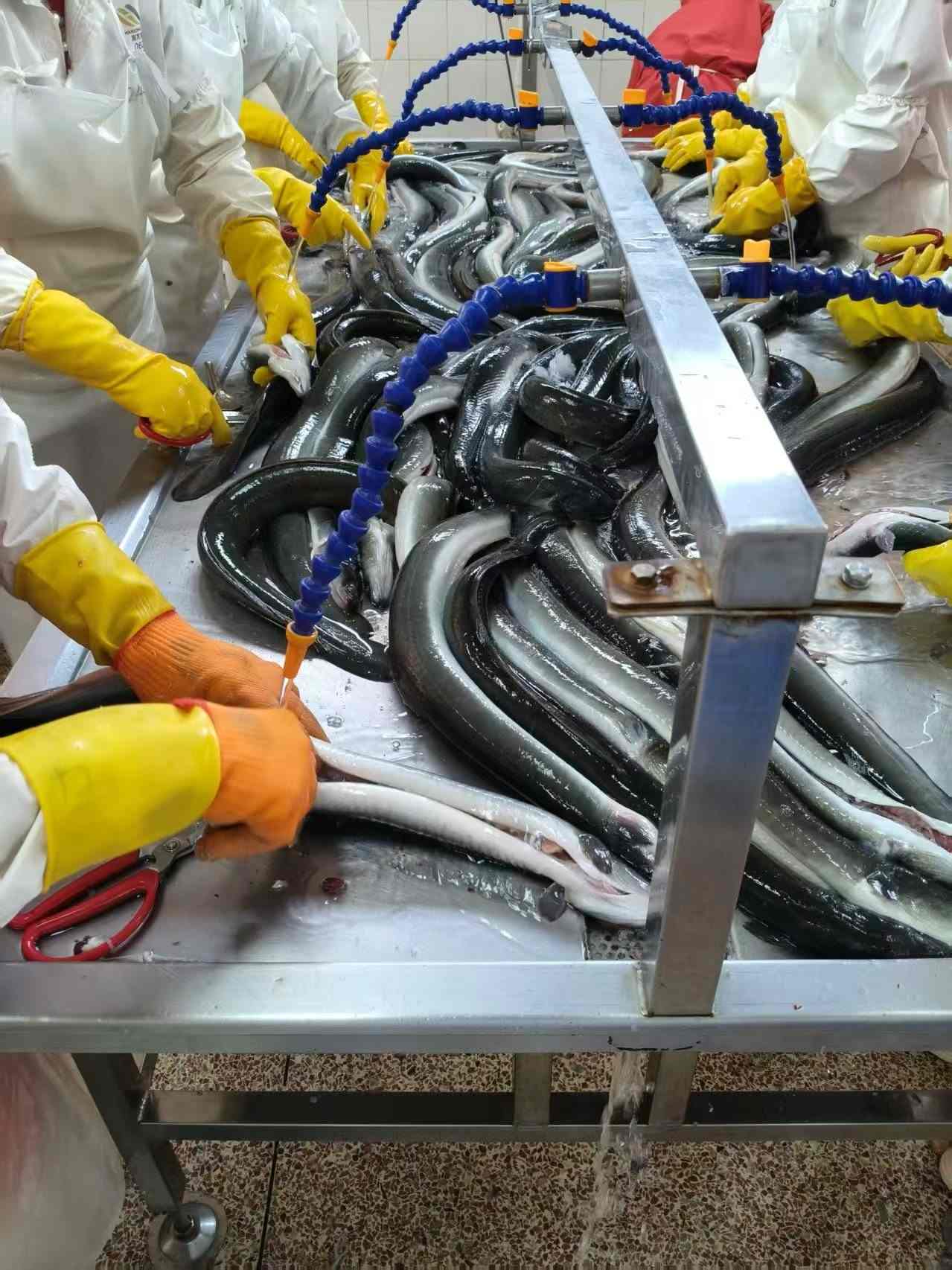
How to Spot Eel Bones in Fillets Before Service
One stray bone in a plate of unagi can end a guest's meal. Most of the time it is not a vertebra. It is a fine, translucent sliver that survived grilling. This guide shows where eel bones remain in processed fillets, and how your team can find them before the plate leaves the pass.

What Bones Can Remain in a Processed Eel Fillet?
Short answer: three types matter in a kitchen. Vertebrae are the large central bones. Rib bones sit along the belly side. Pin bones are the fine intermuscular bones running through the flesh.
Vertebrae and ribs are easy to see and usually handled at the processing stage. Pin bones are the real service risk. They are thin, pale and the same colour as cooked flesh. After grilling and glazing they almost disappear.
Two points frame everything below:
- "Deboned" describes a process, not a guarantee. It tells you the main skeleton was removed. It does not say how many fine bones remain or how large they are.
- Your own check depends on the cut. A whole fillet, a 3-section piece and a diced portion each hide bones differently.
Where Vertebrae, Rib Bones and Fine Pin Bones Appear in Different Eel Cuts
The table below describes general patterns. Actual results depend on each supplier's deboning method and written specification, so confirm them before you set a prep routine.
| Cut / format | Vertebrae | Rib bones | Fine pin bones | Best way to check |
|---|---|---|---|---|
| Split kabayaki fillet (backbone removed) | Normally absent | Possible along the belly edge | Embedded in thicker flesh | Fingertip sweep, belly edge first |
| 3-section cut pieces | Absent if deboned; visible as a central ring if bone-in | Visible on belly-side cut faces | Tiny white dots on cross-cut faces | Inspect every cut face under light |
| Strip or chunk cuts | Depends on the base fillet | Fragments may sit at the edges | Can be buried inside chunks | Break a sample piece open |
| Shredded or diced | Rare | Small fragments may be mixed in | Dispersed, hard to see | Spread on a tray, tap-sort by touch |
| Sushi slices | Absent | Rare | Felt on the bite, visible when thin | Hold slices to a light source |
How processing stage changes what you see
- Raw, split eel: bones contrast with the flesh. This is the easiest point to find them, and it happens at the factory.
- After roasting: bones darken slightly and soften at the thin end. A soft bone is still a bone.
- After sauce coating: glaze hides fine bones. Each soy-sauce layer makes visual inspection less reliable.
- After freezing and thawing: flesh may separate a little, which can expose a pin bone near the surface. Surface moisture can also make touch-checks harder.
A Five-Step Check Before Service
This works for frozen or pre-grilled fillets. It takes about a minute per tray once the team has done it a few times.
- Thaw as the supplier instructs. Do not rush it. Partly frozen flesh feels firm everywhere and hides bones.
- Pat the surface dry. Excess sauce and moisture make fingers slide over fine bones.
- Look first at the belly edge. Rib remnants gather there. A bright light held at a low angle makes pale slivers cast a tiny shadow.
- Run a fingertip against the grain, tail to head. Pin bones catch as a slight prick or ridge. Going with the grain lets them lie flat.
- Pull and set aside any suspect piece. Do not tweezer in front of guests. Route the piece to a back-of-house use such as a chopped or blended preparation.
Limit: this check reduces risk. It does not remove it. Fine bones inside thick sections or diced mixes can pass a visual check, so the supplier's deboning standard still carries most of the weight.
Common Misunderstandings About Boneless Eel
- "Boneless means bone-free." It does not. Confirm what the spec says about pin bones and whether any tolerance is stated.
- "The metal detector would catch it." Metal detectors find metal fragments, not bones. They guard against a different hazard. Our plant runs them at critical control points, but they are not a bone check.
- "Grilling softens everything." It softens thin ends only. A bone that bends under the knife can still catch in a throat.
- "Sauce means we can skip the check." Glaze makes inspection harder, so touch-checking matters more on a coated fillet.
- "Diced portions are safer." Cutting small does not remove bones. It scatters them into a form where you can no longer see them.
Cold fact: some chefs deliberately leave fine bones in thin, crisp-grilled preparations. That is a deliberate technique with its own warning to diners. A frozen fillet that arrives with unexpected pin bones is a different matter.
How Cut, Coating and Handling Interact
No single factor decides how many bones reach the plate. The cut format sets where bones can hide. Processing sets how many are left. Your handling decides how many you can find.
A thin split fillet is easiest to inspect but thickest at the shoulder, where pin bones concentrate. A small dice looks tidy but is the hardest to verify. A heavily glazed fillet looks appetising and hides the most.
So the cut should follow the menu. Slice-forward dishes such as sushi toppings suit fillets you can inspect piece by piece. Mixed dishes such as rice bowls with shredded eel need a stricter supplier standard, because staff can't check each strand.
For handling methods beyond inspection, see this how to cook eel: cleaning guide.

What a Buyer Can Ask the Supplier to Confirm
Kitchen checks work best when the supplier's own controls are clear. Eelpro's unagi kabayaki manufacturer page outlines the production side. Our facility is ISO 22000:2018 and HACCP certified, with 25 technical and quality-control staff and an in-house eel lab of Eelpro Co., Ltd. We cut to custom specifications, including strips, dice, chunks, 3-section pieces and sushi slices, and we supply boneless and deboned eel to reduce back-of-house trimming.
Before you order, ask for:
- The deboning method for each cut, and whether pin bones are addressed or only the main skeleton.
- The written bone specification, including any stated tolerance, rather than only a "boneless" label.
- The sampling and inspection steps applied before packing.
- Whether your target market's standards apply. Our products are made to meet Japan, US and EU food inspection requirements on residues and microbiology, which is separate from bone content.
- A sample from the exact cut you plan to serve, tested on your own line.
A Practical Scenario: Auditing a New Fillet Batch
Here is an illustrative case, not a customer report. A kitchen receives a new carton of frozen unagi kabayaki product and plans an eel-rice menu.
- The chef thaws one tray as the supplier specifies and dries each fillet.
- Two staff check belly edges and shoulders by light and touch.
- They log each find by location: belly edge, shoulder or tail.
- If finds cluster in one area, they trim that zone on every fillet. If finds are scattered, they go back to the supplier with the log and the batch code.
This turns a vague worry into a record the supplier can act on. It is also how long-term foodservice supply works in practice. We supply kabayaki eel to Japanese restaurant chains, and specification feedback of this kind is what keeps cuts consistent from one shipment to the next.
If your menu depends on a particular cut, send us the dish and the portion format. We can discuss the bone specification and send a sample for your own pre-service check through the unagi kabayaki eel range.