

What Is Eel in Japanese? A Buyer's Script Guide
You're staring at a Japanese menu or a supplier invoice, and the word for eel looks different every time. Sometimes it's hiragana. Sometimes it's katakana. Sometimes it's a single kanji character that looks nothing like fish at all. So what is eel in Japanese, really — and why does it change form depending on where you see it? The short answer: eel is うなぎ (unagi) in native reading, written across three different scripts depending on context, formality, and whether the word appears on a restaurant menu or a customs document.
This matters more than it sounds. If you're a restaurant buyer, an importer, or just someone trying to order the right dish, misreading the script can mean confusing freshwater eel with conger eel (anago) or with unrelated seafood entirely. Let's break down exactly when each version shows up and what it signals.
Script-Focused Breakdown: うなぎ, ウナギ, and 鰻 — Reading and Usage Context
Japanese uses three writing systems, and eel gets written in all three depending on the setting. Getting this wrong on a label or PO isn't just a language slip — it can cause mismatched specs between what you ordered and what a supplier ships.
| Script | Reading | Where You'll See It | What It Signals |
|---|---|---|---|
| 鰻 (kanji) | unagi | Formal menus, product packaging, trade documents, restaurant signage (老舗 unagi shops) | Traditional, often higher-end framing — used when the brand wants to signal heritage or craftsmanship |
| うなぎ (hiragana) | unagi | Casual menus, recipe blogs, home cooking contexts, children's materials | Everyday, approachable tone — most common in spoken Japanese and softer branding |
| ウナギ (katakana) | unagi | Biological/scientific texts, seafood trade catalogs, ingredient lists, some export labeling | Technical or species-specific framing — often used to distinguish eel as a category from a dish name |
Here's the practical mistake buyers make: assuming any of these three automatically means "freshwater eel prepared kabayaki-style." They don't. All three simply mean "eel" — the cooking method (kabayaki, shirayaki, or kanro-ni) is usually a separate word attached afterward, like うなぎの蒲焼き (unagi no kabayaki), meaning "eel, kabayaki-style." If a supplier's spec sheet only says 鰻 with no cooking method noted, ask — don't assume it's ready-to-heat kabayaki. This single clarification step prevents a surprising number of order mismatches at the container level.
Why the Kanji Character 鰻 Looks the Way It Does
The kanji 鰻 combines the "fish" radical (魚) with a phonetic component, a common pattern in Japanese characters for aquatic species. It's worth linking this to the broader system of kanji characters, since many seafood names follow the same fish-radical logic — useful if you're trying to read other ingredient labels on the same shipment.
One detail language learners often miss: 鰻 is read differently depending on compound context. Alone, it's unagi. In some regional dishes or older texts, you'll see it paired with other kanji for related species. If a label uses 鰻 next to unfamiliar kanji, don't assume it's standard freshwater eel — confirm the species name in English or Latin binomial before finalizing an order.
Common Mistakes When Reading Eel Terms on Labels or Menus
- Confusing unagi with anago. Anago (穴子) is saltwater conger eel — different texture, different fat content, different price point. They are not interchangeable in sourcing specs.
- Assuming katakana means "imported" or "lower grade." Katakana ウナギ is often just a technical or biological naming convention, not a quality signal.
- Skipping the cooking-method word. 鰻 alone doesn't tell you if it's grilled, seasoned, or raw. Always check for 蒲焼き (kabayaki), 白焼き (shirayaki/white-roasted), or 甘露煮 (kanro-ni, sweet-simmered).
- Treating all sauce references the same. たれ (tare) refers to the glaze/sauce, not the eel itself — so うなぎのたれ means "eel sauce," a separate product line from the fish.
How This Applies to Sourcing Frozen Unagi Kabayaki and Eel Sauce
For B2B buyers importing unagi kabayaki, script literacy isn't academic — it affects how you verify supplier documentation. A few concrete checkpoints:
- Check the product name field on the spec sheet. Look for 鰻蒲焼き or うなぎ蒲焼き — both mean roasted eel with sauce coating. If it just says 鰻 or ウナギ with no 蒲焼き, ask whether it's white-roasted (no sauce) instead.
- Verify the sauce is listed separately if you're buying tare. Eel sauce, or unagi tare, should appear as its own line item — うなぎのたれ or タレ — distinct from the fish product code.
- Cross-check species naming against your import paperwork. Freshwater eel (Anguilla species) should match customs declarations; conger eel or other species won't clear under the same tariff code in most markets.
- Ask for the roasting or coating standard. Suppliers using a layered soy-sauce coating process (commonly 4 passes with temperature control) will usually specify this on request — useful for comparing "1st-coat" versus "4th-coat" color and flavor depth.
Buyer's Decision Checklist Before Placing an Order
- Does the product name include 蒲焼き, 白焼き, or another cooking-method term — or just the bare word for eel?
- Is the sauce (tare) sold separately or already applied to the fish?
- Does the species listed match Anguilla (freshwater eel), not conger or other substitutes?
- Does the supplier's export documentation reference recognized food safety certifications (ISO 22000, HACCP, HALAL where relevant)?
- Is cold-chain handling confirmed from processing through shipment — not just at the factory gate?
Suppliers with certified systems — ISO 22000:2018, HACCP, and HALAL certification, alongside an Export Food Producer Registration Certificate — tend to label products with clearer script and cooking-method distinctions, since export compliance requires precise product naming for customs in Japan, the US, and the EU. This same clarity is why buyers checking labels can catch a mismatch before a shipment leaves port rather than after it arrives.
A Quick Scenario: Reading a Supplier Catalog Entry
Say a catalog lists: "鰻蒲焼き(4層タレ仕込み)冷凍." Breaking it down — 鰻 (eel) + 蒲焼き (kabayaki-style, roasted with sauce) + 4層タレ仕込み (four-layer sauce preparation) + 冷凍 (frozen). That's a fully roasted, four-coat sauce-layered frozen kabayaki product — matching the kind of layered soy-sauce roasting process used in export-grade unagi production. If instead you see "鰻(生)冷凍" — eel (raw) frozen — that's unprepared frozen eel, not ready-to-heat kabayaki, and will need in-house roasting before service.
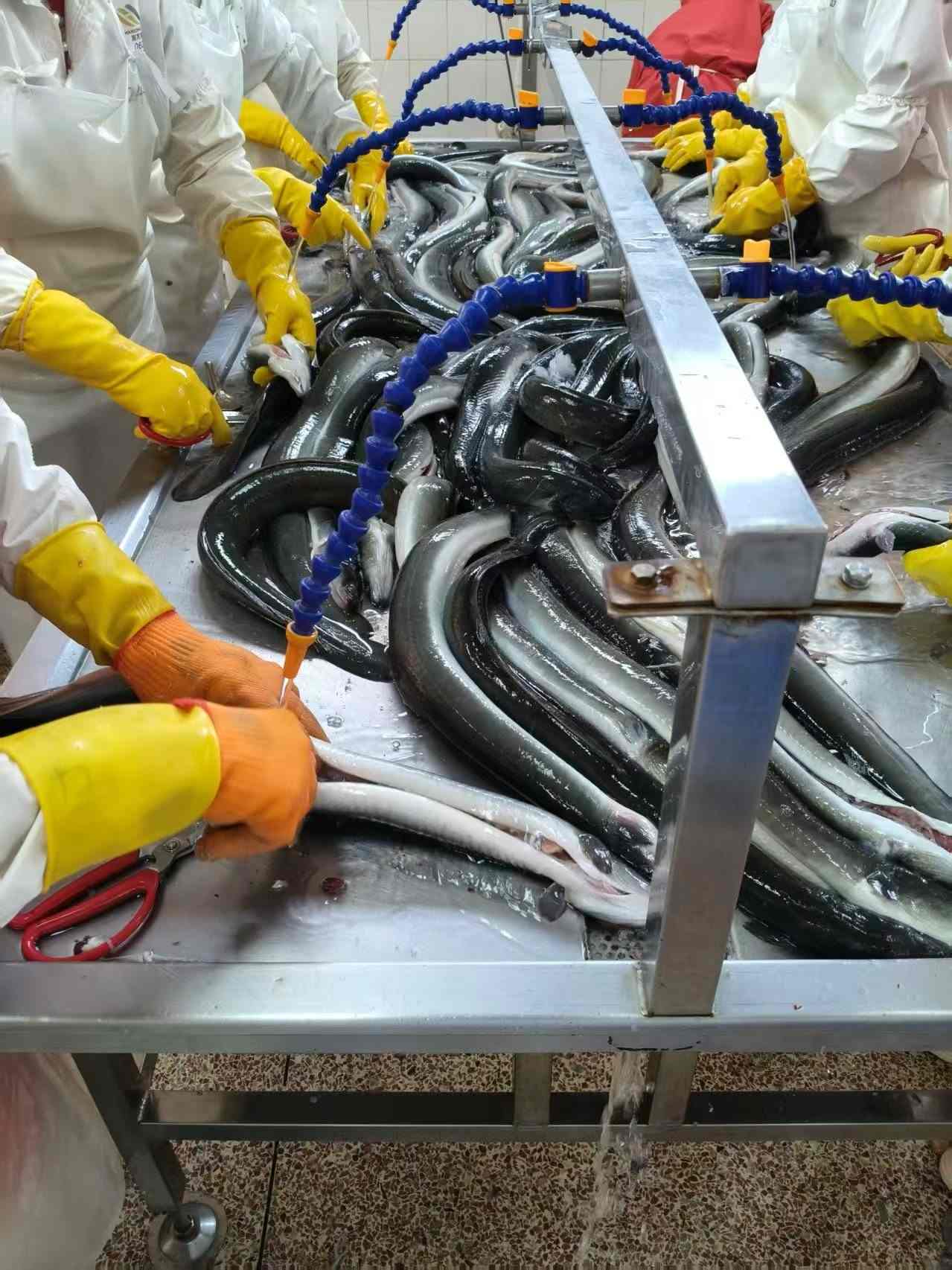
Understanding these small script differences is what separates a smooth import order from a costly mismatch. For deeper flavor context once you've confirmed the right product, our article on kabayaki sauce covers how the coating process affects taste, and our guide to cleaning, skinning, and deboning eel is useful if you're receiving raw frozen stock rather than pre-roasted kabayaki.
Reading Eel Sauce Labels Separately from the Fish
Because unagi tare is sold both bundled with kabayaki and as a standalone condiment, label literacy matters twice as much here. Look for うなぎのたれ or 鰻だれ on standalone bottles — this confirms it's the traditional soy-mirin-sugar glaze rather than a generic teriyaki substitute. If you're sourcing this separately from your fish supplier, our eel sauce page outlines specification options buyers commonly request for foodservice use.
If you're preparing a purchase order and want help confirming product naming, cooking-method specs, or sauce coating standards before you commit, reach out for a spec sheet or sample — it's a quick way to make sure the script on paper matches exactly what lands in your cold storage.