

What Is Unagi Sauce Made Of? A Look at the Four Ingredients Behind That Glossy Glaze
A sushi guest asks a simple question: "does this sauce actually have eel in it?" The server hesitates. This happens more often than you'd think, and it's a fair question to get wrong if nobody on staff has actually read the label. So what is unagi sauce made of? The short answer: soy sauce, mirin, sugar, and sake — reduced together into a thick, glossy glaze. No eel meat, no fish extract, no shortcuts most buyers assume are in there.
I'm Nancy Chen, and I've spent over a decade auditing food safety systems for eel processors exporting to Japan, the US, and the EU. Ingredient sourcing questions like this one come up constantly during buyer onboarding calls — so let's break it down properly.
The Four Core Ingredients — and What Each One Actually Does
Unagi tare (the Japanese term for eel sauce) is not a random blend. Each ingredient has a specific job, and skipping or mis-ratioing any one of them changes the color, shelf stability, or how the glaze behaves when reheated on frozen kabayaki. Here's the function of each, and what goes wrong if the ratio is off.
| Ingredient | Function in the Glaze | What Happens If the Ratio Is Wrong |
|---|---|---|
| Soy sauce | Provides salt, umami depth, and the dark reddish-brown base color | Too much makes the glaze taste sharp and salty; too little leaves it pale and flat, with no roasted color when applied to the eel |
| Mirin | Adds a mild, rounded sweetness and helps the sauce turn glossy as sugars caramelize under heat | Substituting with cheap rice wine or skipping it produces a dull, non-reflective coating that doesn't match the expected "kabayaki shine" |
| Sugar | Drives caramelization (a form of the Maillard reaction when combined with soy sauce proteins) and thickens the glaze as it reduces | Too little sugar means the sauce stays thin and slides off the eel before it sets; too much burns quickly under a broiler, leaving bitter dark spots |
| Sake | Adds savory depth, cuts the sweetness, and helps the sauce reduce evenly without separating | Skipping sake makes the glaze taste one-dimensionally sweet and can cause the sugar to crystallize unevenly during storage |
These four ingredients, simmered and reduced together, are what create the sauce most people call "eel sauce." No eel sauce recipe used commercially actually contains eel as an ingredient — and that surprises a lot of first-time buyers.
Why Most Unagi Sauce Contains No Eel At All
Here's the part that trips up new menu planners: the name "eel sauce" describes what it's served with, not what it's made from. Historically, some home cooks in Japan did simmer eel bones or grilling drippings into the glaze for extra depth — but that's not how commercial unagi tare is produced today, and it's not what you'll find in any standard export-grade product.
Modern kabayaki sauce is a reduction sauce, full stop. The umami richness people associate with "eel flavor" actually comes from two places: the soy sauce's natural fermentation-derived amino acids, and the caramelized layer that forms when the glaze is brushed onto the eel in stages and roasted. That layering — not eel content — is what gives kabayaki its signature taste.
This is worth clarifying to customers directly, especially in markets like the US and Australia where allergen labeling questions come up often. Telling a guest "the sauce itself is soy-based and does not contain eel" is accurate and avoids confusion at the table.
The 4-Layer Soy-Sauce Coating Process — Why It Matters for Buyers
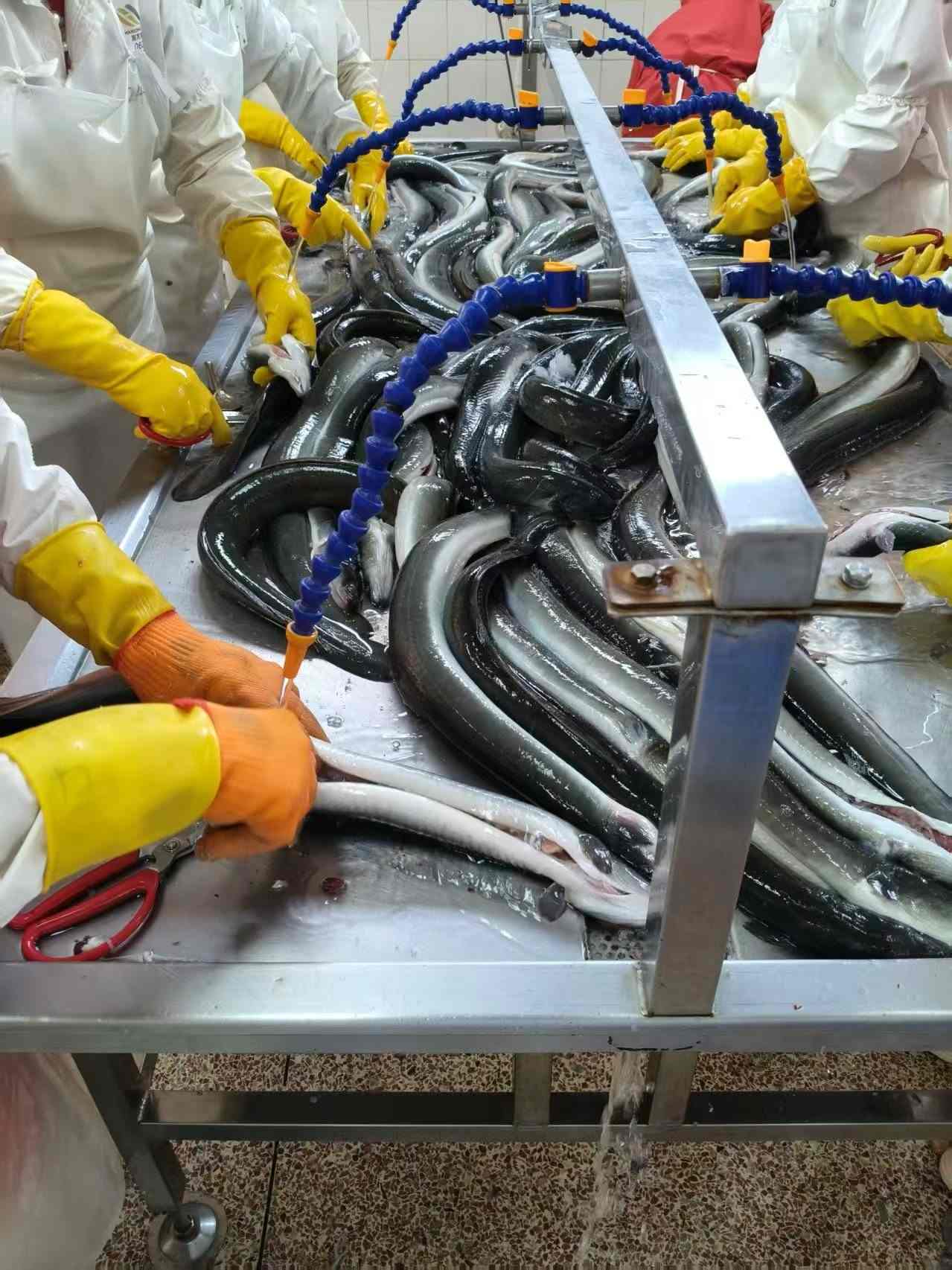
Not all kabayaki glazing is done the same way, and this is where quality differences between suppliers actually show up. A properly roasted unagi kabayaki goes through four precise layers of soy-sauce coating, each applied at a controlled temperature step. This is the process we use across our production lines, built around documented "white-roasted color" and "1st-through-4th soy-sauce coating color" standards.
Why does this matter to a buyer who never sees the production floor? Because inconsistent layering is the single biggest cause of color and flavor variation between batches. If a supplier applies the glaze in one or two passes instead of four, you'll see:
- Uneven color — some pieces look pale, others nearly black at the edges
- Glaze that doesn't hold up during a second reheat cycle in a restaurant kitchen
- Flavor that tastes "flat" compared to a properly layered product, even using the same base ingredients
If you're standardizing a menu across multiple locations, batch-to-batch consistency in glaze layering matters more than the recipe itself. You can read more on how this affects finished flavor in our breakdown on why kabayaki sauce quality varies so much between suppliers.
Common Mistakes When Sourcing or Using Unagi Sauce
After years of fielding buyer questions, the same handful of mistakes come up again and again:
- Assuming eel sauce and teriyaki sauce are interchangeable. Teriyaki typically skips mirin's specific sweetness profile and uses different soy-to-sugar ratios — swapping them 1:1 changes both color and texture on the finished dish.
- Not checking viscosity before ordering in bulk. A sauce too thin won't coat frozen kabayaki evenly during reheating; too thick and it won't distribute over rice bowls properly.
- Storing sauce or glazed product outside proper cold-chain conditions. Temperature abuse during transit affects both texture and microbiological safety — this is exactly why cold storage capacity matters when vetting a supplier.
- Assuming "eel sauce" is a controlled or standardized term. It isn't. Recipes vary widely between manufacturers, so tasting a sample before committing to volume is not optional — it's basic due diligence.
- Overlooking traceability documentation. For import compliance in the US, EU, and Japan, buyers need to confirm the raw eel — not just the sauce — meets veterinary drug residue and microbiological standards.
A Buyer's Checklist for Choosing an Unagi Sauce or Kabayaki Supplier
Whether you're a sushi chain sourcing pre-glazed kabayaki or a distributor buying sauce separately, run through this before signing a contract:
- Does the supplier hold recognized certifications — ISO 22000, HACCP, HALAL — relevant to your import market?
- Can they document a consistent glazing process (layer count, temperature steps) rather than a one-pass coating?
- Is raw material traceable back to registered farming bases, from farm through processing to shipment?
- Does their cold storage capacity match your order volume without risking temperature gaps during peak season?
- Have they tested finished product against your destination country's residue and microbiological standards, not just domestic ones?
As a reference point: our own supply chain runs on 19 self-operated and cooperative certified farming bases producing over 5,000 tons of raw eel annually, plus roughly 20 customs-registered farms totaling 2,150 mu with full traceability from farming registration through shipment. That kind of documentation is what customs and import inspectors actually ask to see — not just a certificate on a wall.
A Quick Worked Example
Say a US foodservice distributor is standardizing kabayaki across 40 restaurant locations. The pain point isn't flavor — it's consistency. One batch tastes noticeably sweeter than the last, and the glaze color varies from unit to unit. The root cause, in most cases we've reviewed, traces back to inconsistent soy-sauce layering at the source, not the sauce recipe itself. Switching to a supplier with a documented 4-layer coating standard and in-house lab testing at critical control points — including metal detection — usually resolves the variation within one or two reorder cycles.
Storage, Shelf Life, and Handling Notes
Unagi sauce and pre-glazed frozen kabayaki behave differently in storage:
- Bottled unagi tare is shelf-stable unopened due to its salt and sugar content, but once opened should be refrigerated and used within a reasonable window to avoid crystallization.
- Pre-glazed frozen kabayaki needs continuous cold-chain handling. Temperature fluctuation during transit or storage is one of the most common causes of texture complaints from foodservice buyers — this is why a dedicated cold storage facility, rather than shared third-party warehousing, tends to produce more consistent results.
If you're building out a menu and want ideas beyond the standard nigiri application, our recipe library covers everything from unagi ramen to donburi variations, which can help justify carrying both the sauce and the kabayaki as separate SKUs.
Sourcing Kabayaki and Eel Sauce Together vs. Separately
| Approach | Best For | Limitation |
|---|---|---|
| Pre-glazed frozen kabayaki (sauce included) | Restaurants wanting consistent color and reduced back-of-house prep | Less flexibility to adjust sweetness/saltiness per regional palate |
| Kabayaki + sauce sourced separately | Chains wanting to fine-tune glaze thickness or flavor for local taste | Requires kitchen staff trained on proper glazing/reheating steps |
Neither approach is universally better — it depends on kitchen labor capacity and how much flavor customization your menu requires. For high-volume foodservice with limited back-of-house staff, boneless unagi kabayaki with sauce already applied tends to reduce prep time and error rate.
Curious how the sauce actually gets applied at the processing stage, or want to see the traceability documentation behind a specific batch? Our team can walk you through spec sheets, sample availability, and MOQ options based on your cutting and packaging requirements — reach out to request a quote or a sample kit.