

Why Eel Sushi Is Always Cooked Before Serving
In a culinary tradition celebrated for its fresh, raw fish, one popular ingredient stands out: unagi, or freshwater eel, is never served raw. For restaurant chains, food importers, and distributors, understanding why is not just a matter of curiosity—it's a critical component of food safety, quality assurance, and customer trust. The reason for serving eel cooked sushi comes down to the inherent biological properties of the eel and the precise processing required to make it safe and palatable.
Raw eel blood contains proteins that can be toxic to humans. Furthermore, as a freshwater species, eels can be hosts to parasites that are eliminated only through proper cooking. This is why a fully cooked, professionally prepared product like unagi kabayaki is the industry standard for sushi bars and restaurants worldwide. At Eelpro, our entire process—from the farm to the final roasted fillet—is designed to mitigate these risks and deliver a product that is consistently safe, flavorful, and ready for use in any professional kitchen.
The Critical Safety Boundary: Raw Eel vs. Cooked Unagi
The transformation from a raw freshwater eel to a sushi-grade unagi fillet is a non-negotiable food safety process. Serving raw or improperly cooked eel poses significant health risks that can damage a brand's reputation and lead to serious liability. The key differences lie in the elimination of natural toxins and parasites, which can only be achieved through controlled heating.
The blood of eels in the order Anguilliformes contains a protein toxin that can cause adverse reactions if ingested. Heat denatures these proteins, rendering them harmless. Additionally, like many freshwater fish, eels can carry parasites that are effectively killed when the internal temperature of the fish reaches a sufficient level during cooking. For B2B buyers, sourcing eel from a supplier with a verified, HACCP-compliant cooking process is the only way to ensure these risks are neutralized before the product ever reaches the end consumer.
Here is a direct comparison of the risks and attributes of raw eel versus professionally cooked unagi:
| Attribute | Raw Freshwater Eel | Eelpro Cooked Unagi Kabayaki |
|---|---|---|
| Food Safety | High Risk. Contains protein toxins in its blood. Potential for freshwater parasites. Unsafe for human consumption without cooking. | Safe for Consumption. Heat processing completely neutralizes blood toxins and eliminates parasites. Our facility is ISO 22000:2018 and HACCP certified. |
| Texture & Flavor | Tough, rubbery, and has a muddy or overly fishy taste. The texture is unsuitable for sushi or other culinary applications. | Tender, flaky, and rich. Our patented low-fat roasting process and 4-layer soy sauce glaze create a savory-sweet flavor profile and a melt-in-your-mouth texture. |
| Kitchen Preparation | Requires skilled labor for deboning, gutting, and cooking. High risk of cross-contamination and inconsistent results in a busy kitchen. | Ready to heat and serve. Boneless, pre-cut, and standardized portions drastically reduce back-of-house labor costs and ensure product consistency. |
| Supply Chain Risk | Volatile quality. Buyers are responsible for implementing a kill step, adding operational complexity and risk. | Low risk. Product is fully cooked and frozen, with quality locked in. Full traceability from our customs-registered eel farming bases to final shipment. |
How Professional Roasting Guarantees Sushi-Grade Safety and Quality
Achieving a perfectly cooked, safe, and delicious unagi fillet is a science. It requires more than just applying heat; it demands a multi-stage process with precise temperature and quality controls at every step. Our production lines, with a combined annual capacity of 4,000 tons, are built around a roasting process that meets the stringent food inspection standards of Japan, the US, and the European Union.
Our commitment to quality is managed by a team of 25 technical and quality-control specialists. We have established clear color standards for both the initial "white-roasted" stage and each of the four subsequent soy-sauce coating stages. This ensures every batch has a uniform appearance, flavor, and texture. Patented technologies, including our low-fat roasting and deodorizing equipment, further refine the product, removing any undesirable muddy notes and ensuring a clean, rich flavor.
The journey from live eel to a ready-to-serve frozen unagi kabayaki fillet involves several critical control points:
- Live Eel Inspection: Raw materials are sourced from our 19 certified farming bases and are inspected upon arrival for health and vitality.
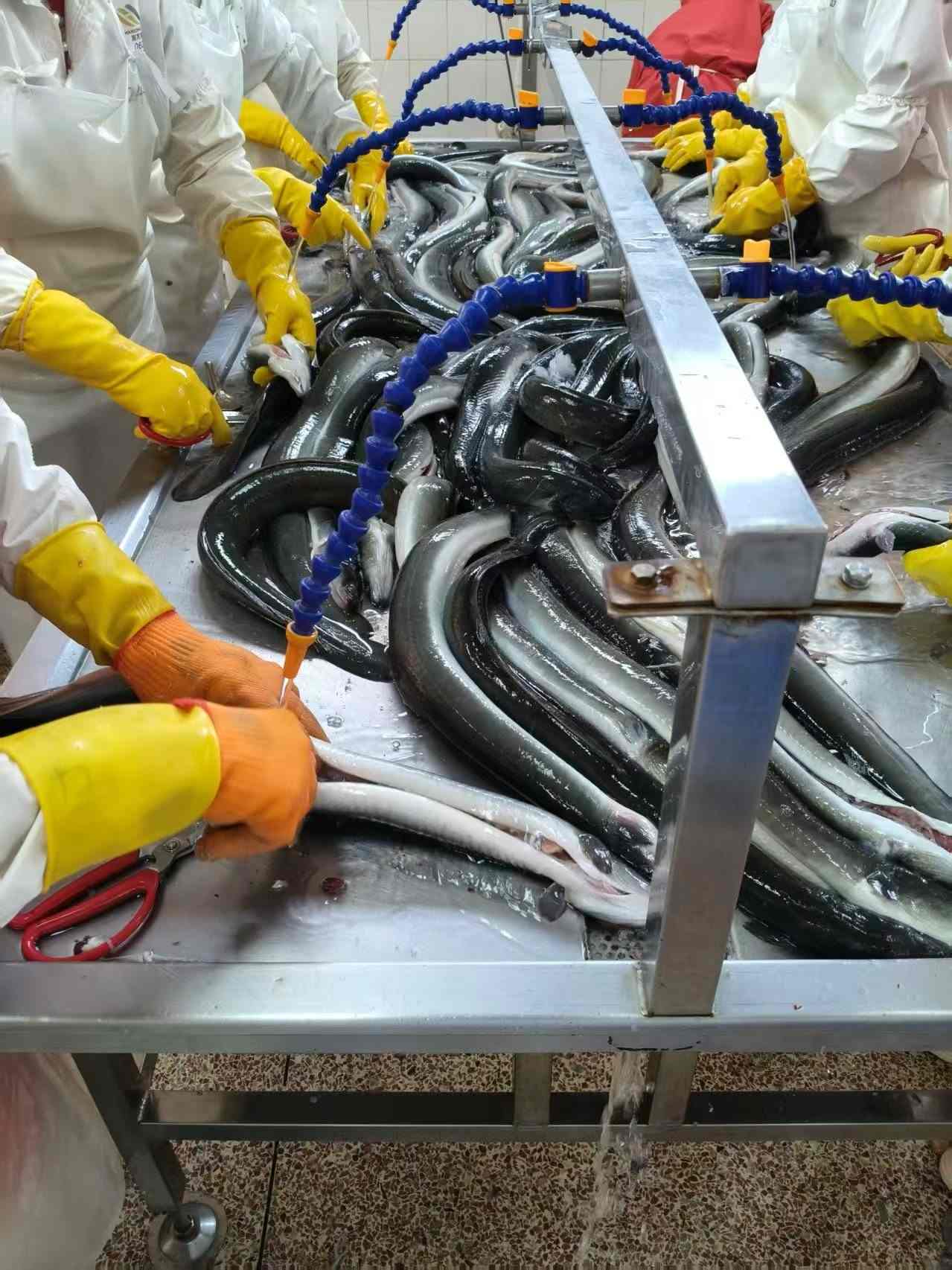
- Preparation: Eels are humanely processed, gutted, deboned, and butterflied to prepare them for roasting. Metal detectors are used at this critical control point.
- White Roasting: The initial roasting step cooks the eel thoroughly, eliminating any biological hazards and setting the foundation for its tender texture.
- Steaming: A steaming process follows roasting to remove excess fat, resulting in a lighter texture and cleaner flavor profile.
- Four-Layer Glazing & Roasting: The eel is coated and roasted four separate times with our savory-sweet kabayaki sauce. Each layer is applied at a specific, controlled temperature to build a deep, caramelized flavor without burning the delicate fillet.
- Rapid Freezing & Packaging: The finished fillets are immediately quick-frozen to lock in freshness and quality, then packaged according to customer specifications (e.g., skin packaging, bulk foodservice packs).
This verified process ensures that every piece of eel is perfectly cooked, completely safe, and ready for use in high-volume foodservice operations, from Japanese restaurant chains to international food distributors.

Sourcing Checklist for B2B Buyers of Cooked Eel
When sourcing cooked eel for your inventory, it's essential to verify your supplier's capabilities to protect your business from trade risks and ensure consistent quality. A reliable partner doesn't just sell a product; they provide a verifiable chain of custody and quality assurance. This is particularly important for products like eel, where safety is paramount.
Before placing your next order for unagi kabayaki or other eel products, use this checklist to evaluate potential suppliers. These are the same standards our long-term partners in Japan, Germany, and the United States use to qualify us as their trusted supplier.
- Verify Core Certifications: Does the supplier hold internationally recognized food safety certifications?
- Must-Haves: Look for ISO 22000:2018 and a functional HACCP system. These are foundational for food safety management.
- Market-Specific: For certain markets, HALAL certification may be required. An Export Food Producer Registration Certificate is also a key indicator of compliance.
- Confirm Full-Chain Traceability: Can the supplier trace the product from the farm to the container?
- Ask about their farming base network. We operate with approximately 20 customs-registered farms, ensuring control over raw material quality and safety from the very beginning.
- Inquire about their tracking systems for veterinary drug residues and microbiological indicators, managed by an in-house professional laboratory.
- Assess Production and Storage Capacity: Can the supplier handle your volume and maintain quality?
- Production: An annual capacity of 4,000 tons across two modern production lines indicates a facility capable of handling large, consistent orders.
- Cold Chain: A sizable cold storage facility (e.g., our 1,000-ton capacity) is critical for maintaining product integrity and ensuring stable logistics.
- Evaluate Product Customization and Foodservice Readiness: Does the product reduce labor in your or your client's kitchen?
- Look for boneless/deboned options and standardized cutting specifications (shredding, dicing, sushi slices, etc.).
- Inquire about flexible MOQ policies and packaging formats (skin-packaging, gift boxes, bulk packs) to suit different channels like catering chains or wholesale.
Beyond Sushi: The Foodservice Advantage of Standardized Cooked Eel
While eel cooked sushi is the most famous application, professionally prepared unagi kabayaki offers tremendous versatility for foodservice menus. Its rich flavor and tender texture make it a premium ingredient in a wide range of dishes, and sourcing a ready-to-heat product provides significant operational advantages.
The primary benefit is the reduction of back-of-house labor. Preparing eel from scratch is time-consuming and requires specialized skills. Our pre-cooked, deboned, and portion-controlled fillets eliminate these steps entirely. A chef can simply heat the product and serve, guaranteeing consistency in every dish and dramatically reducing prep time. This efficiency is a major cost-saver for high-volume operations like restaurant chains in Japan and foodservice channels in Poland and Australia that we supply.
Popular applications beyond a simple eel sushi roll recipe include:
- Unagi Donburi (Hitsumabushi): A classic Japanese rice bowl topped with grilled eel. Our standardized fillets ensure every bowl has the same portion size and quality.
- Appetizers and Small Plates: Cut unagi can be served as skewers (kushiyaki) or as a component in salads and other starters.
- Fusion Dishes: Creative chefs are incorporating unagi into everything from tacos and pizza to pasta dishes, where its savory-sweet profile adds a unique, upscale element.
By leveraging a fully cooked, high-quality eel product, foodservice businesses can expand their menus with profitable, high-demand items without adding complexity to their kitchen workflow. Our stable cold-chain logistics and 30-day average order-to-shipment time ensure you can maintain consistent inventory for these popular dishes.
For detailed specifications on our foodservice-ready unagi kabayaki and custom cutting options, contact our export team to request a product sheet.