


Why the Japanese Eel Supply Chain Begins in the Wild
As a food importer or restaurant operator, you likely source "farm-raised" products to ensure consistency and supply stability. However, when it comes to the highly sought-after Japanese eel (Anguilla japonica), the term "farm-raised" carries a critical nuance. Unlike salmon or tilapia, which can be bred in captivity from egg to harvest, the entire global eel aquaculture industry depends on a wild, unpredictable, and highly regulated natural resource: juvenile eels, known as "glass eels."
This dependency creates unique challenges and risks in the supply chain. Understanding this foundational bottleneck is the first step for any business looking to source high-quality eel products reliably and responsibly. It directly impacts price, availability, and the importance of supplier verification. At Eelpro, our vertical integration is built to manage these exact challenges, providing our partners in Japan, the United States, and the European Union with a stable and traceable supply.

The Glass Eel Bottleneck: Why Farming Still Depends on Wild Juveniles
The core reason eel farming isn't a closed-loop system lies in the species' complex life cycle. The Japanese eel is a catadromous fish, meaning it spawns in the ocean and its young migrate to freshwater to grow. Despite decades of research, commercially viable captive breeding has not been achieved. The process is so difficult and costly that it remains in the experimental phase.
This reality forces the entire industry to rely on capturing juvenile eels from the wild as they approach coastal estuaries. This is where the "farmed" process truly begins, and it's a critical distinction for any buyer to understand.
Here is a breakdown of the eel life cycle and where aquaculture intervenes:
- Stage 1: Spawning (Wild Ocean): Adult eels migrate thousands of kilometers to specific deep-sea locations, like the waters near the Mariana Trench, to spawn and then die. This stage is entirely uncontrolled and occurs in the wild.
- Stage 2: Larval Drift (Wild Ocean): The fertilized eggs hatch into leaf-shaped larvae called leptocephali. These larvae drift on ocean currents for months, a journey that is completely subject to natural conditions.
- Stage 3: Glass Eel Arrival (Wild Capture): As the larvae approach coastlines, they metamorphose into transparent, thread-like "glass eels." This is the point of capture. Fisheries collect these juveniles from estuaries before they swim upstream. Traceability for any eel product begins here.
- Stage 4: Aquaculture Grow-out (Farmed): The captured glass eels are sold to aquaculture facilities, like our network of 19 certified farming bases. Here, they are raised in controlled pond environments, fed specialized diets, and grown to market size over 6-12 months. This is the "farm-raised" portion of the process.
The dependence on the wild glass eel catch is the single greatest point of volatility in the market. The volume of the catch varies dramatically each year due to oceanic conditions, conservation measures, and fishing efforts. This variability directly influences the cost of raw materials and the overall availability of market-ready eels, making a stable supply from a trusted frozen eel supplier essential for business planning.
Sourcing and Traceability Challenges for Eel Importers
The reliance on a wild-caught resource introduces specific business risks that every eel importer must navigate. Without a robustly managed supply chain, buyers can face quality inconsistencies, legal compliance issues, and sudden supply disruptions. The key is to partner with a supplier who can demonstrate control and transparency from the farm onward.
At Eelpro, we have built our operations to address these risks head-on. Our products consistently meet the stringent food inspection standards of Japan, the US, and the EU for veterinary drug residues and microbiological indicators, helping our clients avoid trade risks. For example, our long-term supply agreements with Japanese restaurant chains and US food importers are built on this foundation of trust and verifiable quality.
Use this checklist when evaluating a potential eel supplier to ensure they can manage these inherent supply chain risks:
| Evaluation Point | Key Questions for Your Supplier | Why It Matters for Your Business |
|---|---|---|
| Farming Base Registration | "Are your farming bases registered with customs or other export authorities?" | Official registration, like our network of ~20 customs-registered farms, ensures the facilities are subject to government oversight, audits, and standardized practices for food safety and environmental management. |
| Chain of Custody Control | "Can you document the eel's journey from the registered farm to the final processed product?" | This verifies that the eel you are buying comes from a known, compliant source and hasn't been mixed with untraceable stock. It is fundamental for food safety and regulatory compliance. |
| In-House Testing & Verification | "What is your protocol for testing for veterinary drug residues and microbiological contaminants?" | A supplier with its own professional laboratory demonstrates a proactive approach to quality control, rather than merely relying on third-party checks. It allows for targeted sampling and rapid verification. You can learn about our eel lab of eelpro co. / ltd. |
| Food Safety Certifications | "What internationally recognized food safety management systems do you hold (e.g., ISO 22000, HACCP, HALAL)?" | Certifications like our ISO 22000:2018 and HACCP system provide third-party validation that the supplier's processes are standardized, documented, and designed to prevent food safety hazards. |
How Vertical Integration Creates a Stable and High-Quality Supply
The most effective way to mitigate the risks associated with the eel supply chain is through vertical integration. By controlling every step after the glass eels are sourced, a manufacturer can build layers of quality control and predictability into the system. This is the core of Eelpro's strategy.
Our control begins at our network of 19 self-operated and cooperative certified farming bases, which cover over 2,150 mu and supply more than 5,000 tons of high-quality raw eel annually. This scale provides a consistent buffer against market fluctuations. From there, the eels enter our state-of-the-art processing facility.
Our 8,497 m² production workshop houses two modern lines with a combined annual capacity of 4,000 tons of finished goods. Here, we leverage patented technologies, including low-fat roasting and specialized deodorizing equipment, to produce a superior product. Our signature kabayaki roasting process involves four precise layers of soy sauce applied at carefully controlled temperatures, creating a rich flavor and perfect texture. This meticulous process turns high-quality raw material into a premium unagi kabayaki eel product.
Overseeing this entire operation are our 25 dedicated technical and quality-control specialists. They manage critical control points, operate our in-house laboratory for targeted sampling, and ensure every batch meets export requirements. Finally, our 1,000-ton cold storage facility guarantees that product integrity is maintained from production through to shipment, supported by reliable cold-chain logistics.
Product Specifications and Customization for B2B Clients
A reliable supply chain is only valuable if the final product meets your specific needs. Whether you are a foodservice distributor, a restaurant chain, or a retail packager, the format of the eel product directly impacts your operational efficiency and menu costs. Our boneless, ready-to-heat products are designed to reduce back-of-house labor and ensure consistency for our clients in Germany, Poland, Australia, and across Southeast Asia.
As a specialist with over a decade in kabayaki roasting, I often help clients choose the right format for their application. Our processing capabilities allow for extensive customization.
| Product Format | Description | Common B2B Applications |
|---|---|---|
| Full Kabayaki Fillet | A whole, boneless fillet, roasted and glazed with our signature sauce. Available in various sizes. | Ideal for unadon (eel rice bowls), high-end restaurant plating, and retail gift boxes. |
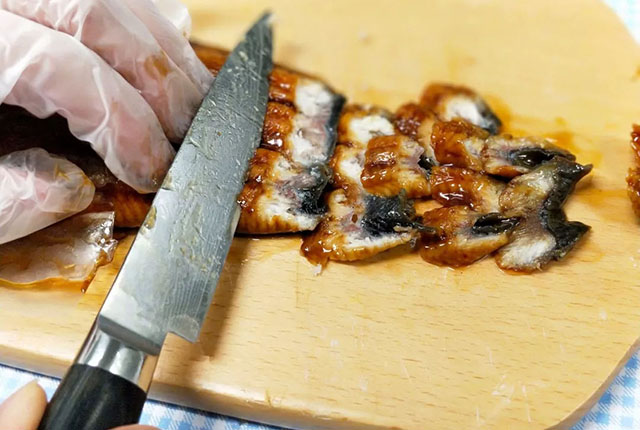
| Cut Pieces (Chunks/Dicing) | Fillets pre-portioned into uniform chunks, cubes, or sections. | Perfect for bento boxes, foodservice portion control, stir-fries, and ready-meal manufacturing. |
| Sushi Slices (Neta) | Thin, uniform slices cut specifically for nigiri sushi or to be used in rolls like in this eel sushi roll recipe: make unagi rolls. | Essential for sushi restaurants, commissaries, and catering services seeking consistency and reduced prep time. |
| Shreds or Strips | Finely cut eel, excellent as a versatile ingredient or topping. | Used in noodle dishes, salads, omelets (umaki), and other creative fusion dishes. |
We accommodate differentiated MOQ policies for different client types and can negotiate specifics based on the product specifications and packaging formats required. This flexibility ensures that both large-scale importers and regional catering chains can access our premium products.
The journey of the Japanese eel from a wild glass eel to a finished kabayaki product is complex. By partnering with a vertically integrated and certified manufacturer, importers can secure a stable, safe, and high-quality supply chain.
For detailed specifications on our traceable unagi kabayaki products or to discuss your import requirements, please contact our team for a consultation.