





Why a Nori Band is Essential for Authentic Japanese Eel Sushi
For any food importer or restaurant chain specializing in Japanese cuisine, understanding the details is what separates acceptable from exceptional. One such detail, often overlooked, is the small strip of nori (seaweed) wrapped around unagi nigiri. It’s not just for decoration. This simple band serves a critical structural purpose, and getting it right starts with sourcing the correct quality of eel. Poorly processed japanese eel sushi toppings can fall apart, making the nori band's job impossible. Here, we'll break down the technical reasons for the nori band and what that means for sourcing bulk frozen unagi.
My name is Nancy Chen, and as the Senior Food Safety & Quality Specialist at Eelpro, I’ve spent over a decade ensuring our products meet the exacting standards of clients in Japan, the US, and the EU. I've seen firsthand how the physical properties of unagi kabayaki—from its texture to the viscosity of its glaze—directly impact its performance in a professional kitchen.
The Nori Band's Role: Securing Warm Eel Without Crushing the Rice
Unagi nigiri is unique among sushi. Unlike fish served raw and cool, unagi is served warm, glazed, and exceptionally tender. This creates a structural challenge that other types of nigiri do not face. The nori band is the elegant solution, providing stability by addressing several physical forces at play.
The primary goal is to secure the warm, heavy, and often slippery piece of eel to the delicate, lightly packed sushi rice. A chef cannot simply press the eel onto the rice; doing so would compress the rice grains into a dense, gummy paste, ruining the intended texture. The nori band acts as a flexible brace, applying gentle, distributed pressure across the top.
Here is a breakdown of the specific functions the nori band performs:
- Structural Integrity: The warm, flaky texture of cooked unagi means it can easily break apart. The nori band provides a secure "seatbelt," holding the topping firmly in place during handling and consumption.
- Pressure Distribution: Instead of a chef's fingers compressing a single point on the rice, the band distributes a light, even tension across the entire piece of sushi. This maintains the rice's airy structure.
- Glaze Containment: The rich, sweet eel sauce, or unagi tare, can make the eel slippery. The slightly porous texture of nori helps absorb any excess glaze, preventing the topping from sliding off the rice.
- Temperature Buffer: The warmth of the eel can cause the rice beneath it to expand slightly. The nori band provides a flexible binding that accommodates this minor change without compromising the sushi's shape.
Sourcing Unagi Kabayaki: Key Specifications for Nigiri-Grade Quality
For foodservice businesses, the quality of the frozen unagi directly determines its suitability for nigiri. Not all frozen eel suppliers produce kabayaki with the right properties. When evaluating suppliers, buyers must look beyond price and consider the technical specifications that affect back-of-house efficiency and final product quality.
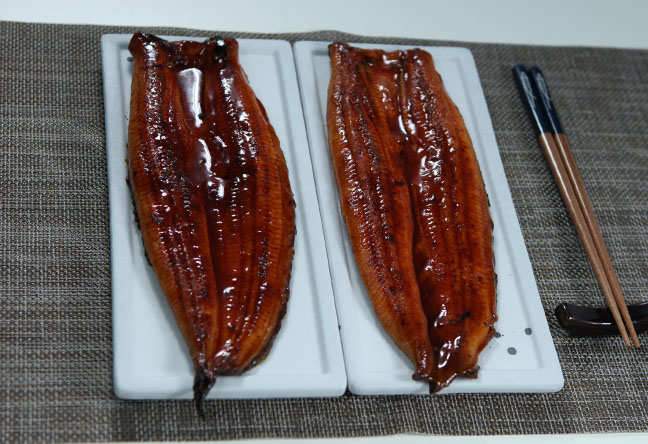
At Eelpro, our entire process is designed to produce unagi that performs reliably for our export clients in demanding markets like Japan and Germany. Our patented low-fat roasting and deodorizing technology ensures a clean flavor profile. The subsequent 4-layer soy-sauce coating process creates a glaze that adheres perfectly to the eel without being overly thick or runny—a critical factor for stable nigiri.
Here is a checklist for importers evaluating a potential unagi kabayaki supplier:
| Specification | Why It Matters for Japanese Eel Sushi | Eelpro Standard |
|---|---|---|
| Cut & Sizing Uniformity | Inconsistent sizes lead to variable portion costs and unprofessional presentation. Pre-cut sushi slices reduce labor and ensure consistency. | We offer custom cutting specifications, including standardized sushi slices, ensuring every piece meets your exact requirements. |
| Bone Removal | Even small pin bones are a significant quality failure and customer hazard. The deboning process must be meticulous. | Our boneless/deboned eel is processed under strict quality control, with 25 technical specialists overseeing production lines. |
| Glaze Viscosity & Adhesion | A glaze that is too thin will run off, while one that is too thick will taste cloying and make the eel slide off the rice. | Our 4-step temperature-controlled saucing process creates a stable, rich glaze that clings to the eel, perfect for nigiri preparation. |
| Fat Content & Texture | Eel that is too fatty becomes greasy when heated. The flesh should be tender and flaky, not mushy or tough. | Our patented low-fat roasting process reduces excess oil, resulting in a tender texture that holds its form. |
Common Sourcing Mistakes That Compromise Sushi Quality
Over my career auditing seafood facilities and guiding clients through import compliance, I've seen several recurring mistakes that buyers make when sourcing frozen eel. These errors can lead to product that is difficult for chefs to work with, inconsistent in quality, or even non-compliant with import regulations.
Avoiding these pitfalls is essential for maintaining a stable and profitable supply chain.
- Mistake 1: Ignoring Farm-Level Traceability. Many buyers focus only on the processing facility's certifications. However, issues like veterinary drug residues originate at the farm. Sourcing from a supplier without full-chain control is a major risk.
- Our Solution: Eelpro operates with approximately 20 customs-registered eel farming bases covering over 2,150 mu. We implement full-chain traceability from our unagi eel farm to final shipment, ensuring our products meet strict Japan, US, and EU food inspection standards.
- Mistake 2: Overlooking Cold Chain Management. The supplier's ability to store and transport the product correctly is just as important as the production quality. Fluctuations in temperature can damage the texture of the eel.
- Our Solution: We operate a 1,000-ton cold storage facility on-site. This allows us to maintain an unbroken cold chain from production to loading, preserving the product's integrity.
- Mistake 3: Choosing a Supplier with Limited Capacity. Partnering with a small facility can lead to inconsistent supply, especially for large restaurant chains or distributors.
- Our Solution: Our two modern production lines have a combined annual capacity of 4,000 tons, providing a reliable supply for long-term partners, such as the Japanese restaurant chains and US food importers we currently serve.
Ensuring Food Safety and Compliance for Global Markets
For any B2B buyer, the top priority is avoiding trade risks. A shipment delayed or rejected at customs due to non-compliance can be catastrophic. That is why certifications and verifiable quality control systems are non-negotiable.
Our facility is certified under the ISO 22000:2018 Food Safety Management System and has a fully implemented HACCP system. We hold an Export Food Producer Registration Certificate, a HALAL certification, and SC Food Production License No. SC11135062401122. These are not just certificates on a wall; they are active systems managed by our team of 25 quality-control personnel.
We use an in-house professional laboratory for targeted sampling and verification, testing for veterinary drug residues and microbiological indicators to ensure compliance with the destination market's standards. Metal detectors are placed at critical control points to eliminate physical contaminants. This rigorous, multi-layered approach to quality assurance is how we confidently supply eel products to demanding markets, including Germany, Poland, Australia, and across Southeast Asia.
The integrity of the final dish—that perfect piece of Japanese eel sushi held together by its nori band—begins thousands of miles away, with controlled farming, precise processing, and a deep commitment to food safety. By understanding the technical requirements of the product, importers can make smarter sourcing decisions that protect their brand and satisfy their customers.
If your business requires a stable supply of high-quality, fully traceable unagi kabayaki for foodservice or distribution, we can provide detailed product specifications and discuss our flexible MOQ policies.
Contact our team to request a product sample or a detailed quotation.

 WhatsApp
 sales@chinaeels.com
 +8619937922411