





How to Create a Commercial Recipe for Unagi Sauce That Scales Consistently
One of the most common challenges food service operators and manufacturers face is scaling a sauce recipe. A perfect 1-liter batch of unagi sauce often becomes a salty, burnt syrup when you multiply the ingredients by 100. Why? Because scaling a sauce isn’t about simple multiplication; it’s about managing evaporation, heat transfer, and chemical reactions. My name is Nancy Chen, and as a food safety and quality specialist at Eelpro, I've spent over a decade overseeing large-scale production for clients in demanding markets like Japan and the United States. I've seen firsthand how a poorly scaled recipe for unagi sauce can ruin a product line.
The problem lies in the physics of reduction. As the volume increases, the ratio of surface area to volume changes dramatically, altering evaporation rates. A small pot and a large industrial kettle behave very differently. In this guide, I’ll walk you through the principles of successful scaling, provide a stable base recipe, and show you how to maintain batch-to-batch consistency—the same principles we use to produce thousands of tons of export-grade eel sauce annually.
The Science of Reduction: Why Scaling a Sauce Isn't Simple Arithmetic
Before attempting to scale, it's essential to understand what happens when you simmer unagi tare. The process is a controlled reduction designed to concentrate flavors and thicken the liquid through two primary mechanisms: water evaporation and sugar caramelization. When you change the batch size, you alter the physics of this process.
Here are the key variables that change with scale:
- Surface Area to Volume Ratio: A small, wide saucepan has a high surface-area-to-volume ratio, leading to rapid evaporation. A deep, 100-liter stockpot or steam-jacketed kettle has a much lower ratio. If you simply multiply the simmer time, the sauce in the large pot will barely reduce, while attempting to speed it up with high heat will scorch the sugars at the bottom.
- Heat Distribution: A small pot on a gas burner heats relatively evenly. A large kettle has significant temperature gradients. The bottom and sides get much hotter than the core, creating a risk of localized burning and bitter off-flavors long before the entire batch has properly reduced. This is why industrial production relies on jacketed vessels for gentle, even heating.
- Ingredient Concentration: As water evaporates, the concentration of soy sauce (salt) and sugar increases. In a large batch that is accidentally over-reduced, this concentration can become extreme, resulting in a sauce that is intensely salty and cloyingly sweet. The Maillard reaction and caramelization, which create desirable flavor compounds, can quickly run away and produce burnt, acrid notes.
Simply multiplying ingredients and cooking time ignores these factors. A successful scaling strategy requires adjusting your process, equipment, and monitoring methods, not just your ingredient list.
A Scalable Base Recipe and Quality Control Checkpoints
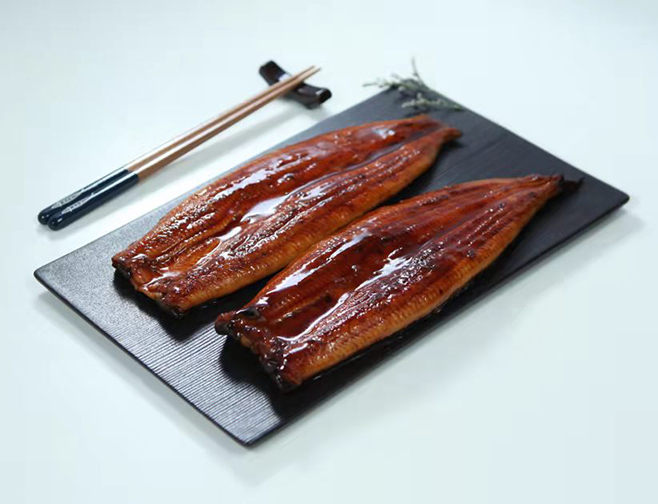
This base recipe provides a balanced starting point. The key to scaling it is to stop relying on time and start using objective quality control measures like temperature and viscosity. This is how we ensure every batch of sauce for our unagi kabayaki product meets the exact same specification.
Base Ingredient Ratios (by Volume)
- 4 parts Japanese Soy Sauce (Shoyu)
- 4 parts Mirin (Sweet Rice Wine)
- 2 parts Sake (Japanese Rice Wine)
- 1 part Granulated White Sugar
Step-by-Step Production & QC Process
- Combine Liquids: In a heavy-bottomed pot or kettle appropriate for your batch size, combine the soy sauce, mirin, and sake.
- Dissolve Sugar: Gently heat the mixture over low-medium heat, stirring continuously until the sugar is fully dissolved. Do not let it boil at this stage. QC Checkpoint 1: Ensure no sugar granules remain. Undissolved sugar can crystallize later or scorch on the bottom.
- Initial Boil: Increase the heat and bring the mixture to a gentle boil to cook off the alcohol from the mirin and sake. This should take only a few minutes. You'll notice the sharp alcoholic smell dissipates.
- Controlled Simmer & Reduction: Reduce the heat to a low, steady simmer. This is the most critical phase. Do not use a timer. Instead, monitor the sauce's consistency. QC Checkpoint 2: The sauce is ready when it has reduced by approximately 25-30% and lightly coats the back of a spoon. It should flow like warm maple syrup. It will thicken considerably as it cools.
- Cooling & Viscosity Check: Remove from heat and let it cool. QC Checkpoint 3 (Professional Method): For ultimate consistency, use a viscometer or a simple Zahn cup to measure viscosity at a set temperature (e.g., 25°C). For a lower-tech approach, place a small amount on a cold plate; it should set to a glaze-like consistency without being gummy.
How Pan Size and Batch Volume Affect Reduction Time
This is where most scaling efforts fail. A recipe that calls for "simmer for 30 minutes" in a 2-liter pot will not work for a 50-liter batch. The relationship between volume, vessel geometry, and time is not linear. The table below illustrates how these variables interact and provides guidance for adjusting your process.
| Batch Volume | Recommended Vessel Type | Evaporation Dynamics | Key Risk Factor | Control Strategy |
|---|---|---|---|---|
| 1-2 Liters | Wide, shallow saucepan (24-28 cm) | High surface area leads to rapid evaporation. Reduction is fast and easy to monitor visually. | Accidental Over-reduction: A few extra minutes can turn the sauce into a thick, unusable syrup. | Monitor visually. Rely on the "back of the spoon" test. A timer can be a rough guide but not the final word. |
| 10-20 Liters | Heavy-bottomed stockpot (30-40 cm) | Moderate surface area. Slower evaporation. The core of the liquid is insulated by the surrounding volume. | Uneven Heating: The bottom can scorch before the surface shows significant reduction. | Stir frequently, ensuring you scrape the bottom. Use a thermometer to check for hot spots. Start checking viscosity after 45-60 minutes of simmering. |
| 50-100+ Liters | Steam-jacketed kettle | Low surface-area-to-volume ratio. Evaporation is slow and highly controlled. | Scorching & Inconsistency: Direct heat from the bottom is a major failure point. Batches are too large for simple stirring to be effective. | Use jacketed heating for gentle, uniform heat. Rely on instrumentation like a Brix refractometer to measure sugar concentration and a viscometer for final consistency. |
Common Scaling Mistakes and How to Fix Them
As a quality auditor, I've seen these same mistakes made by foodservice chains and small-scale producers alike. Avoiding them is critical for a stable, high-quality product that your customers can depend on, whether they are in Germany, Poland, or Australia.
- Mistake 1: Blindly Multiplying Simmer Time.
The Problem: Assuming a 10x batch needs 10x the time. As shown above, this math doesn't work due to changing evaporation physics.
The Fix: Ditch the timer as your primary tool. Use visual cues (coating a spoon), physical measurements (Brix for sugar solids), and viscosity tests. Log the final parameters of a perfect batch and aim to replicate those measurements every time, regardless of how long it takes. - Mistake 2: Using the Wrong Vessel Geometry.
The Problem: Pouring a 20-liter batch into a narrow, tall stockpot severely limits surface area, making reduction incredibly slow and inefficient.
The Fix: Use a vessel that is wider than it is tall for batches under 20 liters to maximize surface area. For larger commercial batches, a steam-jacketed kettle is non-negotiable for its even heating. - Mistake 3: Ignoring Ingredient Variability.
The Problem: Different brands of soy sauce have different sodium levels and solids content. Mirin can vary in sugar content. Switching suppliers without re-calibrating the recipe can lead to inconsistent results.
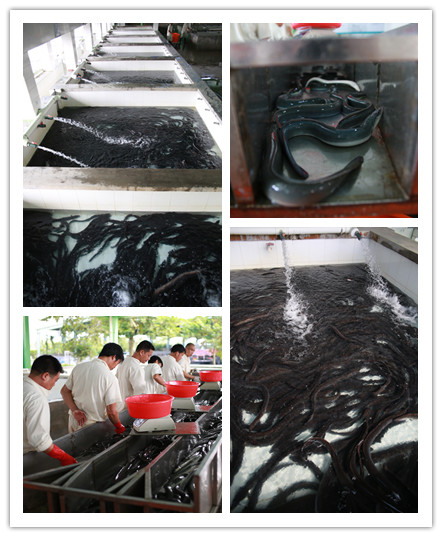
The Fix: Standardize your suppliers. If you must switch, run a small test batch first. At Eelpro, all raw materials are tested in our in-house laboratory before entering the production line to guarantee consistency.
Achieving Export-Grade Consistency in Every Batch
For international buyers, consistency is not a preference; it's a requirement. A restaurant chain in Japan or an importer in the EU needs every shipment to taste and perform exactly like the last. This is where industrial process control becomes essential.
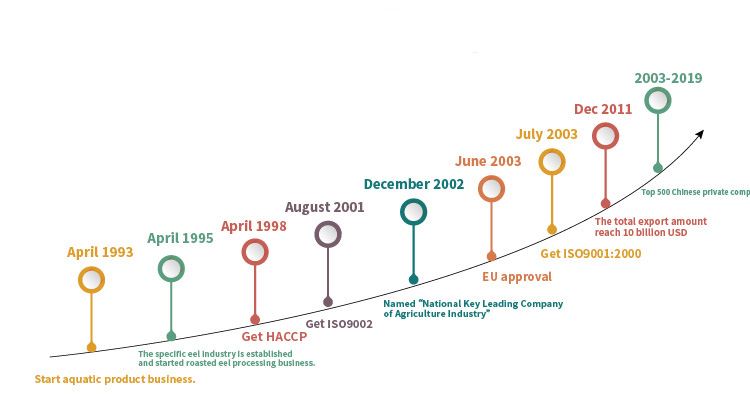
At our ISO 22000:2018 and HACCP-certified facility, we don't leave consistency to chance. Our production lines utilize patented low-fat roasting and deodorizing technology, which complements our precisely controlled sauce-making process. We use a 4-layer soy-sauce coating process for our unagi, where each layer is applied at a specific temperature to build flavor without over-reduction. This level of control ensures our products meet the stringent food inspection standards for veterinary drug residues and microbiological indicators required by Japan, the US, and the EU.
By moving from a time-based recipe to a process-based one with clear QC checkpoints, you can achieve similar consistency in your own operations. It protects your brand, satisfies your customers, and reduces waste from failed batches.
If your business demands a reliable, high-volume supply of unagi kabayaki or eel sauce that is ready for international markets, contact our team to request a product specification sheet or a sample.
 WhatsApp
 sales@chinaeels.com
 +8619937922411