

Is Unagi the Only Eel in Japanese Name, or Are There Others?
A restaurant buyer once asked us a simple question that turned out to have a complicated answer: "If unagi is the eel in Japanese name, why does this other menu list anago too?" Good question. The short answer is no — unagi is not the only eel in Japanese name. It's the freshwater eel specifically. Anago, hamo, and even utsubo (moray) all show up on Japanese menus, and confusing them can cost an import buyer both money and credibility with clients.
This matters most when you're sourcing product, not just eating it. Get the terminology wrong on a purchase order, and you might end up with saltwater conger eel when your kitchen actually needs freshwater unagi for a kabayaki dish — or vice versa. Let's sort out exactly where each name applies.
What "Eel in Japanese Name" Actually Covers
In Japanese, "eel" is not one word — it's a family of names attached to biologically distinct animals. Unagi (鰻) refers specifically to freshwater eel, genus Anguilla, most commonly Anguilla japonica in East Asian sourcing. This is the species used for kabayaki, unadon, and unaju.
Other common names include:
- Anago (穴子) — saltwater conger eel, family Congridae
- Hamo (鱧) — pike conger, a bony saltwater eel used mainly in Kansai-region summer dishes
- Utsubo (ウツボ) — moray eel, a regional specialty in a few coastal areas, rarely exported
If a supplier or menu simply says "eel" without specifying, always ask which of these is meant. For export buyers, this distinction determines everything from cold-chain handling to price point.
Unagi vs Anago: Where Freshwater Eel Ends and Conger Eel Begins
This is the question we get most often from new import clients, so let's answer it directly, including where the line gets blurry.
Are unagi and anago the same fish?
No. They belong to different families entirely. Unagi is Anguilla japonica, a freshwater eel that migrates to sea only to spawn. Anago is a marine conger eel that lives in coastal waters its entire life.
Comparison table: Unagi vs Anago
| Feature | Unagi (Freshwater Eel) | Anago (Conger Eel) |
|---|---|---|
| Habitat | Freshwater rivers, farmed ponds | Coastal saltwater |
| Fat content | Higher, richer flavor | Leaner, milder taste |
| Common prep | Grilled with soy-based tare, kabayaki style | Simmered or lightly grilled, often for sushi |
| Typical menu item | Unadon, unaju, hitsumabushi | Anago nigiri, anago tempura |
| Price tier (general market) | Higher, especially wild-caught | Generally lower |
Can a restaurant substitute one for the other?
Not without changing the dish's identity. Unagi's higher fat content is what makes the roasting process work — the fat renders during grilling and carries the kabayaki sauce flavor into the flesh. Anago is leaner and cooks differently; using it for a kabayaki-style dish will produce a drier, less traditional result. This substitution does happen in budget-driven kitchens, but it should always be disclosed on the menu — mislabeling is a real compliance risk in the US and EU.
When does the boundary blur?
Menu translation is where things go wrong most often. Some English-language Japanese menus translate both unagi and anago simply as "eel," leaving diners and even purchasing staff unable to tell them apart. If you're a foodservice buyer building an English menu, specify "freshwater eel (unagi)" and "conger eel (anago)" separately to avoid ambiguity.
Common Mistakes Buyers Make When Sourcing "Japanese Eel"
We've seen these errors repeated across import inquiries, regardless of market:
- Ordering "eel fillet" without specifying species — leads to receiving conger eel when unagi was expected, or the reverse.
- Assuming all kabayaki-style products use the same eel — some processors use conger eel with kabayaki sauce and label it loosely as "eel kabayaki." Ask for species confirmation in writing.
- Confusing eel sauce (tare) with the fish itself — eel sauce is a soy-based glaze; it doesn't guarantee the protein underneath is unagi.
- Skipping documentation on farming origin — freshwater eel raised in uncontrolled ponds may carry higher veterinary drug residue risk, a common cause of held shipments in the EU and Japan.
A Worked Example: Building a Kabayaki Menu Line
Say a US restaurant chain wants to add a kabayaki eel donburi to its menu. Here's a realistic sourcing sequence:
- Confirm the species required — for traditional kabayaki, it must be freshwater eel (unagi), not conger eel.
- Request species certification and farming traceability documents from the supplier.
- Check that the product meets the destination market's veterinary drug residue and microbiological standards — Japan, US, and EU thresholds differ slightly.
- Confirm cutting spec — whole fillet, cut pieces, or 3-section cut depending on plating format.
- Request a sample batch before committing to a full container order.
This is essentially the process behind our own unagi kabayaki eel line — sourced from customs-registered freshwater eel farming bases, not open-market conger eel substitutes.
Buyer's Checklist: Confirming You're Getting Genuine Unagi
- ☐ Supplier confirms species as Anguilla japonica (freshwater eel), not conger or moray
- ☐ Farming origin is traceable to a registered or certified base
- ☐ Product carries food safety certification relevant to your import market (ISO 22000, HACCP, or equivalent)
- ☐ Lab test reports available for veterinary drug residues and microbiological indicators
- ☐ Cutting specification matches your kitchen's prep capacity (whole, cut pieces, or deboned)
- ☐ Sample requested and tasted before bulk order confirmation
How Traceability Reduces Naming Confusion at the Source
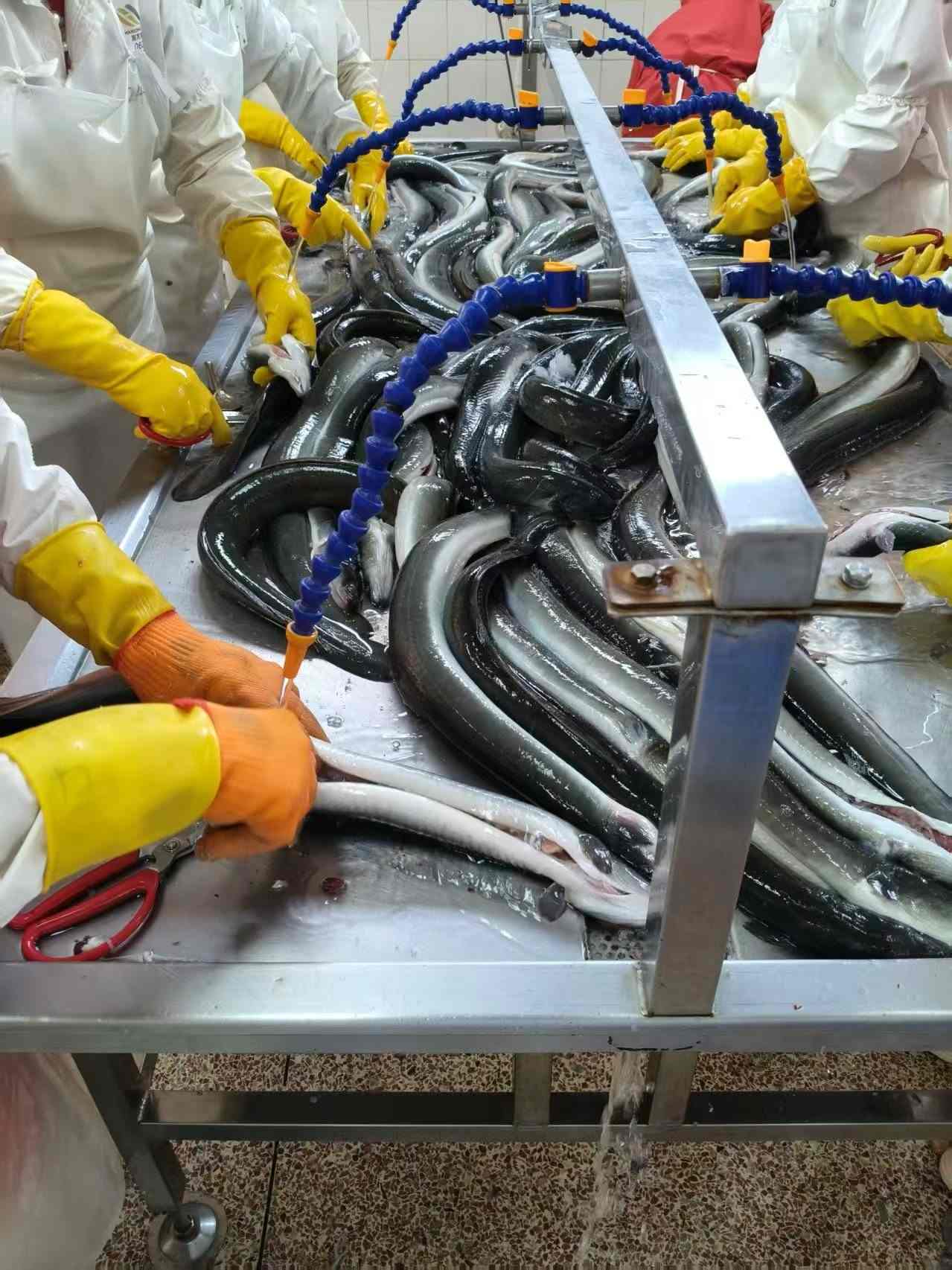
Naming mix-ups usually start at the farming or processing stage, not the menu. This is why full-chain traceability matters more than a label. Our supply comes from roughly 20 customs-registered eel farming bases covering over 2,150 mu, with tracking from eel farming bases registration through process verification and targeted sampling. Every batch that passes through our processing lines is also checked in our in-house laboratory, with metal detectors placed at critical control points. This kind of documentation is what lets a buyer confirm — on paper, not just on a label — that the eel in Japanese name they've ordered is actually the species they're paying for.
For foodservice buyers, this also solves a back-of-house problem: boneless, standardized-cut unagi reduces prep labor compared to whole fish that need deboning and species verification in-house.
Practical Menu-Context Examples
Here's how the distinction plays out on real menus:
- Unadon — rice bowl topped with grilled unagi kabayaki, always freshwater eel
- Anago nigiri — sushi topped with simmered conger eel, never unagi
- Unagi sushi rolls — see our guide on how to make unakyu maki, which specifically calls for freshwater eel for its richer texture
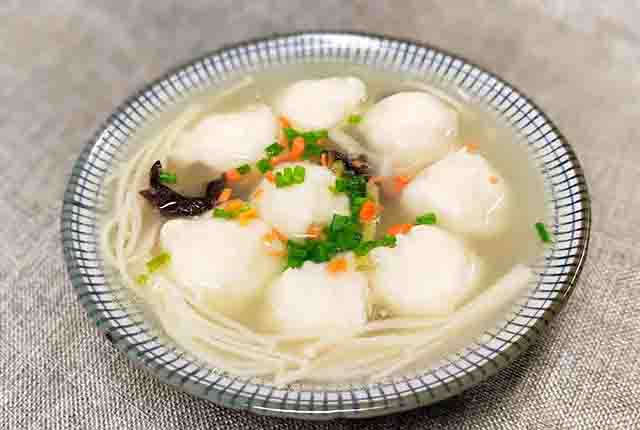
- Eel noodle soup — regional preparations vary; check our notes on eel noodle soup for species-specific adjustments
If a menu item calls simply for "eel" without specifying unagi or anago, treat that as a red flag requiring clarification before ordering — both for kitchen consistency and for customer transparency.
Have a specific species or cutting spec you need confirmed before placing an order? Send us your requirements and we'll walk through sourcing documentation and sample options with you.