


Build Unagi Eel Sushi Nigiri That Holds Together Every Time
You press the rice, lay the kabayaki on top, and by the second bite the topping has already slid off into the soy dish. Sounds familiar? That slip isn't bad luck — it's a build problem. Making unagi eel sushi that stays stacked at home comes down to three fixable steps: rice shaping, eel sizing, and nori placement. Get those three right and the nigiri holds from plate to mouth, no toothpicks required.
Why Unagi Eel Sushi Toppings Slip Off the Rice
Before fixing the problem, it helps to know what causes it. Four things usually go wrong at once:
- Rice too hot or too wet. Freshly cooked sushi rice at above 100°F (38°C) releases steam under the topping, which acts like a lubricant. Let it cool to roughly 98°F (37°C) — warm to the touch, not steaming — before shaping.
- Eel strip wider than the rice base. An overhanging piece of kabayaki has nothing to grip and drags sideways with every bite.
- No anchor strap. Without a thin nori band, rice and eel are only held by surface contact and a dab of pressure — that's not enough once sauce is added.
- Tare sauce applied before assembly. Brushing eel sauce (unagi tare) onto the eel before it sits on the rice makes the contact surface slick, so the topping slides before the nori even goes on.
Action-Focused Method for Rice Shaping, Eel Sizing, and Nori Placement
This is the part that actually fixes the slide. Each step has a target spec and a checkpoint — skip the checkpoint and the piece falls apart on the plate.
| Step | Target Spec | Checkpoint | Common Failure |
|---|---|---|---|
| 1. Shape the rice | ~20g oval block, pressed twice with a slight dome | Rice holds shape when turned upside down without crumbling | Over-packing rice flat, leaving no curve for the eel to sit into |
| 2. Size the eel | Strip trimmed 3–5mm narrower than the rice on each side | Eel edges sit inside the rice silhouette, not hanging over | Using a full-width kabayaki fillet without trimming to match rice length |
| 3. Place the nori strap | 1cm-wide strip wrapped under the belly, not over the top | Strap tucked and overlapped at the base, not just draped | Wrapping nori too high, which pinches the topping instead of anchoring it |
Working order matters here. Shape the rice first and let it rest 10–15 seconds — this lets the vinegar coating set slightly, giving the eel something to grip. Then size the eel strip against the actual rice block in front of you, not a standard template, since hand-shaped rice varies piece to piece. Finally slide the nori strap underneath, pull it snug around the belly of the rice, and press the ends together on the underside. If the strap sits on top of the eel instead of wrapping under the rice, it will pinch rather than lock the piece together.
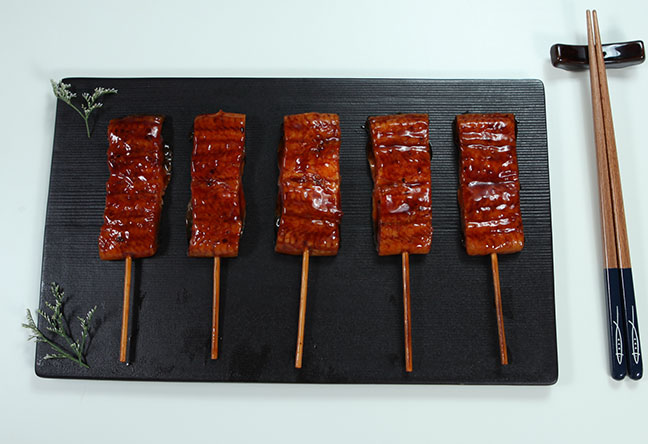
Common Mistakes When Assembling Unagi Eel Sushi
- Brushing tare before placing the eel. Sauce first means a slick surface. Brush the glaze after the eel is seated on the rice, not before.
- Using eel straight from the freezer. Kabayaki needs a full, even thaw — partially frozen centers cut unevenly and won't drape over the rice shape properly.
- Cutting eel too thick. A strip over 7-8mm thick adds weight the rice can't support without a wider base, which throws off the whole proportion.
- Skipping the rest period. Pressing eel onto rice the second it's shaped doesn't give the vinegar coating time to tack slightly — that tack is part of what holds the piece.
- Wetting hands too much. Damp hands keep rice from sticking to you, but soaked rice won't hold the eel either. A light mist is enough.
Choosing the Right Cut of Frozen Unagi Kabayaki for Nigiri
Not every cut works the same way for nigiri. Suppliers that offer custom cutting — shredding, dicing, strip-cutting, chunk-cutting, three-section cut, or sushi slices — give home cooks and foodservice buyers more control over the final build.
| Cut Type | Best For | Typical Thickness | Notes |
|---|---|---|---|
| Sushi slices | Nigiri, boxed sushi sets | 5–7mm | Pre-sized to match standard rice blocks, less trimming needed |
| Strip-cutting | Nigiri, hand rolls | Custom, usually 6–8mm | Needs trimming to rice width before assembly |
| 3-section cut | Donburi, bento trays | Thicker portions | Not ideal for nigiri without re-cutting |
| Chunk-cutting | Stir-fry, noodle soup | Irregular | Avoid for nigiri — too thick to drape |
For readers assembling nigiri specifically, sushi-slice format saves time because it's already sized close to a standard rice block. If you're working from a whole frozen unagi kabayaki fillet instead, plan on trimming each piece individually rather than slicing the whole fillet uniformly — rice blocks aren't perfectly identical in size, and matching eel to rice (not the other way around) is what keeps the topping from overhanging.
A Worked Example — Plating 12 Pieces for a Family Dinner
Here's how the method plays out at a practical scale. For 12 pieces of unagi eel sushi:
- Rice: roughly 240g cooked sushi rice (20g per piece), cooled to 98°F before shaping.
- Eel: one standard kabayaki fillet, thawed fully, sliced into 12 strips sized to each rice block individually.
- Nori: one half-sheet cut into 12 thin straps, roughly 1cm wide each.
- Sauce: 2–3 tablespoons of kabayaki sauce, brushed on after assembly, not before.
Shape all 12 rice blocks first and let them rest together for about a minute while you size the eel strips. This staggered timing — shape, rest, size, assemble — is what separates nigiri that holds from nigiri that slides off the plate before it reaches the table.
Sourcing Consistent Frozen Unagi Kabayaki for Reliable Results
Technique only gets you so far if the eel itself is inconsistent — uneven thickness, variable fat content, or residual bones all work against a clean nigiri build. Eelpro's production runs through ISO 22000:2018 and HACCP-certified lines, with a patented low-fat roasting and four-layer soy-sauce coating process that keeps thickness and color consistent across batches. Raw material traceability runs back through nearly 20 customs-registered farming bases covering over 2,150 mu, with every batch checked in our in-house lab testing process and screened at metal-detector checkpoints before packing.
That consistency matters for buyers supplying Japanese restaurant chains, US importers, and German and Polish distributors who need the same bite texture in every shipment — not just the first sample batch. Readers working on knife prep before assembly may also find the cleaning, skinning and deboning guide useful, and anyone building rolls instead of nigiri can follow the same sizing logic in the unakyu maki recipe.
The same sizing and grip logic that holds a nigiri together at home is what foodservice buyers ask about before placing bulk orders — thickness tolerance, cut consistency, and how the eel behaves once thawed. If you're sourcing for a menu rather than a dinner table, request a sample pack of frozen eel supplier cuts and test the build method above against your own rice before committing to a full order.