Why Does Your Ankimo Recipe Turn Grainy After Steaming
You steamed the monkfish liver, unwrapped it, and instead of that silky, custard-like slice you expected — crumbles. Grainy, dry, maybe even a puddle of orange fat pooling on the plate. If your ankimo recipe keeps failing at the same point, the liver itself is rarely the problem. Heat, wrapping, and timing are — usually in that exact order.
I'm Nancy Chen. My day job is auditing seafood processing lines for HACCP and ISO 22000 compliance, which means I spend a lot of time watching what happens when fat-rich proteins meet heat that's too fast or too long. Monkfish liver behaves a lot like foie gras — roughly half fat by weight, wrapped in a loose protein matrix that breaks down the moment you overcook it. Here's how to read what went wrong and fix it before your next batch.
Why Ankimo Turns Grainy or Broken Instead of Silky
Monkfish liver is mostly fat suspended in a thin protein network. When you steam it gently, the proteins set just enough to hold that fat in place — you get a smooth, sliceable texture. Push the heat too far, and the process known as protein denaturation goes past the point of no return: the protein strands tighten, squeeze out the fat, and what's left behind is dry, coarse curd instead of a silky terrine.
Three things drive that outcome almost every time:
- Overheating — water at a rolling boil instead of a gentle simmer
- Loose wrapping — air pockets that let fat separate and pool instead of staying emulsified
- Excessive steaming time — leaving the liver in past the point where the center has already set
Diagnosis Order: Check Heat First, Then Wrap, Then Time
When a batch fails, don't guess — work through the checks in this order. Each symptom points to a specific cause, and fixing the wrong variable wastes another liver.
| Symptom | Check First | Likely Cause | Judgment Criteria |
|---|---|---|---|
| Fat pooled outside, dry crumbly core | Water temperature | Overheating — steamer running at a full boil | Water should stay at a gentle simmer, roughly 180–190°F (82–88°C), not a rolling boil |
| Uneven texture, one side smooth, one side gritty | Wrap tightness | Loose wrapping — air pockets during rolling | Roll should feel firm with no visible air gaps when you press it; a properly rolled log holds its shape when you slice a test end |
| Entire liver dry and chalky, shrunk noticeably in size | Total steam time | Excessive steaming — left in after internal temp was already reached | Internal temperature should read 140–145°F (60–63°C); anything higher for more than a few minutes pushes the liver past silky into grainy |
| Liver splits open, sauce leaking during cooking | Wrap seal and steamer lid | Combination of loose wrap plus condensation dripping onto the roll | Wrap should be sealed at both ends like a sausage casing; cover the steamer loosely to stop drip-back |
Start with the water temperature because it's the fastest thing to fix and the most common culprit. If that checks out, move to the wrap. Only look at timing last — a liver that's wrapped and heated correctly rarely fails from time alone unless it sits far past the target window.
Step-by-Step Method for a Silky Ankimo Recipe
This is the sequence I'd follow for a standard 300–400g lobe of monkfish liver, whether you're cooking one for the table or testing a batch for a foodservice menu.
- Soak and devein. Rinse the liver, then soak it in cold water with a splash of sake or milk for 20–30 minutes to pull out blood and reduce bitterness. Use a skewer to gently push out any visible veins.
- Season lightly. A light brush of sake and a pinch of salt is enough — the liver's own fat carries most of the flavor.
- Roll tightly. Wrap the liver in plastic wrap or a bamboo mat into a tight log, twisting both ends like a candy wrapper. No air pockets, no loose sections.
- Steam at a gentle simmer. Keep the water at 180–190°F (82–88°C). A full rolling boil is the single fastest way to ruin texture.
- Steam for 20–25 minutes depending on thickness, checking internal temperature rather than relying on the clock alone.
- Ice bath immediately. Shock the roll in ice water the moment it hits temperature. This stops carryover cooking, which is a hidden cause of graininess even when the steaming itself was correct.
- Chill before slicing. Refrigerate at least 2 hours, ideally overnight, so the fat re-sets and slices hold together cleanly.
If you're also working through knife technique on delicate seafood proteins, the same care applies across species — our cleaning and deboning guide covers similar handling principles for freshwater eel.
Common Mistakes That Wreck Ankimo Texture
- Skipping the ice bath — the liver keeps cooking from residual heat for several more minutes without it.
- Wrapping too loosely "to be gentle" — a firm, tight roll is what actually protects the texture, not a loose one.
- Using liver straight from frozen without a proper thaw — uneven thawing creates uneven cooking, and uneven cooking is what produces the two-texture problem (silky on one side, grainy on the other).
- Steaming multiple sizes together — a thin lobe and a thick lobe need different times; cooking them side by side guarantees one is overdone.
- Checking doneness by poking with a fork instead of a thermometer — by the time a fork tells you it's firm, you've usually overshot the target internal temperature.
Sourcing Matters as Much as Technique
Even a perfect ankimo recipe can't fix liver that arrived poorly handled. Fat-rich seafood organs are sensitive to temperature abuse during transport — repeated freeze-thaw cycles break down the same protein-fat structure that heat mismanagement does in the steamer, just earlier in the chain.
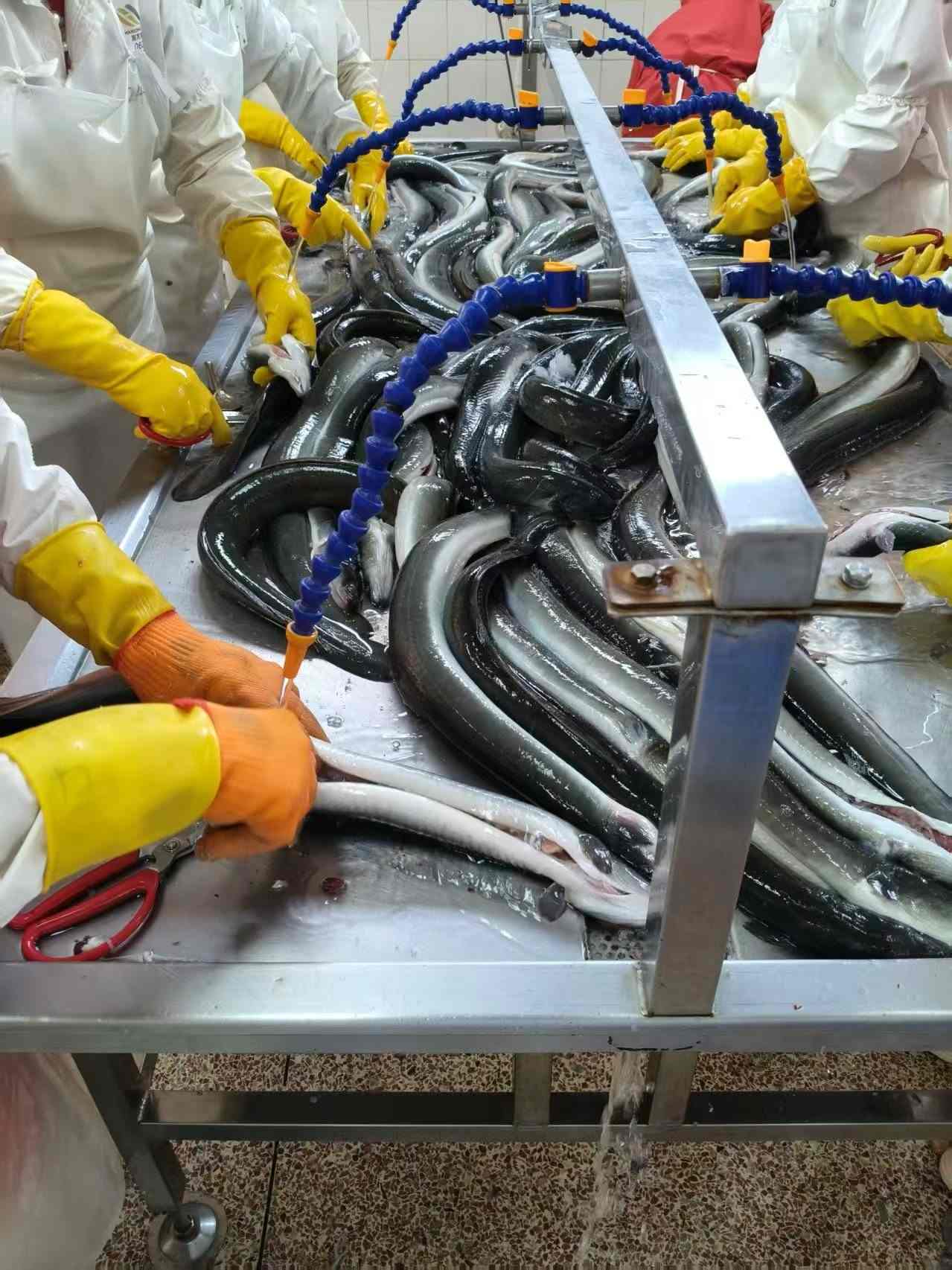
This is where cold-chain discipline matters. In our own operation, we run a 1,000-ton cold storage facility specifically to keep delicate frozen seafood at stable holding temperatures from processing through shipment — the same principle applies whether you're storing eel or monkfish liver. If you're buying frozen liver or any delicate frozen seafood product, ask your supplier how many times the product has been temperature-cycled before it reaches you. A supplier with in-house testing, like our eel lab, can usually tell you exactly what quality checks a batch went through.
Buyer's Checklist Before You Steam
- Liver was fully thawed under refrigeration, not at room temperature
- No off smell or discoloration on the surface
- Wrap materials on hand (plastic wrap or bamboo mat) before you start deveining
- Steamer water is at a controlled simmer, not boiling, before the liver goes in
- A probe thermometer is ready — don't rely on time alone
- Ice bath is prepped and waiting before the liver comes out
What to Do If a Batch Has Already Failed
If the ankimo recipe you followed produced a grainy or broken result, don't discard it outright. Grainy liver can often be pressed into a coarse spread, blended with a little of its own rendered fat and a splash of dashi to smooth it back into a usable texture — not restaurant-plating quality, but fine for a home-style appetizer with ponzu and scallion. If the liver split during steaming and leaked heavily, the fat loss is usually too severe to recover; that batch is better used in a sauce base than served sliced. For a related idea on stretching seafood proteins into make-ahead dishes, see our notes on meal prep and make-ahead ideas.
If you handle frozen seafood at any volume — restaurant, importer, or retailer — and want to talk through cold-chain specs or request a sample of our frozen eel or seafood products, reach out to our team for a quote or spec sheet.