





Eel fish have long, narrow bodies, but an eel-shaped fish is not always a true eel. The distinction matters when reviewing seafood specifications, verifying a scientific name, or comparing freshwater eels with marine species.
For importers, distributors, and food buyers, names such as “eel,” “conger,” and “eel-like fish” are not interchangeable. Species, family, processing method, and local market names all affect accurate product identification. This guide covers the essentials of eel identification and explains how true eels differ from fish that simply look like them.
Biologically, true eels belong to the order Anguilliformes. The group includes freshwater eels, conger eels, moray eels, snake eels, and several related families. True eels are jawed bony fishes, not reptiles, amphibians, or jawless fish.
Their streamlined bodies are suited to moving through narrow spaces, mud, crevices, and rocky areas. Most true eels share several visible features:
These traits are useful for basic field identification, but appearance alone is not always enough. Moray eels, for instance, are true eels even though most species lack pectoral fins. A scientific name or approved commercial specification is more reliable than a photograph.
Freshwater eels in the genus Anguilla are among the best-known commercial true eel species. They spend most of their growth phase in rivers, lakes, estuaries, or coastal waters before migrating to the ocean to reproduce. This life cycle is known as catadromy.
Japanese eel, Anguilla japonica, is widely used in unagi dishes. European eel, Anguilla anguilla, and American eel, Anguilla rostrata, are other recognized species in the same genus. Distribution, fishery status, and trade requirements vary by species, so buyers should request the Latin name and harvest details when relevant.
Conger eels belong mainly to the family Congridae. These marine true eels can grow considerably larger than many freshwater eels. Congers are used in regional cuisines and may be sold under different market names depending on the country.
Moray eels belong to the family Muraenidae. They typically live around reefs, rocky shorelines, and other marine habitats. Their mouths and jaws are unmistakable, and many morays have neither pectoral nor pelvic fins. Despite their dramatic appearance, they are true eels.
Snake eels, worm eels, and spiny eels show why eel taxonomy is more useful than body shape alone. Snake eels and worm eels are true eels, while spiny eels belong to a different group despite their similar form. Fin structure, skull anatomy, scales, and evolutionary relationships can differ substantially. For commercial identification, always compare the family and species name with the product specification.
When a whole fish is available, start with the fins. A true eel fish usually has a continuous fin edge along much of its back and underside. The dorsal and anal fins commonly connect around the tail, while pelvic fins are absent. That absence is one of the clearest identifying clues.
Then look at the head and gill area. True eels have jaws and, in many families, paired pectoral fins; morays are a notable exception. Their gill openings are positioned behind the head rather than underneath it. The body is covered with small scales or skin that makes the scales hard to see.
Color is not a dependable guide. A freshwater eel may be olive, brown, gray, or nearly black, while a moray can have spots, stripes, or pale markings. Color changes with age, habitat, handling, and processing. Skin-on fillets also remove several clues visible on a whole fish.
For frozen seafood, the most dependable references are the product label, Latin name, processing description, and supplier documentation. Confirm whether the item is a whole fish, portion, fillet, or cooked product. “Eel” on a menu may describe a culinary category, but the packing list should state the actual species.
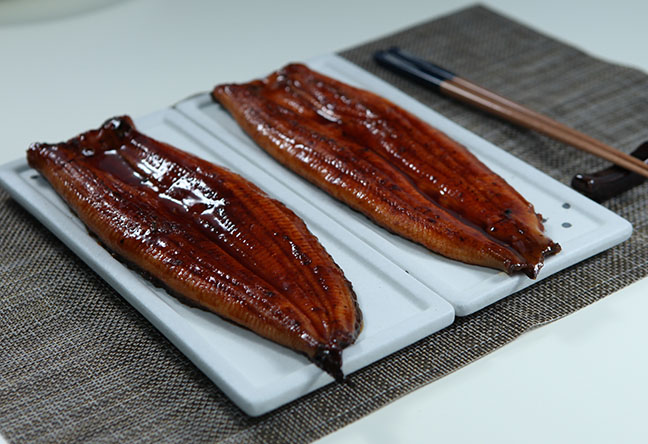
Several unrelated animals have an eel-like body. They may move in similar ways or live in similar habitats, but they are not true eel fish.
The electric eel is not a true eel. It is a South American freshwater knifefish in the order Gymnotiformes. Its long body and lack of a typical dorsal fin create its familiar eel-like profile. It produces electrical discharges and relies on an elongated anal fin for much of its movement.
Wolf eels are marine fish in the family Anarrhichthidae. Their long bodies, strong jaws, and continuous dorsal fins can make them look like eels at first glance. However, their head shape, fin arrangement, and taxonomy place them outside the order Anguilliformes.
Lampreys are jawless vertebrates, not bony eel fish. Their round, sucker-like mouths and smooth bodies set them apart from true eels. They also have a different skeleton and feeding structure, despite their elongated shape.
Hagfish are marine jawless animals with soft, flexible bodies. When disturbed, they can produce large amounts of slime. Their internal anatomy differs sharply from that of true eels. Although casual descriptions sometimes group them with eel-like animals, hagfish are not eels.
Sea snakes are reptiles, not fish. They breathe air with lungs, have forked tongues, and many species have flattened tails. A photo taken underwater can make identification difficult, but their breathing, skin, and body structure are fundamentally different from those of eel fish.
The main difference is biological classification. True eels belong to Anguilliformes, while eel-like fish can belong to entirely unrelated groups. Their similar body shapes often reflect similar environmental pressures: moving through vegetation, sand, rock gaps, or strong currents favors a long, flexible form.
| Feature | True eel fish | Eel-like fish |
|---|---|---|
| Taxonomy | Order Anguilliformes | Several unrelated orders and families |
| Pelvic fins | Absent in true eels | Varies by group |
| Fin pattern | Dorsal and anal fins usually extend toward the tail | May have a different fin structure or no obvious dorsal fin |
| Skeleton and jaws | Jawed bony fish | May be a bony fish, jawless vertebrate, or even a reptile |
| Commercial identification | Should be confirmed by genus and species | Common names can be especially misleading |
For seafood buyers, this distinction helps prevent errors in menus, labels, and purchasing documents. A supplier may sell unagi kabayaki made from a specified freshwater eel species, while another product labeled “eel” may refer to a different marine fish. The preparation may be similar, but the species is not necessarily the same.
Species identification involves more than scientific accuracy. It can affect food labeling, import documentation, allergen or food-safety review, traceability, portion yield, and customer expectations. Freshwater eel and marine eel products may also differ in texture, fat content, market price, and preferred preparation.
When buying frozen eel products, check these five points:
For ready-to-serve unagi, the sauce is part of the finished product experience. Buyers comparing specifications can review our eel sauce range and read about kabayaki sauce to see how seasoning complements grilled eel dishes.
True eel fish are commonly grilled, steamed, simmered, or added to soups. Eel noodle soup is one practical example: the broth, noodles, and sliced eel require a product that retains a suitable texture after reheating. Our eel recipes offer a preparation reference for foodservice and home kitchens.
Check for a long flexible body, no pelvic fins, and dorsal and anal fins that usually continue toward and around the tail. Confirm the result with the scientific name because unrelated fish can share the same body shape.
Electric eels, wolf eels, lampreys, hagfish, and some long-bodied marine fish are commonly mistaken for true eels. Sea snakes may also be confused with eels in photographs, although they are reptiles rather than fish.
True eels belong to the order Anguilliformes and have a characteristic fin pattern, absent pelvic fins, and a jawed bony-fish skeleton. Eel-like fish may belong to completely different groups and can have different jaws, fins, breathing systems, or skeletons.
No. Freshwater eels such as Anguilla japonica belong to the family Anguillidae, while morays belong to the family Muraenidae. Both are true eels, but they differ in habitat, appearance, life cycle, and common culinary use.
Body shape may suggest an eel, but taxonomy and supplier documentation provide a clearer answer. When you need frozen freshwater eels, prepared unagi kabayaki, eel sauce, or other frozen seafood, Eelpro Co., LTD can help with product selection and clear specifications for overseas buyers. Contact us to discuss your required species, format, packaging, and market.




 WhatsApp
 sales@chinaeels.com
 +8619937922411