





Ever tried deboning an eel and felt like you’re wrestling a silk ribbon? The secret behind that slippery, eel‑like grace is the skeleton itself. An eel’s framework isn’t a rigid cage—it’s a masterpiece of biological engineering built for wriggling through tight river mouths, burrowing in mud, and swimming backward into crevices. At its core, the skeleton of an eel is a long, hyper‑flexible chain of vertebrae, a streamlined skull, and a set of ribs so fine they’re closer to toothpicks than to bones.
Unlike the chunky, load‑bearing bones of land animals, an eel’s skeleton evolved to conserve energy during long migrations—some eels travel 5,000 km without eating. The vertebrae interlock but leave enough gap to let the body coil like a spring. This isn’t a random design; it’s why a 3‑foot freshwater eel can squeeze through a gap smaller than a coin.
The eel skeleton anatomy breaks down into three main parts that work together like a living chain: the skull, the vertebral column, and a delicate ribcage. Let’s pull these apart—without the slime.
When we talk about an eel’s flexibility, we’re really praising its eel vertebrae. An adult Japanese eel (Anguilla japonica) carries between 105 and 119 vertebrae, each one a tiny, spool‑shaped ring of bone. That’s roughly the same number as the vertebrae in a giraffe’s neck—but packed into a body that’s 90% muscle. In our processing facility, we’ve X‑rayed unagi destined for export; the chain looks like a pearl necklace that’s been stretched taut.
Each vertebra has a cone‑shaped front and a socket‑like rear, forming a ball‑and‑socket joint that allows movement in multiple planes. But here’s the clever part: the joint surfaces aren’t perfectly smooth. Micro‑ridges lock slightly to prevent over‑rotation, so the spine can bend into a tight “S” curve without snapping. Add a sheath of cartilage, and you get the silent, effortless glide that makes eels masters of escape.
An eel’s skull is surprisingly robust for such a soft‑looking fish. The eel bone structure of the head combines a long, tapered cranium with powerful jaws and dozens of tiny teeth. These teeth aren’t just for grabbing—when an eel bites, a vacuum is created, sucking prey straight into the gullet. The skull bones are fused in adults, giving the head enough strength to crack snail shells, yet the overall profile stays wonderfully hydrodynamic. If you’ve ever watched an unagi chef slice off an eel’s head with one clean stroke, you’ve seen exactly how cleanly the skull separates from the vertebrae.
Eel ribs are so thin they often disintegrate during cooking, which is both a curse and a blessing. In the wild, these ribs protect the swim bladder and organs, but they offer almost zero structural support. That’s why a raw eel fillet feels boneless and why novices struggle with pin‑bone removal. The dorsal and anal fins are supported by soft rays, not stiff bone, so the fin membranes flow continuously along the body—helping the eel swim backward almost as fast as forward.
Scientists have measured an eel’s lateral bending and found the body can achieve a curvature of 0.8 radians per body length—imagine a human spine bending into a near‑circle. The eel bone structure achieves this through three tricks. First, the vertebrae are not locked by thick intervertebral discs like ours; instead, each joint is a tiny shock‑absorbing pad of cartilage. Second, the neural spines (the little fins of bone that stick up from each vertebra) are short and never overlap, so they don’t limit side‑bending. Third, the entire skeleton is disproportionately light—only about 3–4% of total body weight, compared to roughly 15% in a typical bony fish. This lightness lets eels rise and sink in the water with minimal fin movement.
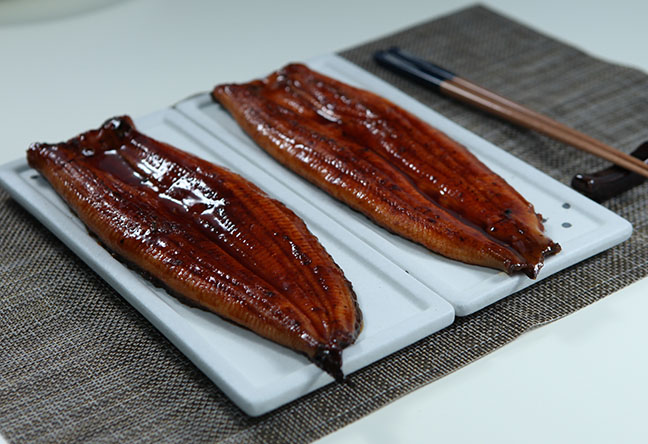
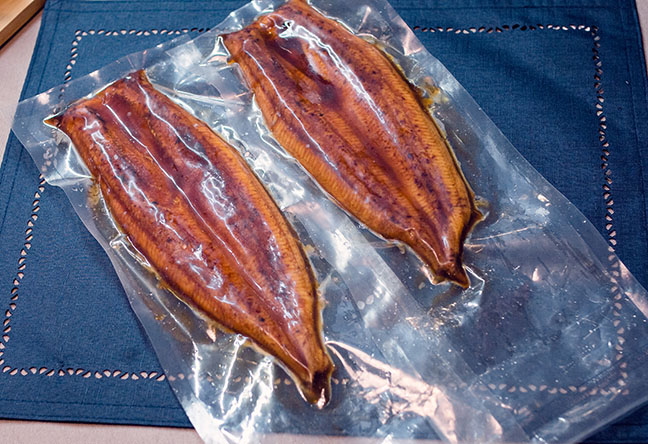
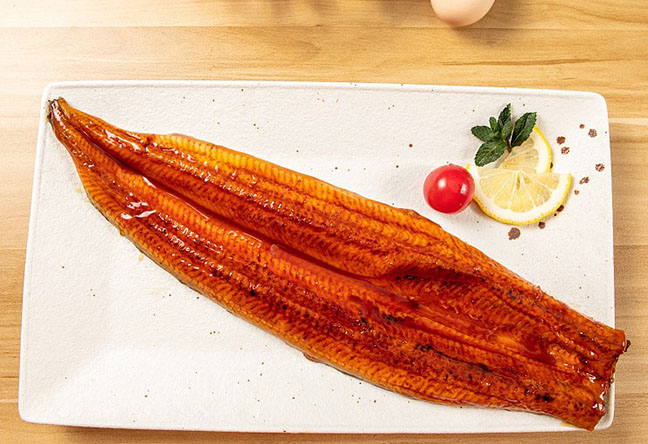
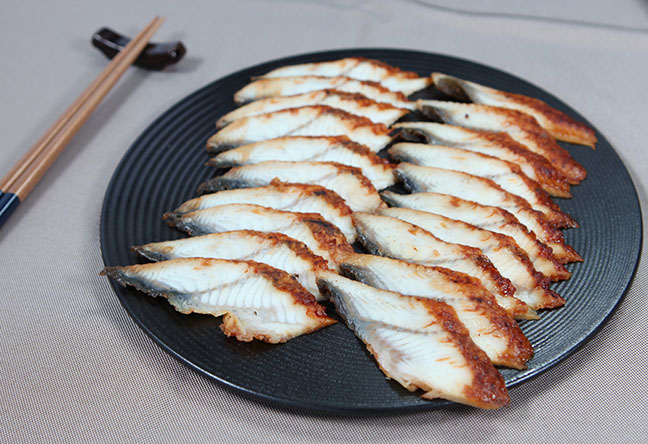
What does this mean for the cook? If you’re preparing fresh eel, the flesh will contract and twist fiercely when it hits heat—because the flexible skeleton allows the muscle to pull in unpredictable directions. That’s why traditional Japanese preparation calls for pinning the eel flat on a board with three nails (me-uchi) before filleting. At Eelpro, we bypass this whole drama. Our frozen unagi kabayaki eel is already expertly pinned, deboned, and grilled, so you get all the tenderness without wrestling a noodle of bones.
If you’ve never seen an eel skeleton, picture a snake’s spine but even more delicate. An eel anatomy diagram reveals a long, evenly spaced column of creamy‑white vertebrae, thinning towards the tail until the last bone is barely a fleck. The skull resembles a miniature crocodile’s, with a wide gape and smooth curves. Behind the skull, the first few vertebrae support tiny ribs, but by the time you reach the mid‑body, the ribs vanish, leaving only the centra (the main body of each vertebra) which are connected by thin ligaments.
In our Eelpro lab, we keep a skeletal preparation of a large freshwater eel—it's an elegant artifact that helps us train workers on deboning precision. The visual takeaway: an eel’s frame is almost entirely vertebral. There’s no bulky hip bone, no shoulder girdle to speak of. That design makes eels the perfect raw material for boneless products like our frozen kabayaki.
The question “how many bones does an eel have” doesn’t have one simple answer because it depends on the species and length. The Japanese eel hovering in your miso soup likely had 112 vertebrae plus a skull comprising 28 separate bones. A European eel can push closer to 125 vertebrae. Add the intermuscular “pin” bones that lace through the fillet, and a single eel can contain over 200 tiny bone elements. That’s a lot of hidden hardware for something that looks so smooth.
For chefs, this number is a daily reality. Traditional unagi chefs learn to feel pin bones through the flesh and pull them with angled tweezers while the fish is still raw. Miss one, and a diner will notice. That’s why many restaurants—even in Japan—now use frozen pre‑grilled unagi. Our unagi kabayaki product undergoes optical bone detection, so every fillet leaving our Jiangmen factory is guaranteed free of bones longer than 3 mm. The skeleton of the eel becomes a non‑issue; you just grill, glaze, and serve.
Understanding eel skeletal anatomy isn’t just a biology lesson—it’s a competitive edge. B2B buyers who know exactly how a product is processed can sell with confidence. When you source frozen eel from us, you’re purchasing a product where the entire eel bone structure has been meticulously removed, leaving only the sweet, fatty meat that caramelizes so beautifully under a broiler. No pin bones, no vertebrae fragments, no customer complaints.
Pair that perfect fillet with our eel sauce (unagi tare), a syrup‑like glaze brewed with soy, mirin, and a touch of secret sweetness that penetrates just right when brushed over hot, flaky kabayaki. And if you ever want to experiment with whole eel, our how to cook eel: cleaning, skinning & deboning guide walks you through each step with the same care our team uses.

What does the skeleton of an eel look like?
It looks like a long, flexible chain of tiny ivory‑colored vertebrae, each about the size of a grain of rice, connected by cartilage. The skull is streamlined, and the ribs are so fine they resemble whiskers. Picture a snake skeleton but more compact and lightweight—perfect for gliding through water.
How many bones does an eel have?
An eel typically has between 105 and 125 vertebrae, a skull made of roughly 28 bones, and dozens of floating ribs and pin bones—often totaling over 200 individual bone elements. The count varies by species and age.
Why are eel bones so flexible?
Eel bones are flexible because the vertebrae have a ball‑and‑socket design with thick cartilage pads, short neural spines that never jam, and an extremely light overall structure—only 3‑4% of the animal’s body weight. This allows extreme bending without breaking, essential for swimming in tight spaces.
The next time you watch a kabayaki fillet sizzle, remember the intricate skeleton of an eel that nature built and our team so carefully removed. Whether you’re a ramen shop owner looking to top your Japanese eel noodle soup guide with flawless filets, or a meal‑prep enthusiast hunting for eel recipes for meal prep: make-ahead ideas, the smart choice is to start with boneless, quality‑controlled unagi. Skip the knife work, the nail board, the pin‑bone hunt. Ours comes ready to glaze, grill, and impress.
Got an edgy eel story? A bone‑pulling mishap? Share your thoughts in the comments below. And if you’re sourcing for a restaurant or distribution, reach out for a sample box—we’ll ship the skeleton‑free unagi that keeps your customers coming back.




 WhatsApp
 sales@chinaeels.com
 +8619937922411